. 2011 Feb 15;25(4):350-62.
doi: 10.1101/gad.2003811.

BLM-DNA2-RPA-MRN and EXO1-BLM-RPA-MRN constitute two DNA end resection machineries for human DNA break repair

Affiliations

BLM-DNA2-RPA-MRN and EXO1-BLM-RPA-MRN constitute two DNA end resection machineries for human DNA break repair

Amitabh V Nimonkar et al. Genes Dev. .

Abstract

Repair of dsDNA breaks requires processing to produce 3'-terminated ssDNA. We biochemically reconstituted DNA end resection using purified human proteins: Bloom helicase (BLM); DNA2 helicase/nuclease; Exonuclease 1 (EXO1); the complex comprising MRE11, RAD50, and NBS1 (MRN); and Replication protein A (RPA). Resection occurs via two routes. In one, BLM and DNA2 physically and specifically interact to resect DNA in a process that is ATP-dependent and requires BLM helicase and DNA2 nuclease functions. RPA is essential for both DNA unwinding by BLM and enforcing 5' → 3' resection polarity by DNA2. MRN accelerates processing by recruiting BLM to the end. In the other, EXO1 resects the DNA and is stimulated by BLM, MRN, and RPA. BLM increases the affinity of EXO1 for ends, and MRN recruits and enhances the processivity of EXO1. Our results establish two of the core machineries that initiate recombinational DNA repair in human cells.


Figures
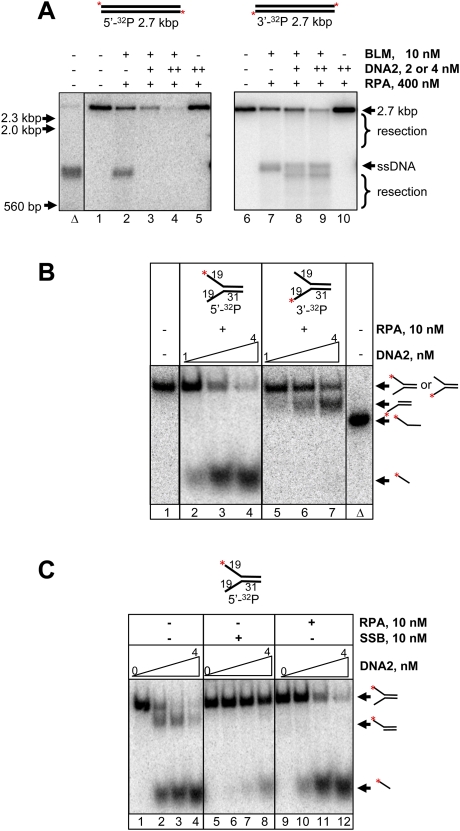
Figure 1.
Figure 1.
BLM and DNA2 resect dsDNA. (A) Resection of plasmid-length dsDNA. Nuclease reactions were performed using 5′- or 3′-end-labeled 2.7-kb DNA; reactions contained 400 nM RPA and 2 mM MgCl2. (Lane Δ) Heat-denatured substrate. (Lanes 1,6) Substrate. (Lanes 2,7) BLM. (Lanes 3,8) BLM and 2 nM DNA2. (Lanes 4,9) BLM and 4 nM DNA2. (Lanes 5,10) DNA2 (4 nM). Single plus sign (+) and double plus signs (++) refer to 2 nM and 4 nM DNA2, respectively. The positions of the intact substrate (2.7 kb), unwound substrate (ssDNA), resection products, and molecular size markers are indicated. (B) DNA2 cleaves forked DNA with 5′ → 3′ polarity. Nuclease reactions with varying DNA2 concentrations (1, 2, and 4 nM) were performed using 5′- or 3′-end-labeled 50-bp forked DNA (1.5 nM ends, 75 nM nucleotides). Reactions contained 10 nM RPA and 5 mM MgCl2. (Lane 1) Substrate. (Lanes 2–4) Reactions with 5′-end-labeled fork. (Lanes 5–7) Reactions with 3′-end-labeled fork. (Lane Δ) Heat-denatured substrate. (C) RPA modulates DNA2-mediated cleavage of forked DNA. Nuclease reactions with DNA2 (0, 1, 2, and 4 nM) were performed using 5′-end-labeled 50-bp forked DNA in the absence or presence of indicated ssDNA-binding protein (RPA or E. coli SSB). All reactions contained 5 mM MgCl2. (Lanes 1–4) DNA2 alone. (Lanes 5–8) DNA2 and SSB. (Lanes 9–12) DNA2 and RPA. The positions of the intact fork, unwound substrate, and cleavage products are indicated schematically.
Figure 2.
Figure 2.
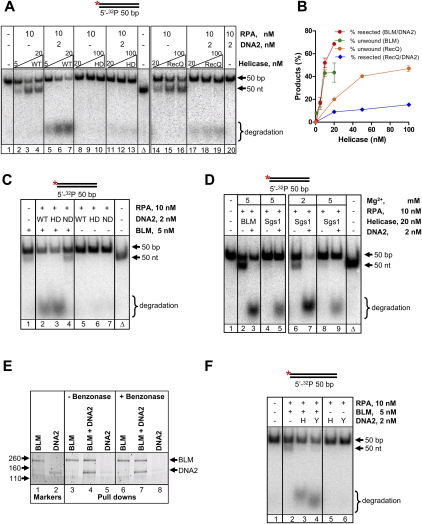
BLM and DNA2 interact specifically to resect dsDNA. (A) BLM-mediated unwinding is essential for resection by BLM and DNA2. Nuclease reactions were performed using a 5′-end-labeled 50-bp DNA fragment. Where indicated, wild-type BLM (WT) was substituted with helicase-dead K695R mutant (HD) or E. coli RecQ. Reactions contained 10 nM RPA and 5 mM MgCl2. (Lane 1) Substrate. (Lanes 2–4,5–7) BLM (wild type) (5, 10, and 20 nM) in the absence or presence of DNA2, respectively. (Lanes 8–10,11–13) BLM (helicase-dead) (20, 50, and 100 nM) in the absence or presence of DNA2, respectively. (Lane Δ) Heat-denatured substrate. (Lanes 14–16,17–19) RecQ (20, 50, and 100 nM) in the absence or presence of DNA2, respectively. (Lane 20) DNA2 alone. (B) The percentage of dsDNA unwound or resected, from experiments as shown in A, plotted as a function of helicase concentration. The percentage resected or unwound was obtained by expressing the amount of DNA degraded or unwound, respectively, as a percentage of total signal, and is plotted as “products.” Error bars indicate standard deviation from three to five independent experiments and are smaller than the symbols when not evident. (C) Resection requires the nuclease but not helicase activity of DNA2. Reactions were performed as described in A, with the exception that, where indicated, DNA2 was substituted with helicase-dead (HD) or nuclease-dead (ND) DNA2. (Lane 1) BLM. (Lanes 2–4) BLM with wild-type (WT), K671E (HD), or D294A (ND) DNA2, respectively. (Lanes 5–7) Wild type (WT), helicase-dead (HD), and nuclease-dead (ND) DNA2, respectively. (Lane Δ) Heat-denatured substrate. (D) Sgs1 can substitute for BLM at low [Mg2+] (2 mM). Where indicated, BLM was replaced with Sgs1.The concentration of Mg2+ was as indicated in the figure. (Lane 1) Substrate. (Lanes 2,3) Reactions with BLM (absence or presence of DNA2). (Lanes 4–9) Reactions with Sgs1 (absence or presence of DNA2). (Lane Δ) Heat-denatured substrate. (E) BLM and DNA2 interact directly. Pull-down experiments were performed with BLM and DNA2 in three sets: BLM alone, BLM and DNA2, and DNA2 alone. The bound fractions were analyzed by gel electrophoresis followed by Sypro Orange staining. (Lanes 1,2) Approximately 250 ng of BLM and DNA2, respectively. (Lanes 3–5) Pull-downs with BLM alone, BLM and DNA2, and DNA2 alone, respectively. (Lanes 6–8) Same as lanes 3–5, but in the presence of 12.5 U of benzonase. The positions of size markers (in kilodaltons), BLM, and DNA2 are indicated. (F) Yeast Dna2 functions with BLM in DNA end resection. Reactions were performed as described in A, except that, when indicated, DNA2 was substituted with Dna2 (human RPA throughout). (Lane 1) Substrate. (Lane 2) BLM. (Lane 3) BLM–DNA2. (Lane 4) BLM–Dna2. (Lane 5) DNA2. (Lane 6) Dna2. DNA2 and Dna2 are indicated as “H” and “Y,” respectively.
Figure 3.
Figure 3.
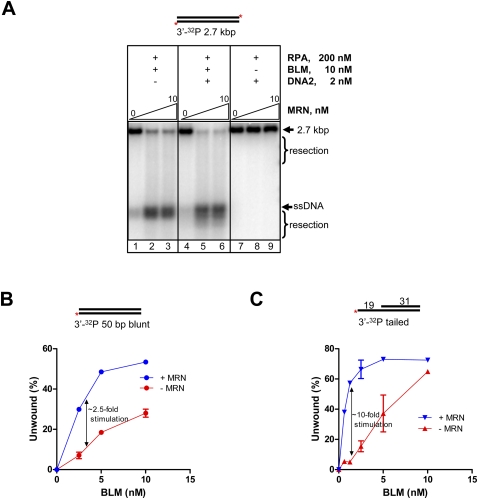
MRN stimulates processing of dsDNA by BLM–DNA2–RPA. (A) Resection by BLM–DNA2 as a function of MRN concentration. Nuclease reactions were performed at varying MRN concentrations (0, 5, and 10 nM) using 3′-end-labeled 2.7-kb DNA. Reactions contained 200 nM RPA and 2 mM MgCl2. (Lanes 1–3) BLM and MRN. (Lanes 4–6) BLM, DNA2, and MRN. (Lanes 7–9) DNA2 and MRN. (B) MRN stimulates BLM-mediated unwinding of blunt-end DNA. The percentage of dsDNA unwound from experiments as shown in Supplemental Figure S4C, plotted as a function of BLM concentration. The percentage unwound was obtained by expressing the amount of ssDNA as a percentage of the total signal. Error bars indicate standard deviation from three to five independent experiments and are smaller than the symbols when not evident. (C) MRN stimulates BLM-mediated unwinding of 3′-tailed DNA. The percentage of 3′-tailed DNA unwound from experiments as shown in Supplemental Figure S4D, plotted as a function of BLM concentration. The percentage unwound was obtained by expressing the amount of ssDNA as a percentage of the total signal. Error bars indicate standard deviation from three to five independent experiments and are smaller than the symbols when not evident. In B and C, this linear regime for DNA unwound as a function of BLM concentration was used to calculate the slope (DNA unwound/[BLM]); this value was determined in both the absence and presence of MRN, and was used to define the fold stimulation by MRN.
Figure 4.
Figure 4.
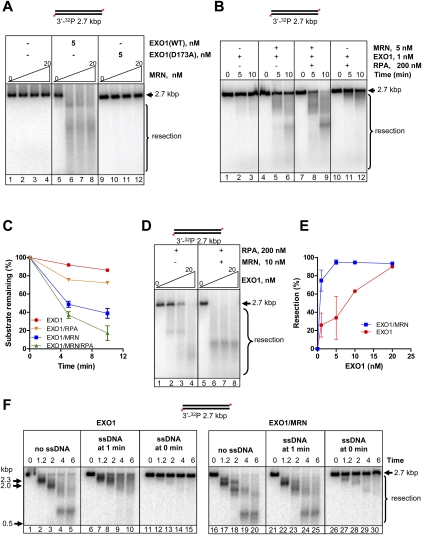
MRN stimulates resection by EXO1. Nuclease reactions with EXO1 and MRN were performed using 3′-end-labeled 2.7-kb DNA. All reactions contained 5 mM MgCl2. RPA (200 nM) was included when indicated. (A) Resection by EXO1 (wild type) and EXO1 (D173A) as a function of MRN concentration (0, 5, 10, and 20 nM). (Lanes 1–4) MRN alone. (Lanes 5–8) MRN and EXO1 (wild type). (Lanes 9–12) MRN and EXO1 (D173A). (B) Kinetics of resection by EXO1 in the presence of RPA and MRN. (Lanes 1–3) EXO1. (Lanes 4–6) EXO1 and MRN. (Lanes 7–9) EXO1, MRN, and RPA. (Lanes 10–12) EXO1 and RPA. (C) The percentage of intact DNA from experiments as shown in B, plotted as a function of time. The percentage intact was obtained relative to the 0-min time point for each set. Error bars indicate standard deviation from three to five independent experiments and are smaller than the symbols when not evident. (D) Resection as a function of EXO1 concentration (0, 5, 10, and 20 nM) in the absence or presence of MRN. Reactions contained 200 nM RPA. Incubation time was 10 min. (Lanes 1–3) EXO1. (Lanes 4–6) EXO1 and MRN. (E) The percentage of intact DNA from experiments as shown in D, plotted as a function of EXO1 concentration. The percentage intact was obtained relative to 0 nM EXO1 reaction for each set. Error bars indicate standard deviation from three to five independent experiments and are smaller than the symbols when not evident. (F) MRN increases processivity of EXO1. Inhibitor challenge experiments were performed as described in the Supplemental Material. (Lanes 1–5,16–20) EXO1 and EXO1–MRN reaction in the absence of challenger DNA, respectively. (Lanes 6–10,21–25) EXO1 and EXO1–MRN reaction with challenger DNA added at 1 min, respectively. (Lanes 11–15,26–30) EXO1 and EXO1–MRN reaction with challenger DNA added at 0 min, respectively. The concentrations of EXO1, MRN, and φX174 ssDNA were 10 nM, 10 nM, and 32 μM (nucleotides), respectively.
Figure 5.
Figure 5.
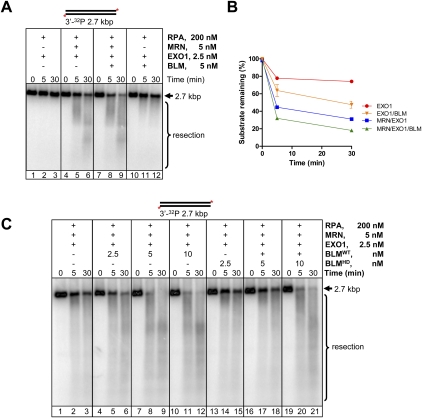
Stimulation of EXO1 by MRN and BLM. Nuclease reactions were performed using 3′-end-labeled 2.7-kb DNA. All reactions contained 200 nM RPA and 5 mM MgCl2. (A) Kinetics of resection in the absence of ATP. (Lanes 1–3) EXO1. (Lanes 4–6) MRN and EXO1. (Lanes 7–9) MRN, EXO1, and BLM. (Lanes 10–12) EXO1 and BLM. (B) The percentage of intact DNA from experiments as shown in A, plotted as a function of time. The percentage intact was obtained relative to the 0-min time point for each set. Error bars indicate standard deviation from three to five independent experiments and are smaller than the symbols when not evident. (C) Kinetics of resection in the presence of ATP and also with the helicase-dead BLM mutant. (Lanes 1–3) EXO1. (Lanes 4–12) MRN, EXO1, and BLM (wild-type). (Lanes 13–21) MRN, EXO1, and BLM (helicase-dead).
Figure 6.
Figure 6.
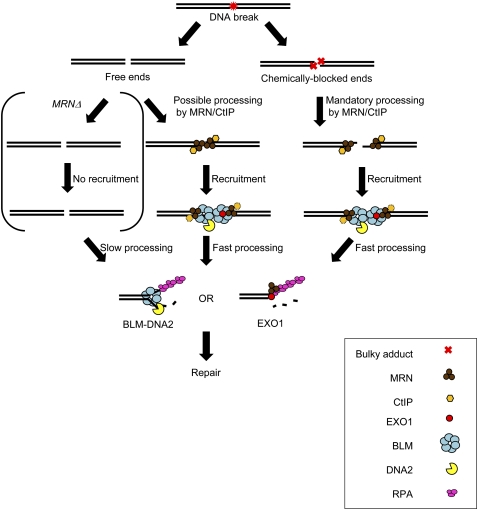
Model depicting DNA end resection pathways during DSB repair. DSBs caused by exogenous or endogenous sources (represented by the red symbol) can be free or chemically blocked. The blocked ends are indicated by red crosses. DSBs are bound by MRN (brown trimer), which can recruit CtIP (orange hexagon) to form one resection complex. Resection by MRN and CtIP is required to cleave the chemically blocked ends and can resect several hundred nucleotides, but is not essential for resection of the free DNA ends. However, processing in the physical absence of MRN is kinetically delayed (“slow processing”). MRN also functions to recruit the BLM–DNA2 (BLM indicated by blue hexamer; DNA2 indicated by yellow pac molecule) or EXO1–BLM (EXO1 indicated by red sphere) to the ends (“fast processing”). Subsequently, extensive processing (>1 kb) can proceed by either the BLM–DNA2–RPA (RPA indicated by pink trimer) or the EXO1–BLM–RPA machinery.

References

    1. Bae SH, Bae KH, Kim JA, Seo YS 2001. RPA governs endonuclease switching during processing of Okazaki fragments in eukaryotes. Nature 412: 456–461 - PubMed
    1. Brosh RM Jr, Li JL, Kenny MK, Karow JK, Cooper MP, Kureekattil RP, Hickson ID, Bohr VA 2000. Replication protein A physically interacts with the Bloom's syndrome protein and stimulates its helicase activity. J Biol Chem 275: 23500–23508 - PubMed
    1. Budd ME, Campbell JL 2009. Interplay of Mre11 nuclease with Dna2 plus Sgs1 in Rad51-dependent recombinational repair. PLoS ONE 4: e4267 doi: 10.1371/journal/pone.0004267 - PMC - PubMed
    1. Budd ME, Choe W, Campbell JL 2000. The nuclease activity of the yeast DNA2 protein, which is related to the RecB-like nucleases, is essential in vivo. J Biol Chem 275: 16518–16529 - PubMed
    1. Bugreev DV, Yu X, Egelman EH, Mazin AV 2007. Novel pro- and anti-recombination activities of the Bloom's syndrome helicase. Genes Dev 21: 3085–3094 - PMC - PubMed

Publication types

MeSH terms