


Soil clay content underlies prion infection odds
- PMID: 21326232
- PMCID: PMC3105318
- DOI: 10.1038/ncomms1203
Soil clay content underlies prion infection odds
Abstract
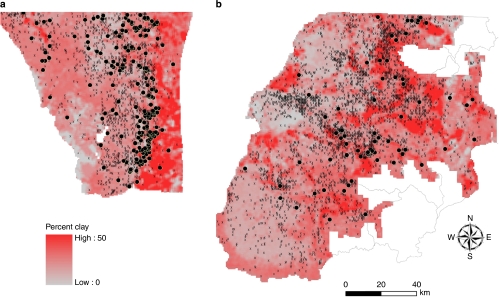
Environmental factors-especially soil properties-have been suggested as potentially important in the transmission of infectious prion diseases. Because binding to montmorillonite (an aluminosilicate clay mineral) or clay-enriched soils had been shown to enhance experimental prion transmissibility, we hypothesized that prion transmission among mule deer might also be enhanced in ranges with relatively high soil clay content. In this study, we report apparent influences of soil clay content on the odds of prion infection in free-ranging deer. Analysis of data from prion-infected deer herds in northern Colorado, USA, revealed that a 1% increase in the clay-sized particle content in soils within the approximate home range of an individual deer increased its odds of infection by up to 8.9%. Our findings suggest that soil clay content and related environmental properties deserve greater attention in assessing risks of prion disease outbreaks and prospects for their control in both natural and production settings.
Figures
References
-
- Willich A. F. M. & Mease J. The Domestic Encyclopaedia; or, A Dictionary of Facts and Useful Knowledge, First American Edition, Vol. IV (William Young Birch & Abraham Small, 1803).
-
- Cleeve H. Practical essay on the diseases of sheep. The Farmer's Magazine 4, 268–280 (1840).
-
- Greig J. R. Scrapie. Trans. Highland Agric. Soc. Scotland 52, 71–90 (1940).
-
- Sigurdsson B. Rida, a chronic encephalitis of sheep. Br. Vet. J. 110, 341–354 (1954).
-
- Brown P. & Gajdusek D. C. Survival of scrapie virus after 3 years' interment. Lancet 337, 269–270 (1991). - PubMed
Publication types
MeSH terms
Substances
LinkOut - more resources
Full Text Sources
