. 2008 Mar;25(1):48-57.
doi: 10.1055/s-2008-1052306.

Radioembolization of yttrium-90 microspheres for hepatic malignancy

Affiliations

Radioembolization of yttrium-90 microspheres for hepatic malignancy

Ravi Murthy et al. Semin Intervent Radiol. 2008 Mar.

Abstract

The liver represents a frequent site for primary and secondary neoplasia. Cytoreductive techniques positively influence the outcome of disease progression in these patients. Transhepatic arterial radioembolotherapy utilizing yttrium-90 microspheres represents a recently available in situ therapy that has shown encouraging results in the treatment of these patients. Harnessing the skills of many different specialties, such as interventional radiology, surgical oncology, medical oncology, nuclear medicine, radiation oncology, medical physics, and radiation safety, brings invaluable expertise to the treatment process for a safe and effective radioembolization treatment program.

Keywords: Liver cancer; radioembolization; yttrium-90.


Figures
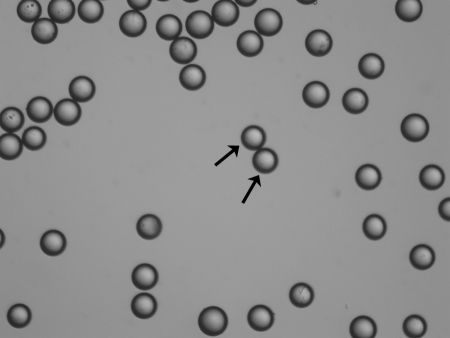
Figure 1
Figure 1
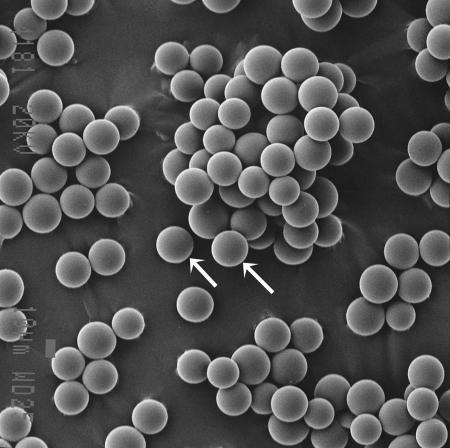
TheraSphere. Electron micrograph. Device is represented by individual spherical microspheres (arrows).
Figure 2
Figure 2
SIR-Spheres. Electron micrograph. Device is represented by individual spherical microspheres (arrows). (Courtesy of Ms. Mara Cvejic, SEM Unit, Institute of Dental Research, Westmead Hospital, Sydney, Australia.)
Figure 3
Figure 3
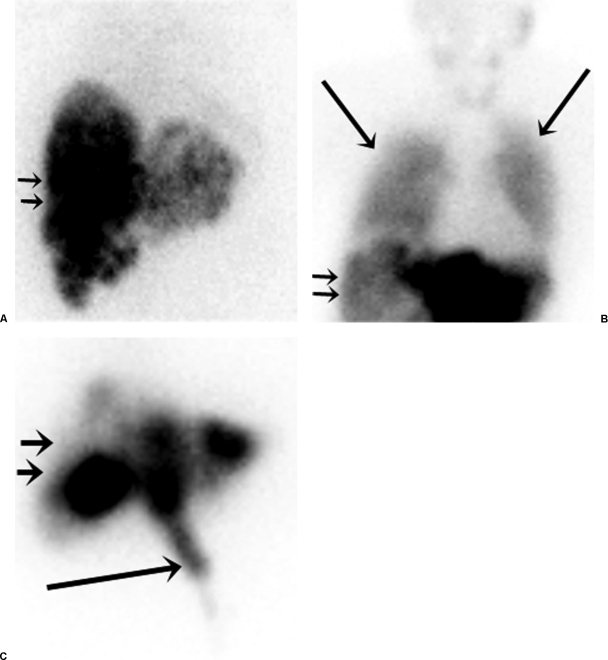
Nuclear scintigraphy following hepatic arterial injection of Tc99m MAA (liver depicted with small arrows). (A) A 48-year-old woman with intermediate-grade neuroendocrine hepatic metastases demonstrating normal radionuclide distribution with no significant pulmonary or gastrointestinal activity. (B) A 66-year-old woman with hepatic metastatic high-grade neuroendocrine tumor depicting excessive hepatopulmonary shunting (large arrows) that precluded safe treatment. (C) A 55-year-old man with hepatic metastatic colorectal cancer demonstrating gastrointestinal deposition (large arrow) from small unnamed extrahepatic arteries arising from the proper hepatic artery.
Figure 4
Figure 4
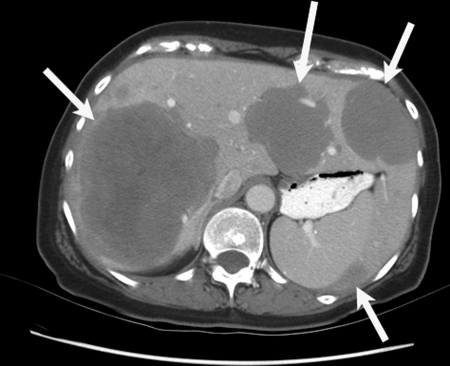
Triple-phase computed tomography scan. A 68-year-old woman with low-grade hepatic metastatic neuroendocrine cancer assessed for radioembolotherapy. Multiple low attenuation lesions (white arrows) within the liver are noted. Normal hepatic parenchyma and tumor volume is required for dosimetry.
Figure 5
Figure 5
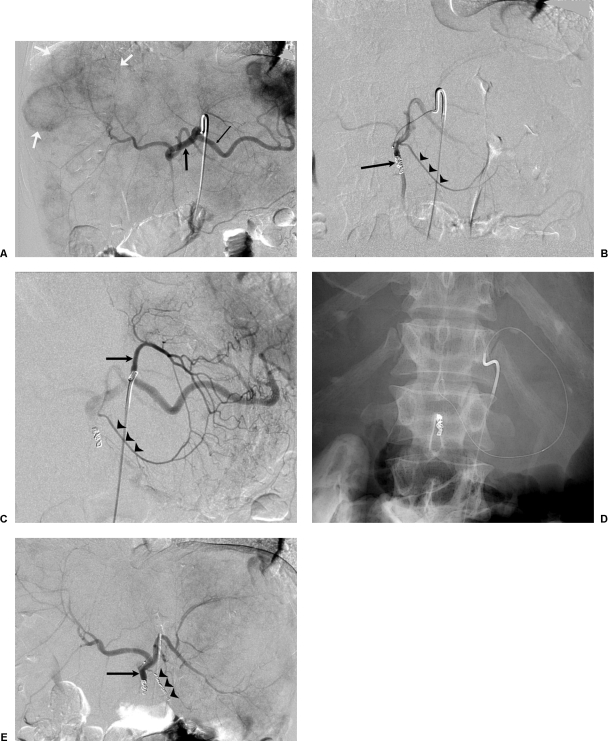
Pre-radioembolotherapy arteriography in a 55-year-old man with hepatic metastatic colorectal cancer. (A) Celiac arteriogram. Splenic artery (thin black arrow) and common hepatic artery (thick black arrow) arise normally. Note numerous hepatic metastases (white arrows). (B) Proper hepatic arteriogram. The gastroduodenal artery has been coil embolized (single arrow). Note opacification of the right gastric artery arising from the proper hepatic artery (arrowheads). (C) Left gastric arteriogram. The left gastric artery (arrow) anastomoses with the right gastric artery (arrowheads) along the lesser curvature of the stomach. (D) Retrograde access of the right gastric artery. Digital Photospot image demonstrating a microcatheter and wire at the origin of the right gastric artery in preparation for coil embolization. (E) Postembolization proper hepatic arteriogram. The gastroduodenal (single arrow) and right gastric artery (arrowheads) have been coil embolized and demonstrate absence of flow to the gastroduodenal region.
Figure 6
Figure 6
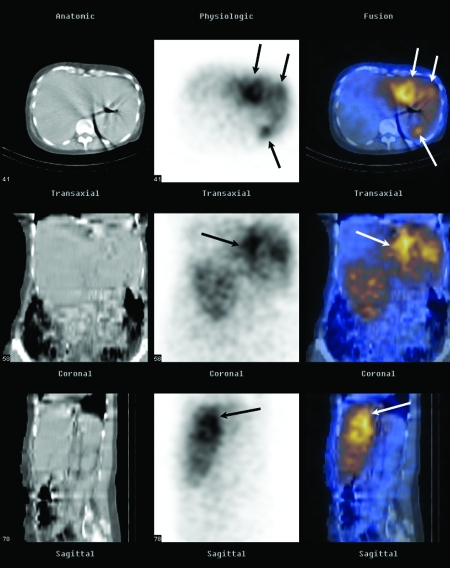
Bremsstrahlung imaging. Successful targeting of hepatic metastases in a 68-year-old woman (same as Fig. 4). Representative axial, coronal, and sagittal computed tomography (CT) images (first column), single-photon emission computed tomography (SPECT) images (second column), and SPECT/CT fusion images (third column) obtained with a dual-modality imaging system (Hawkeye; GE Medical Systems, Milwaukee, WI) show selective activity in the left hepatic lobe metastases (arrows) ~24 hours after intra-arterial infusion of 35 mCi (945 MBq) of Y90 resin microspheres.
Figure 7
Figure 7
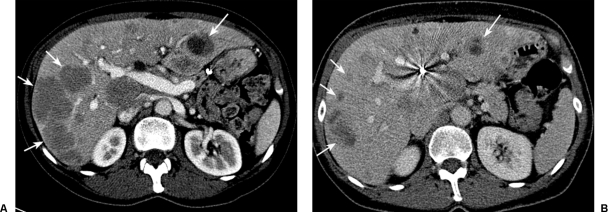
Colorectal cancer. 50-year-old woman with hepatic metastatic colorectal cancer refractory to oxaliplatin and irinotecan chemotherapy. (A) Pretreatment contrast-enhanced axial CT scan demonstrates a multiple bilobar hepatic metastases (arrows). Radioembolization was performed with resin microspheres on a lobar basis. First treatment was to the left lobe, which received 1.16 GBq. Forty days later, the right lobe was treated with 1.62 GBq. (B) Partial response by RECIST (arrows).
Figure 8
Figure 8
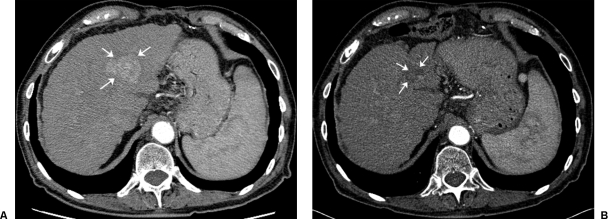
Hepatocellular cancer. 75-year-old male with hepatitis C–induced cirrhosis and left lobe hepatocellular carcinoma. (A) Pretreatment contrast-enhanced axial CT scan demonstrates a single lesion in the right lobe (arrows). (B) Following a single 1.67 GBq glass microsphere radioembolization (134 Gy dose), a near complete response (arrows) is noted after a 2-year follow-up period.

References

    1. Gilbert H A, Kagan A R. In: Weiss L, editor. Fundamental Aspects of Metastasis. Amsterdam: North Holland; 1976. Metastasis: incidence, detection and evaluation without histological confirmation. pp. 385–405.
    1. Jemal A, Siegel R, Ward E, Murray T, Xu J, Thun M J. Cancer statistics, 2007. CA Cancer J Clin. 2007;57(1):43–66. - PubMed
    1. Fong Y, Cohen A, Fortner J, et al. Liver resection for colorectal metastases. J Clin Oncol. 1997;15(3):938–946. - PubMed
    1. Abdalla E K, Vauthey J N, Ellis L M, et al. Recurrence and outcomes following hepatic resection, radiofrequency ablation, and combined resection/ablation for colorectal liver metastases. Ann Surg. 2004;239(6):818–825. - PMC - PubMed
    1. El-Serag H B, Davila J A, Petersen N J, McGlynn K A. The continuing increase in the incidence of hepatocellular carcinoma in the United States: an update. Ann Intern Med. 2003;139(10):817–823. - PubMed