


The predictive mirror: interactions of mirror and affordance processes during action observation
- PMID: 21327353
- PMCID: PMC3042113
- DOI: 10.3758/s13423-010-0029-x
The predictive mirror: interactions of mirror and affordance processes during action observation
Abstract
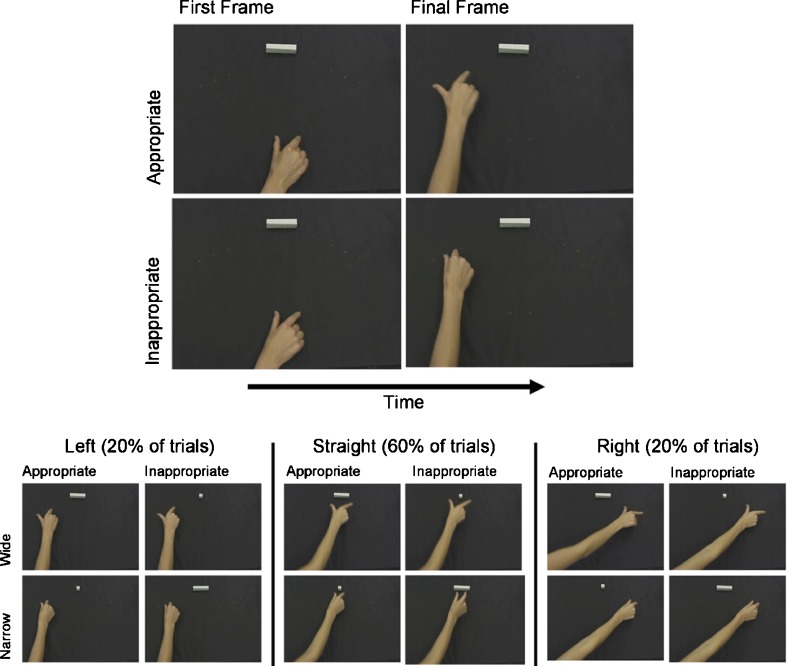
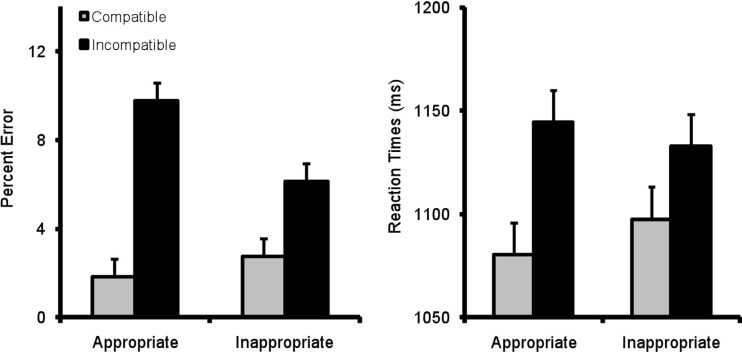
An important question for the study of social interactions is how the motor actions of others are represented. Research has demonstrated that simply watching someone perform an action activates a similar motor representation in oneself. Key issues include (1) the automaticity of such processes, and (2) the role object affordances play in establishing motor representations of others' actions. Participants were asked to move a lever to the left or right to respond to the grip width of a hand moving across a workspace. Stimulus-response compatibility effects were modulated by two task-irrelevant aspects of the visual stimulus: the observed reach direction and the match between hand-grasp and the affordance evoked by an incidentally presented visual object. These findings demonstrate that the observation of another person's actions automatically evokes sophisticated motor representations that reflect the relationship between actions and objects even when an action is not directed towards an object.
Figures
References
-
- Bosbach S, Prinz W, Kerzel D. Movement-based compatibility in simple response tasks. European Journal of Cognitive Psychology. 2005;17(5):695–707. doi: 10.1080/09541440540000086. - DOI
Publication types
MeSH terms
Grants and funding
LinkOut - more resources
Full Text Sources
Medical
