


Influence of efforts of employer and employee on return-to-work process and outcomes
- PMID: 21328060
- PMCID: PMC3217145
- DOI: 10.1007/s10926-011-9293-5
Influence of efforts of employer and employee on return-to-work process and outcomes
Abstract
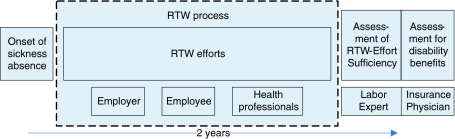
Background: Research on disability and RTW outcome has led to significant advances in understanding these outcomes, however, limited studies focus on measuring the RTW process. After a prolonged period of sickness absence, the assessment of the RTW process by investigating RTW Effort Sufficiency (RTW-ES) is essential. However, little is known about factors influencing RTW-ES. Also, the correspondence in factors determining RTW-ES and RTW is unknown. The purpose of this study was to investigate 1) the strength and relevance of factors related to RTW-ES and RTW (no/partial RTW), and 2) the comparability of factors associated with RTW-ES and with RTW.
Methods: During 4 months, all assessments of RTW-ES and RTW (no/partial RTW) among employees applying for disability benefits after 2 years of sickness absence, performed by labor experts at 3 Dutch Social Insurance Institute locations, were investigated by means of a questionnaire.
Results: Questionnaires concerning 415 cases were available. Using multiple logistic regression analysis, the only factor related to RTW-ES is a good employer-employee relationship. Factors related to RTW (no/partial RTW) were found to be high education, no previous periods of complete disability and a good employer-employee relationship.
Conclusions: Different factors are relevant to RTW-ES and RTW, but the employer-employee relationship is relevant for both. Considering the importance of the assessment of RTW-ES after a prolonged period of sickness absence among employees who are not fully disabled, this knowledge is essential for the assessment of RTW-ES and the RTW process itself.
Figures
References
-
- OECD . Transforming disability into ability: policies to promote work and income security for disabled people. Paris: Organisation for Economic Co-operation and Development; 2003.
MeSH terms
LinkOut - more resources
Full Text Sources
Medical
