. 2011 Jul;181(5):681-9.
doi: 10.1007/s00360-011-0559-1. Epub 2011 Feb 17.

Effects of season and reproductive state on lipid intake and fatty acid composition of gastrointestinal tract contents in the European hare

Affiliations

Effects of season and reproductive state on lipid intake and fatty acid composition of gastrointestinal tract contents in the European hare

F D Popescu et al. J Comp Physiol B. 2011 Jul.

Abstract

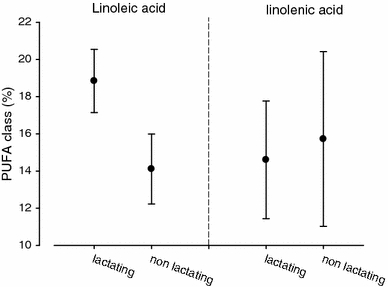
We investigated lipid content and fatty acid (FA) composition of gastrointestinal tract contents in free-living, herbivorous European hares (Lepus europaeus). Mean crude fat content in hare stomachs and total gastrointestinal (GI) tracts was higher than expected for typical herbivore forages and peaked in late fall when hares massively deposited body fat reserves. Changes of FA proportions in different parts of the GI-tract indicated a highly preferential absorption of polyunsaturated fatty acids (PUFA). A further reduction of PUFA content in the caecum, along with the appearance of odd-chained FAs in caecum, caecotrophes, and colon content, pointed to a biohydrogenation of PUFA in the hare's hindgut. GI-tract contents showed significant seasonal changes in their FA composition. Among PUFA, α-linolenic acid peaked in spring while linoleic acid was predominant in late summer and fall, which probably reflected changes in the plant composition of forage. However, independent of seasonal changes, GI-tracts of lactating females showed a significantly (+33%) higher content of linoleic acid, a FA that is known to increase reproductive performance in European hares. This finding suggests that lactating females actively selected dietary plants rich in linoleic acid, a PUFA that may represent a limited resource for European hares.


Figures
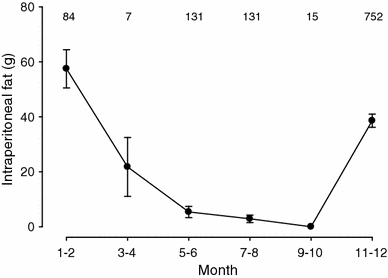
Fig. 1
Fig. 1
Seasonal change of intraperitoneal fat content (w/o gonadal fat depots) in free-living European hares (both sexes) shot at bi-monthly intervals in Lower Austria. The numbers above the symbols indicate sample sizes. Means ± 95% confidence intervals
Fig. 2
Fig. 2
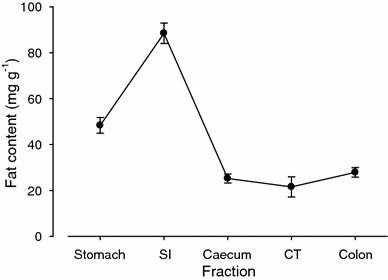
Crude fat content of digesta in different fractions of the gastrointestinal tract of free-living European hares. SI small intestine, CT caecotrophes. Means ± 95% confidence intervals
Fig. 3
Fig. 3
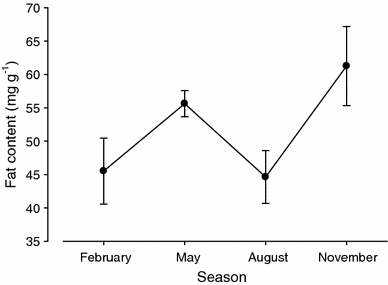
Mean crude fat content of digesta in the gastrointestinal tract of European hares as a function of season. Means ± 95% confidence intervals
Fig. 4
Fig. 4
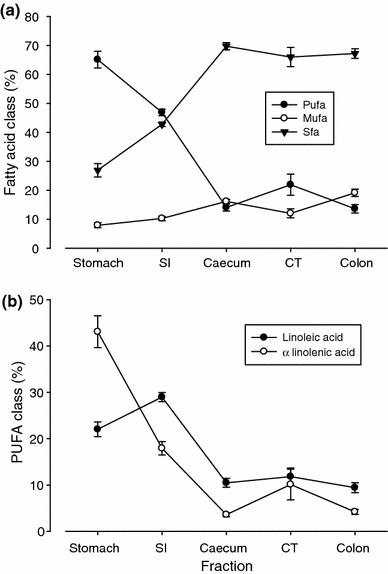
Fatty acid content in different fractions of the gastrointestinal tract of European hares. Means ± 95% confidence intervals. a Proportions of polyunsaturated (PUFA), monounsaturated (MUFA) and saturated (SFA) fatty acids. b Proportions of linoleic acid (C18:2n-6) and α-linolenic acid (C18:3n-3) within PUFA
Fig. 5
Fig. 5
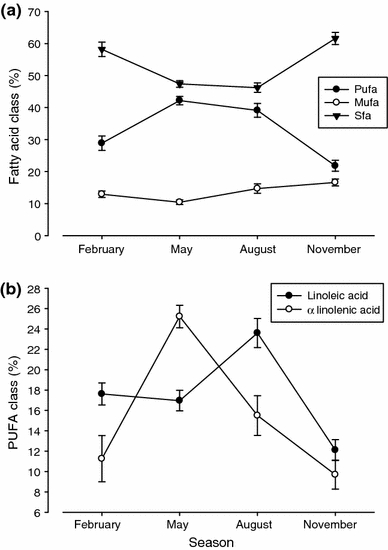
Mean fatty acid proportions in the gastrointestinal tract contents of European hares as a function of season. Means ± 95% confidence intervals. a Proportions of polyunsaturated (PUFA) monounsaturated (MUFA) and saturated (SFA) fatty acids. b Proportions of linoleic acid and α-linolenic acid within PUFA
Fig. 6
Fig. 6
Linoleic acid and α-linolenic acid proportions in the gastrointestinal tract content of lactating and non-lactating female European hares. Means from all fractions of the gastrointestinal tract ± 95% confidence intervals

References

    1. Bairlein F. How to get fat: nutritional mechanisms of seasonal fat accumulation in migratory song birds. Naturwiss. 2002;89:1–10. doi: 10.1007/s00114-001-0279-6. - DOI - PubMed
    1. Bargo F, Muller LD, Kolver ES, Delahoy JE. Production and digestion of supplemented dairy cows on pasture. J Diary Sci. 2003;86:1–42. doi: 10.3168/jds.S0022-0302(03)73581-4. - DOI - PubMed
    1. Berteaux D, Crete M, Huot J, Maltais J, Oullet JP. Food choice by white-tailed deer in relation to protein and energy content of the diet: a field experiment. Oecologia. 1998;115:84–92. doi: 10.1007/s004420050494. - DOI - PubMed
    1. Bordoni A, Nunzio MD, Danesi F, Biagi PL. Polyunsaturated fatty acids: from diet to binding to PPARs and other nuclear receptors. Genes Nutr. 2006;1:95–106. doi: 10.1007/BF02829951. - DOI - PMC - PubMed
    1. Bryant JP, Kuropat PJ. Selection of winter forage by subarctic browsing vertebrates: the role of plant chemistry. Annu Rev Ecol Syst. 1980;11:261–285. doi: 10.1146/annurev.es.11.110180.001401. - DOI

Publication types