


Low-fat diets for acquired hypercholesterolaemia
- PMID: 21328303
- PMCID: PMC6492464
- DOI: 10.1002/14651858.CD007957.pub2
Low-fat diets for acquired hypercholesterolaemia
Abstract
Background: Hypercholesterolaemia, characterised by raised blood cholesterol levels, is not a disease itself but a metabolic derangement that often contributes to many diseases, notably cardiovascular disease. In most cases, elevated cholesterol levels are associated with high-fat diet, especially saturated fat, coupled with an inactive lifestyle. Less commonly, raised cholesterol may be related to an inherited disorder, familial hypercholesterolaemia. This systematic review is only concerned with acquired hypercholesterolaemia.
Objectives: To assess the effects of low-fat diets for acquired hypercholesterolaemia and to investigate the incidence of adverse effects from low-fat dietary interventions. We planned to compare the relative effectiveness of low-fat diets with calorie-restricted diets for acquired hypercholesterolaemia. We also wanted to look into the relative effectiveness of low-fat diets and pharmacological interventions for acquired hypercholesterolaemia.
Search strategy: Studies were obtained from computerised searches of The Cochrane Library, MEDLINE, EMBASE and databases of ongoing trials. Date of last search was February 2010.
Selection criteria: Otherwise healthy adults (equal to or greater than 18 years) with acquired (not familial) hypercholesterolaemia. We defined hypercholesterolaemia as either total cholesterol greater than 5.2 mmol/L, LDL-cholesterol greater than 3.0 mmol/L, HDL-cholesterol less than 1.0 mmol/L or a combination thereof, although investigators' definitions were also accepted. We wanted to include any low-fat dietary intervention, like low-fat and low-saturated fat diets, intended to lower serum total and LDL-cholesterol or to raise HDL-cholesterol. A low-fat diet was considered as a fat calorie intake less than 20% of the total calories. The minimum duration of the intervention had to be six months. We excluded studies in unhealthy people.
Data collection and analysis: Two authors were planned to independently assess risk of bias and extract data.
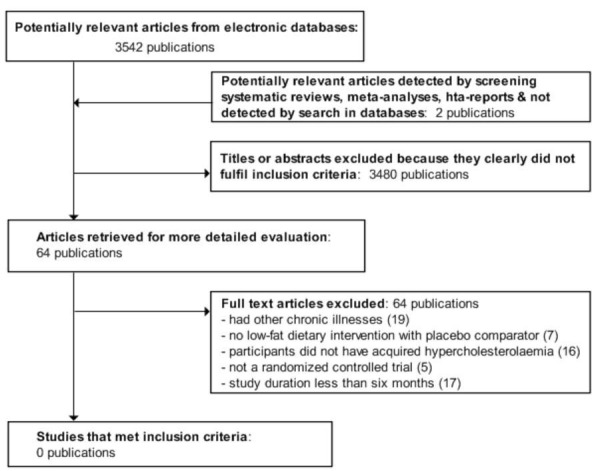
Main results: No study met our inclusion criteria.
Authors' conclusions: Well designed, adequately powered randomised controlled trials investigating patient-relevant outcomes of low-fat diets for otherwise healthy people with hypercholesterolaemia are required.
Conflict of interest statement
None known.
Figures
Update of
References
References to studies excluded from this review
-
- Aquilani R, Tramarin R, Pedretti RF, Bertolotti G, Sommaruga M, Mariani P, et al. Despite good compliance, very low fat diet alone does not achieve recommended cholesterol goals in outpatients with coronary heart disease. European Heart Journal 1999;20(14):1020‐9. - PubMed
-
- Avogaro P, Bittolo Bon G, Belussi F, Pontoglio E, Cazzolato G. Variations in lipids and proteins of lipoproteins by fenofibrate in some hyperlipoproteinaemic states. Atherosclerosis 1983;47(1):95‐100. - PubMed
-
- Baumann J, Martschick R. Therapy of hyperlipidemia with xanthinol nicotinate as opposed to low fat diet. Medizinische Welt 1982;33(4):139‐41. - PubMed
-
- Birley AJ, MacLennan R, Wahlqvist M, Gerns L, Pangan T, Martin NG. MN blood group affects response of serum LDL cholesterol level to a low fat diet. Clinical Genetics 1997;51(5):291‐5. - PubMed
-
- Blacket RB, Leelarthaepin B, McGilchrist CA, Palmer AJ, Woodhill JM. The synergistic effect of weight loss and changes in dietary lipids on the serum cholesterol of obese men with hypercholesterolaemia: implications for prevention of coronary heart disease. Australian and New Zealand Journal of Medicine 1979;9(5):521‐529. - PubMed
Additional references
-
- Athyros, V. G.Kakafika, A. I.Tziomalos, K.Karagiannis, A.Mikhailidis, D. P. Pleiotropic effects of statins ‐ clinical evidence. Current Pharmaceutical Design 15;5:479‐89. - PubMed
-
- Callow, AD. Cardiovascular disease 2005 ‐ the global picture. Vascular Pharmacology 2005;45(5):302‐7. - PubMed
-
- Cohen J. A coefficient of agreement for nominal scales. Educational and Psychological Measurement 1960;20:37‐46.
Publication types
MeSH terms
LinkOut - more resources
Full Text Sources
Other Literature Sources
Medical
Miscellaneous
