


Comparison of urine cotinine and the tobacco-specific nitrosamine metabolite 4-(methylnitrosamino)-1-(3-pyridyl)-1-butanol (NNAL) and their ratio to discriminate active from passive smoking
- PMID: 21330276
- PMCID: PMC3045466
- DOI: 10.1093/ntr/ntq237
Comparison of urine cotinine and the tobacco-specific nitrosamine metabolite 4-(methylnitrosamino)-1-(3-pyridyl)-1-butanol (NNAL) and their ratio to discriminate active from passive smoking
Abstract
Objectives: Cotinine is the most widely used biomarker to distinguish active versus passive smoking. However, there is an overlap in cotinine levels when comparing light or occasional smokers versus heavily exposed passive smokers. 4-(methylnitrosamino)-1-(3-pyridyl)-1-butanol (NNAL) is a tobacco-specific nitrosamine measurable in urine with a much longer half-life than cotinine. The aim of the study was to determine optimal cutoff points to discriminate active versus passive smokers and to compare sensitivity and specificity for the use of cotinine, NNAL, and the ratio of the NNAL/cotinine in urine.
Methods: Cotinine and NNAL were measured in urine of 373 active smokers and 228 passive smokers.
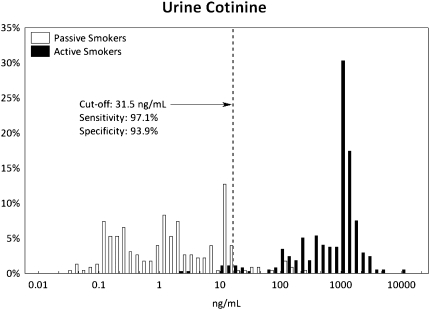
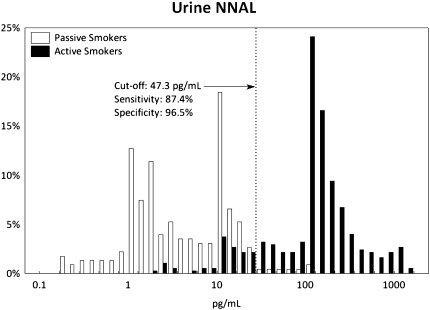
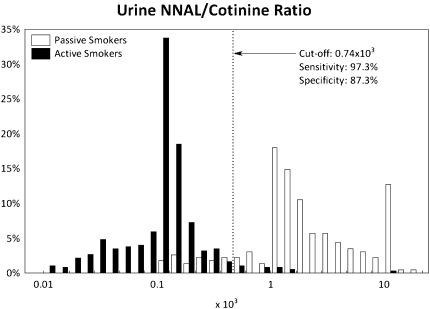
Results: Geometric mean cotinine levels were 2.03 ng/ml (interquartile interval: 0.43-8.60) and 1,043 ng/ml (658-2,251) and NNAL levels were 5.80 pg/ml (2.28-15.4) and 165 pg/ml (90.8-360) pg/ml in passive and active smokers, respectively. NNAL/cotinine ratio in urine was significantly higher for passive smokers when compared with active smokers (2.85 vs. 0.16, p < .01). The receiver operating characteristics analysis determined optimal cutoff points to discriminate passive versus active smokers: 31.5 ng/ml for cotinine (sensitivity: 97.1% and specificity: 93.9%), 47.3 pg/ml for NNAL (87.4% and 96.5%), and 0.74 x 10⁻³ for NNAL/cotinine ratio (97.3% and 87.3%).
Conclusions: Both urine cotinine and NNAL are sensitive and specific biomarkers for discriminating the source of tobacco smoke exposure. Cotinine is the best overall discriminator when biomarkers are measured while a person has ongoing exposure to tobacco smoke. NNAL because of its long half-life would be particularly useful when there is a delay between exposure and biomarker measurement. The NNAL/cotinine ratio provides similar sensitivity but poorer specificity at discriminating passive versus active smokers when compared with NNAL alone.
Figures
References
-
- Benowitz N, Goniewicz ML, Eisner MD, Lazcano-Ponce E, Zielinska-Danch W, Koszowski B, et al. Urine cotinine underestimates exposure to the tobacco-derived lung carcinogen 4-(methylnitrosamino)-1-(3-pyridyl)-1-butanone in passive compared with active smokers. Cancer Epidemiology & Biomarkers of Prevention. 2010;19:2795–2800. doi:1055-9965.EPI-10-0497. - PMC - PubMed
-
- Benowitz NL. Cotinine as a biomarker of environmental tobacco smoke exposure. Epidemiology Review. 1996;18:188–204. - PubMed
-
- Benowitz NL, Bernert JT, Caraballo RS, Holiday DB, Wang J. Optimal serum cotinine levels for distinguishing cigarette smokers and nonsmokers within different racial/ethnic groups in the United States between 1999 and 2004. American Journal of Epidemiology. 2009;169:236–248. doi:kwn301. - PubMed
-
- Bernert JT, Jain RB, Pirkle JL, Wang L, Miller BB, Sampson EJ. Urinary tobacco-specific nitrosamines and 4-aminobiphenyl hemoglobin adducts measured in smokers of either regular or light cigarettes. Nicotine & Tobacco Research. 2005;7:729–738. doi:X08147535X68KH31. - PubMed
-
- Boffetta P, Clark S, Shen M, Gislefoss R, Peto R, Andersen A. Serum cotinine level as predictor of lung cancer risk. Cancer Epidemiology Biomarkers Prevention. 2006;15:1184–1188. doi:15/6/1184. - PubMed
Publication types
MeSH terms
Substances
Grants and funding
LinkOut - more resources
Full Text Sources
Medical
