. 2011 May;157(Pt 5):1457-1465.
doi: 10.1099/mic.0.045997-0. Epub 2011 Feb 17.

The dlt operon confers resistance to cationic antimicrobial peptides in Clostridium difficile

Affiliations

The dlt operon confers resistance to cationic antimicrobial peptides in Clostridium difficile

Shonna M McBride et al. Microbiology (Reading). 2011 May.

Abstract

The dlt operon in Gram-positive bacteria encodes proteins that are necessary for the addition of d-alanine to teichoic acids of the cell wall. The addition of d-alanine to the cell wall results in a net positive charge on the bacterial cell surface and, as a consequence, can decrease the effectiveness of antimicrobials, such as cationic antimicrobial peptides (CAMPs). Although the roles of the dlt genes have been studied for some Gram-positive organisms, the arrangement of these genes in Clostridium difficile and the life cycle of the bacterium in the host are markedly different from those of other pathogens. In the current work, we determined the contribution of the putative C. difficile dlt operon to CAMP resistance. Our data indicate that the dlt operon is necessary for full resistance of C. difficile to nisin, gallidermin, polymyxin B and vancomycin. We propose that the d-alanylation of teichoic acids provides protection against antimicrobial peptides that may be essential for growth of C. difficile in the host.


Figures
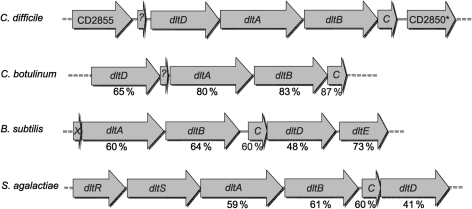
Fig. 1.
Fig. 1.
Comparison of the dlt regions of C. difficile and of other Gram-positive bacteria. Shown is the organization of the dlt operon and accessory genes of C. difficile (GenBank accession no. AM180355), Clostridium botulinum (CP001078), B. subtilis (AL009126) and Streptococcus agalactiae (CP000114). Numbers below the arrows indicate percentage similarity of proteins to the corresponding C. difficile sequences.
Fig. 2.
Fig. 2.
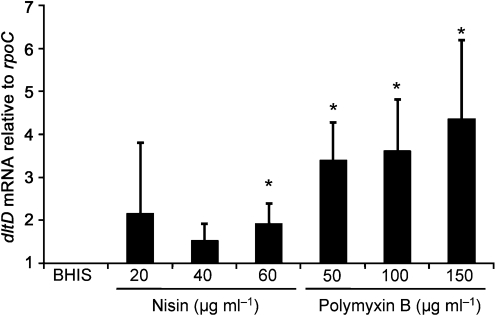
qPCR analysis of dltD expression in C. difficile during growth in polymyxin B and nisin. C. difficile wild-type (JIR8094) was grown to OD600 0.2 in BHIS alone or BHIS supplemented with 20, 40 or 60 µg nisin ml−1, or 50, 100 or 150 µg polymyxin B ml−1, as indicated. RNA was harvested, cDNA synthesized and qPCR performed using gene-specific primers for dltD. Results were normalized to an internal control gene (rpoC). The means and sds of biological replicates are shown. Asterisks, P≤0.05 by Student’s t test.
Fig. 3.
Fig. 3.
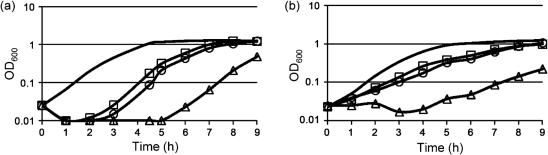
Growth of C. difficile wild-type and mutant isolates in nisin and polymyxin B. C. difficile wild-type (JIR8094, □), MC120 (dltD : : intron : : ermB, △) and MC129 (dltD : : intron : : ermB, dltDABC+, ○) strains were grown in BHIS medium or BHIS medium supplemented with 10 µg nisin B ml−1 (a) or 75 µg polymyxin B ml−1 (b). The growth rates of strains in BHIS alone were indistinguishable and are thus shown as a single solid line for clarity.
Fig. 4.
Fig. 4.
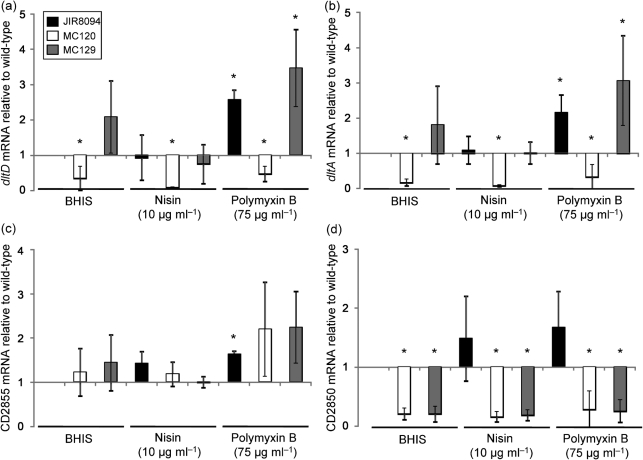
Expression of the dlt genes of wild-type and mutant strains in the presence of the CAMPs nisin and polymyxin B. C. difficile wild-type (JIR8094), MC120 (dltD : : intron : : ermB) and MC129 (dltD : : intron : : ermB, dltDABC+) strains were grown to OD600 0.2 in BHIS or BHIS supplemented with 10 µg nisin ml−1 or 75 µg polymyxin B ml−1. RNA was harvested, cDNA synthesized and qPCR performed using gene-specific primers for (a) dltD, (b) dltA, (c) CD2855 or (d) CD2850. Results were normalized to an internal control gene (rpoC) and are presented as the ratio of each transcript level to that of wild-type cells grown in BHIS. The means and sds of biological replicates are shown. Asterisks, P≤0.05 by Student’s t test.
Fig. 5.
Fig. 5.
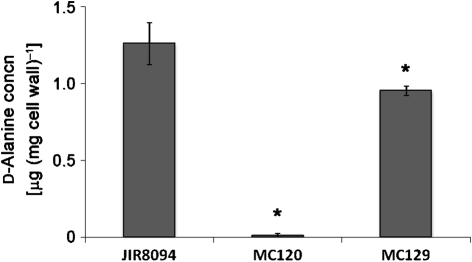
Analysis of ester-linked d-alanine content in C. difficile cell walls. Cell walls partially purified from C. difficile wild-type (JIR8094), MC120 (dltD : : intron : : ermB) and MC129 (dltD : : intron : : ermB, dltDABC+) strains harvested after growth to OD600 0.2 in BHIS were assayed for incorporation of d-alanine into teichoic acids of the cell wall. Results represent the means and sds of three biological replicates, each replicate tested in duplicate samples. Asterisks, P≤0.05 by Student’s t test.

References

    1. Abachin E., Poyart C., Pellegrini E., Milohanic E., Fiedler F., Berche P., Trieu-Cuot P. (2002). Formation of d-alanyl-lipoteichoic acid is required for adhesion and virulence of Listeria monocytogenes. Mol Microbiol 43, 1–14. 10.1046/j.1365-2958.2002.02723.x - DOI - PubMed
    1. Abi Khattar Z., Rejasse A., Destoumieux-Garzón D., Escoubas J. M., Sanchis V., Lereclus D., Givaudan A., Kallassy M., Nielsen-Leroux C., Gaudriault S. (2009). The dlt operon of Bacillus cereus is required for resistance to cationic antimicrobial peptides and for virulence in insects. J Bacteriol 191, 7063–7073. 10.1128/JB.00892-09 - DOI - PMC - PubMed
    1. Allen, D. (2008) Transcriptional regulation of the dlt operon in Enterococcus faecalis and further characterization of a dltA mutant. MS thesis, Kansas State University, Manhattan, KS.
    1. Bartlett J. G., Onderdonk A. B., Cisneros R. L., Kasper D. L. (1977). Clindamycin-associated colitis due to a toxin-producing species of Clostridium in hamsters. J Infect Dis 136, 701–705. - PubMed
    1. Cao M., Helmann J. D. (2004). The Bacillus subtilis extracytoplasmic-function σX factor regulates modification of the cell envelope and resistance to cationic antimicrobial peptides. J Bacteriol 186, 1136–1146. 10.1128/JB.186.4.1136-1146.2004 - DOI - PMC - PubMed

Publication types

MeSH terms

Substances

LinkOut - more resources