. 2011 Apr;60(4):1090-9.
doi: 10.2337/db10-0901. Epub 2011 Feb 17.

High pancreatic n-3 fatty acids prevent STZ-induced diabetes in fat-1 mice: inflammatory pathway inhibition

Affiliations

High pancreatic n-3 fatty acids prevent STZ-induced diabetes in fat-1 mice: inflammatory pathway inhibition

Jérôme Bellenger et al. Diabetes. 2011 Apr.

Abstract

Objective: Because of confounding factors, the effects of dietary n-3 polyunsaturated fatty acids (PUFA) on type 1 diabetes remain to be clarified. We therefore evaluated whether fat-1 transgenic mice, a well-controlled experimental model endogenously synthesizing n-3 PUFA, were protected against streptozotocin (STZ)-induced diabetes. We then aimed to elucidate the in vivo response at the pancreatic level.

Research design and methods: β-Cell destruction was produced by multiple low-doses STZ (MLD-STZ). Blood glucose level, plasma insulin level, and plasma lipid analysis were then performed. Pancreatic mRNA expression of cytokines, the monocyte chemoattractant protein, and GLUT2 were evaluated as well as pancreas nuclear factor (NF)-κB p65 and inhibitor of κB (IκB) protein expression. Insulin and cleaved caspase-3 immunostaining and lipidomic analysis were performed in the pancreas.

Results: STZ-induced fat-1 mice did not develop hyperglycemia compared with wild-type mice, and β-cell destruction was prevented as evidenced by lack of histological pancreatic damage or reduced insulin level. The prevention of β-cell destruction was associated with no proinflammatory cytokine induction (tumor necrosis factor-α, interleukin-1β, inducible nitric oxide synthase) in the pancreas, a decreased NF-κB, and increased IκB pancreatic protein expression. In the fat-1-treated mice, proinflammatory arachidonic-derived mediators as prostaglandin E₂ and 12-hydroxyeicosatetraenoic acid were decreased and the anti-inflammatory lipoxin A₄ was detected. Moreover, the 18-hydroxyeicosapentaenoic acid, precursor of the anti-inflammatory resolvin E1, was highly increased.

Conclusions: Collectively, these findings indicate that fat-1 mice were protected against MLD-STZ-induced diabetes and pointed out for the first time in vivo the beneficial effects of n-3 PUFA at the pancreatic level, on each step of the development of the pathology-inflammation, β-cell damage-through cytokine response and lipid mediator production.


Figures

FIG. 1.
FIG. 1.
n-3 fatty acid enrichment protects animals from MLD-STZ–induced hyperglycemia. Blood glucose level was measured in nonfasted WT and transgenic animals given STZ or STZ-vehicle as control (n = 4). Results are presented as a mean ± SE. Differences were analyzed by the Newman-Keuls test. Means assigned a superscript letters (a, b, c) were statistically different at P < 0.05. WC, citrate-treated WT mice; WS, STZ-induced WT mice; FC, citrate-treated fat-1 mice; FS, STZ-induced fat-1 mice.
FIG. 2.
FIG. 2.
n-3 fatty acid enrichment protects animals from MLD-STZ–induced β-cell damage. A: Representative hematoxylin and eosin (H&E)-stained sections analysis showing islet morphology of WT (top) and fat-1 transgenic (bottom) mice (n = 3). B: Representative effect of STZ administration on pancreas GLUT2 gene expression (n = 4). C: Representative immunohistochemistry for insulin in the pancreatic islets of WT (top) and fat-1 transgenic (bottom) mice (n = 3). Islet quantification of WT and fat-1 mice presented as percentage of islets with an area bigger than 20,000 μm2. Plasma insulin concentration in control or STZ-injected WT and transgenic mice (n = 4) is shown. D: Representative immunohistochemistry for cleaved caspase-3 in the pancreatic islets of the WT (top) and fat-1 transgenic (bottom) mice (n = 3). Results are presented as a mean ± SE. Differences were analyzed by the Newman-Keuls test. Means assigned different superscript letters (a, b, c) (D) were statistically different at P < 0.05. For A, C, and D, results were obtained at day 9 after the fifth STZ injection. WC, citrate-treated WT mice; WS, STZ-induced WT mice; FC, citrate-treated fat-1 mice; FS, STZ-induced fat-1 mice. (A high-quality digital representation of this figure is available in the online issue.)
FIG. 3.
FIG. 3.
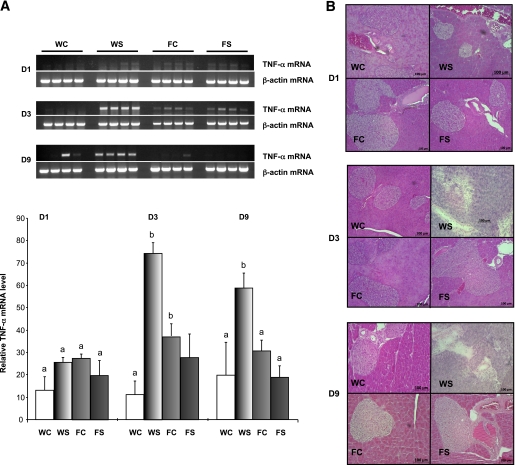
A: Time course mRNA level for TNF-α in pancreas collected 1, 3, and 9 days after the last STZ injection, from WT and transgenic animals injected with multiple low doses of streptozotocin or citrate as vehicle. B: Representative hematoxylin and eosin (H&E)-stained pancreas sections analysis, showing islet morphology of WT (top) and fat-1 transgenic (bottom) mice (n = 3). Differences were analyzed by Newman-Keuls test. Bars assigned different superscript letters (a, b, c) were statistically different at P < 0.05; n = 4 mice in each group. WC, citrate-treated WT mice; WS, STZ-induced WT mice; FC, citrate-treated fat-1 mice; FS, STZ-induced fat-1 mice. (A high-quality digital representation of this figure is available in the online issue.)
FIG. 4.
FIG. 4.
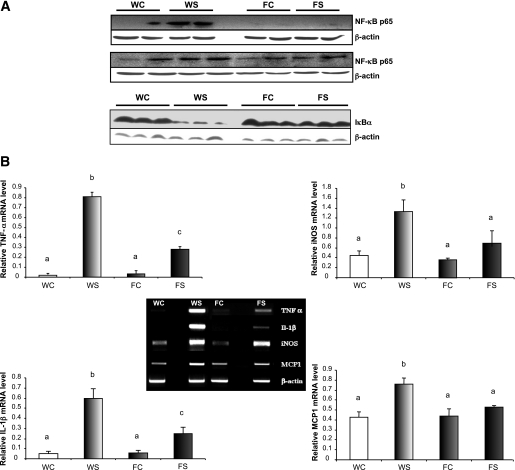
Pancreas n-3 fatty acid enrichment inhibits expression of NF-κB p65 and proinflammatory cytokines and increases expression of IκBα in fat-1 transgenic mouse model. A: Representative effect of STZ administration on pancreas NF-κB (p65) and IκBα protein expression. B: mRNA levels for proinflammatory cytokines and chemokine in pancreas from WT and transgenic animals. TNF-α, IL-1β, iNOS, MCP-1, and β-actin mRNA levels from pancreas of animals that have been injected with MLD-STZ or citrate as control are shown. Differences were analyzed by Newman-Keuls test. Bars assigned different superscript letters (a, b, c) were statistically different at P < 0.05; n = 4 mice in each group. In A, for NF-κB (p65) results were obtained at day 3 (top) and day 20 (bottom) after the fifth STZ injection. For IκBα, results were obtained at day 3 after the fifth STZ injection. For B, results were obtained at day 3 after the fifth STZ injection. WC, citrate-treated WT mice; WS, STZ-induced WT mice; FC, citrate-treated fat-1 mice; FS, STZ-induced fat-1 mice.
FIG. 5.
FIG. 5.
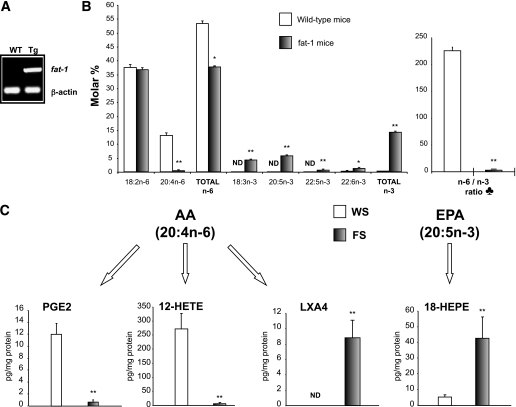
A: Representative RT-PCR for fat-1 and β-actin pancreas expression. Tg, fat-1 transgenic mice. B: Pancreas major fatty acids composition, total n-6, total n-3, and n-6–to–n-3 ratio are indicated for untreated WT and fat-1 transgenic mice as white and gray bars, respectively (mean ± SE). *P < 0.05; **P < 0.01 (Student t test); n = 11 per group. ND, not detected. ♣, The n-6–to–n-3 ratio is given by (18:2 n-6 + 20:4 n-6 + 22:4 n-6 + 22:5 n-6)/(18:3 n-3 + 20:5 n-3 + 22:5 n-3 + 22:6 n-3). C: Presence of different lipid mediators in pancreas samples of STZ-induced WT (n = 4) and fat-1 transgenic mice (n = 4). **P < 0.01 (Student t test).
FIG. 6.
FIG. 6.
A: Plasma major fatty acids composition, total n-6, and total n-3 are indicated for untreated and STZ-induced WT and fat-1 mice (n = 5). B: Plasma fatty-acids ratios in untreated and STZ-induced WT and fat-1 mice (n = 5). C: Plasma total lipid level in untreated and STZ-induced animals. Results are presented as a mean ± SE. Differences were analyzed by the Newman-Keuls test. Means assigned different superscript letters (a, b, c) were statistically different at P < 0.05.

References

    1. Pighin D, Karabatas L, Pastorale C, et al. Role of lipids in the early developmental stages of experimental immune diabetes induced by multiple low-dose streptozotocin. J Appl Physiol 2005;98:1064–1069 10.1152/japplphysiol.00559.2004 - DOI - PubMed
    1. Karabatas LM, Pastorale C, de Bruno LF, et al. Early manifestations in multiple-low-dose streptozotocin-induced diabetes in mice. Pancreas 2005;30:318–324 10.1097/01.mpa.0000161888.02244.7a - DOI - PubMed
    1. Kim WH, Lee JW, Gao B, Jung MH. Synergistic activation of JNK/SAPK induced by TNF-alpha and IFN-gamma: apoptosis of pancreatic beta-cells via the p53 and ROS pathway. Cell Signal 2005;17:1516–1532 10.1016/j.cellsig.2005.03.020 - DOI - PubMed
    1. Emre Y, Hurtaud C, Karaca M, Nubel T, Zavala F, Ricquier D. Role of uncoupling protein UCP2 in cell-mediated immunity: how macrophage-mediated insulitis is accelerated in a model of autoimmune diabetes. Proc Natl Acad Sci USA 2007;104:19085–19090 10.1073/pnas.0709557104 - DOI - PMC - PubMed
    1. Makarov SS. NF-kappaB as a therapeutic target in chronic inflammation: recent advances. Mol Med Today 2000;6:441–448 10.1016/S1357-4310(00)01814-1 - DOI - PubMed

Publication types

MeSH terms