


Waist Circumference, Body Mass Index, and Other Measures of Adiposity in Predicting Cardiovascular Disease Risk Factors among Peruvian Adults
- PMID: 21331161
- PMCID: PMC3034939
- DOI: 10.4061/2011/931402
Waist Circumference, Body Mass Index, and Other Measures of Adiposity in Predicting Cardiovascular Disease Risk Factors among Peruvian Adults
Abstract
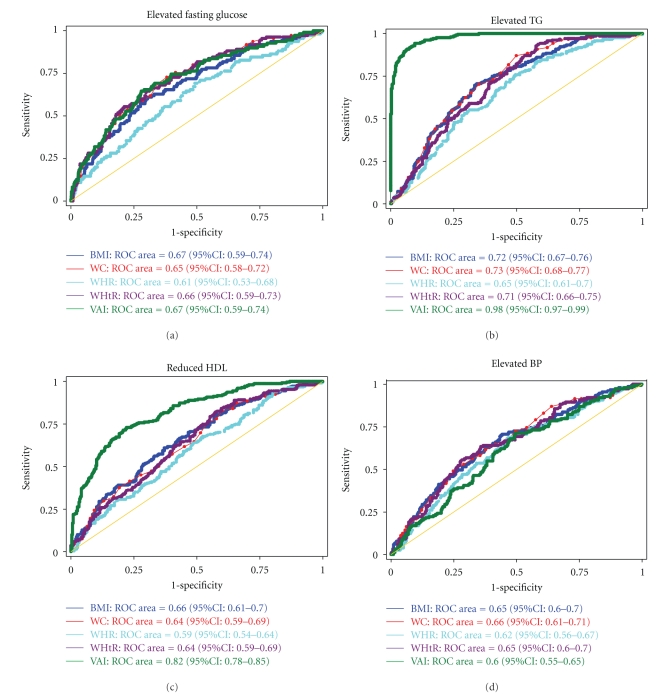
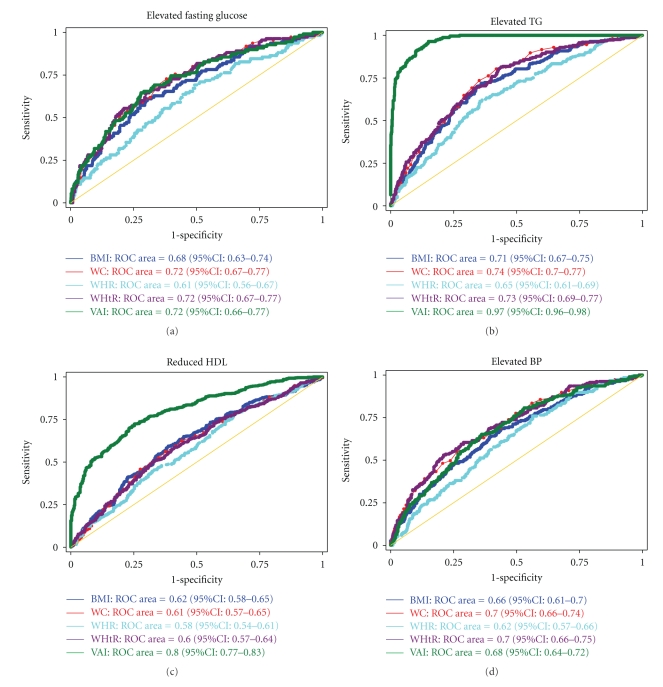
Objectives. To examine the extent to which measures of adiposity can be used to predict selected components of metabolic syndrome (MetS) and elevated C-reactive protein (CRP). Methods. A total of 1,518 Peruvian adults were included in this study. Waist circumference (WC), body mass index (BMI), waist-hip ratio (WHR), waist-height ratio (WHtR), and visceral adiposity index (VAI) were examined. The prevalence of each MetS component was determined according to tertiles of each anthropometric measure. ROC curves were used to evaluate the extent to which measures of adiposity can predict cardiovascular risk. Results. All measures of adiposity had the strongest correlation with triglyceride concentrations (TG). For both genders, as adiposity increased, the prevalence of Mets components increased. Compared to individuals with low-BMI and low-WC, men and women with high-BMI and high- WC had higher odds of elevated fasting glucose, blood pressure, TG, and reduced HDL, while only men in this category had higher odds of elevated CRP. Overall, the ROCs showed VAI, WC, and WHtR to be the best predictors for individual MetS components. Conclusions. The results of our study showed that measures of adiposity are correlated with cardiovascular risk although no single adiposity measure was identified as the best predictor for MetS.
Figures
References
-
- WHO. The Global Burden of Disease 2004 Update. Geneva, Switzerland: WHO; 2004.
-
- WHO. World Health Report. Prevention Chronic Disease: A vital Investment. Geneva, Switzerland, 2008, http://www.who.int/chp/chronic_disease_report/contents/part1.pdf.
-
- Ford ES. Risks for all-cause mortality, cardiovascular disease, and diabetes associated with the metabolic syndrome: a summary of the evidence. Diabetes Care. 2005;28(7):1769–1778. - PubMed
-
- Grundy SM, Becker D, Clark LT, et al. Detection, evaluation, and treatment of high blood cholesterol in adults (Adult Treatment Panel III) Circulation. 2002;106(25):3143–3421. - PubMed
Grants and funding
LinkOut - more resources
Full Text Sources
Research Materials
Miscellaneous
