A 36-hospital time and motion study: how do medical-surgical nurses spend their time?
- PMID: 21331207
- PMCID: PMC3037121
- DOI: 10.7812/tpp/08-021
A 36-hospital time and motion study: how do medical-surgical nurses spend their time?
Abstract
Context: Nurses are the primary hospital caregivers. Increasing the efficiency and effectiveness of nursing care is essential to hospital function and the delivery of safe patient care.
Objective: We undertook a time and motion study to document how nurses spend their time. The goal was to identify drivers of inefficiency in nursing work processes and nursing unit design.
Design: Nurses from 36 medical-surgical units were invited to participate in research protocols designed to assess how nurses spend their time, nurse location and movement, and nurse physiologic response.
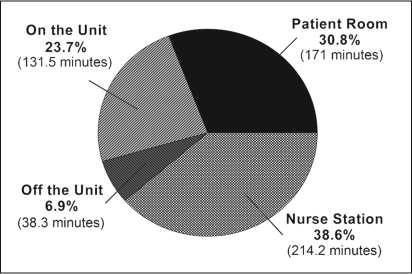
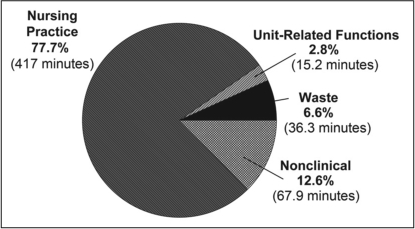
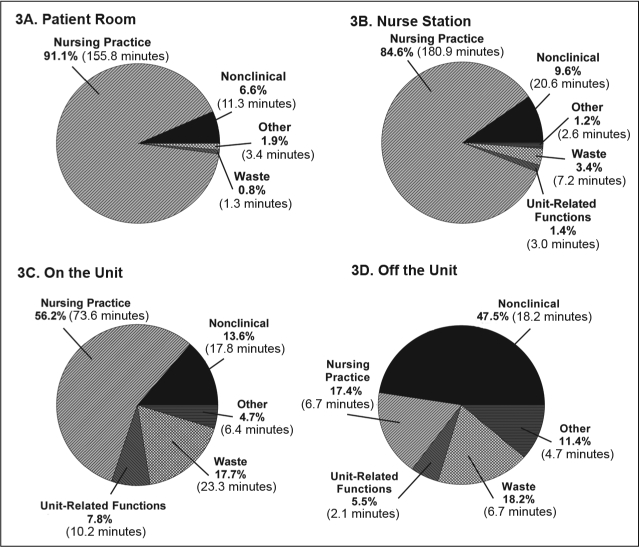
Main outcome measures: Nurses' time was divided into categories of activities (nursing practice, unit-related functions, nonclinical activities, and waste) and locations (patient room, nurse station, on-unit, off-unit). Total distance traveled and energy expenditure were assessed. Distance traveled was evaluated across types of unit design.
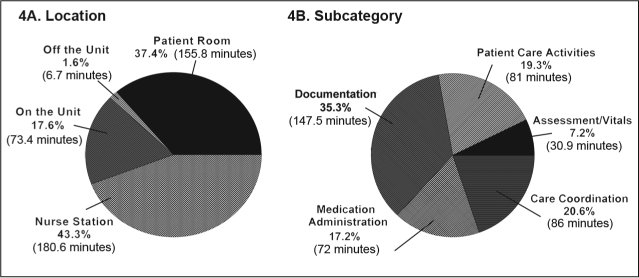
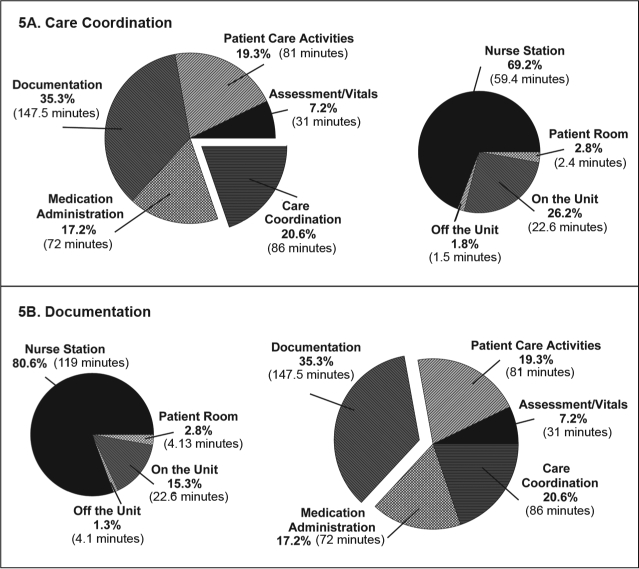
Results: A total of 767 nurses participated. More than three-quarters of all reported time was devoted to nursing practice. Three subcategories accounted for most of nursing practice time: documentation (35.3%; 147.5 minutes), medication administration (17.2%; 72 minutes), and care coordination (20.6%; 86 minutes). Patient care activities accounted for 19.3% (81 minutes) of nursing practice time, and only 7.2% (31 minutes) of nursing practice time was considered to be used for patient assessment and reading of vital signs.
Conclusion: The time and motion study identified three main targets for improving the efficiency of nursing care: documentation, medication administration, and care coordination. Changes in technology, work processes, and unit organization and design may allow for substantial improvements in the use of nurses' time and the safe delivery of care.
Figures



References
-
- Ulrich R, Quan X, Zimring C, Joseph A, Choudhary R.The role of the physical environment in the hospital of the 21st century: a once-in-a-lifetime opportunity [monograph on the Internet, about 69 pages] Concord, CA: The Center for Health Design; 2004. [cited 2008 Apr 21]. Available from: www.healthdesign.org/research/reports/pdfs/role_physical_env.pdf.
-
- Aiken LH, Clarke SP, Sloane DM, Sochalski J, Silber JH. Hospital nurse staffing and patient mortality, nurse burnout, and job dissatisfaction. JAMA. 2002 Oct 23;288(16):1987–93. - PubMed
-
- Needleman J, Buerhaus P, Mattke S, Stewart M, Zelevinsky K. Nurse-staffing levels and the quality of care in hospitals. N Engl J Med. 2002 May 30;346(22):1715–22. - PubMed
-
- Anderson S.Deadly consequences: the hidden impact of America's nursing shortage [monograph on the Internet] Arlington, VA: National Foundation for American Policy; 2007 Sep. [cited 2008 Apr 21]. Available from: www.nfap.com/pdf/0709deadlyconsequences.pdf.
LinkOut - more resources
Full Text Sources