


On the role of v-ATPase V0a1-dependent degradation in Alzheimer disease
- PMID: 21331254
- PMCID: PMC3038078
- DOI: 10.4161/cib.3.6.13364
On the role of v-ATPase V0a1-dependent degradation in Alzheimer disease
Abstract
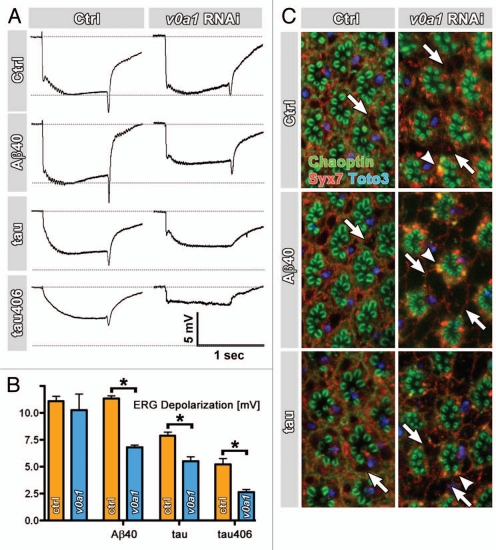
Defective autophagy and lysosomal degradation are hallmarks of numerous neurodegenerative disorders. Vesicular ATPases are intracellular proton pumps that acidify autophagosomes and lysosomes. V0a1 is a key component of the v-ATPase that is only required in neurons in Drosophila melanogaster. We have recently shown that loss of V0a1 in Drosophila photoreceptor neurons leads to slow, adult-onset degeneration.1 Concurrently, Lee et al.2 reported that V0a1 fails to localize to lysosomal compartments in cells from Presenilin 1 knock-out cells. Together these two reports suggest that a neuronal V0a1-dependent degradation mechanism may be causally linked to Alzheimer pathology. Indeed, we now show that loss of V0a1 makes Drosophila neurons more susceptible to insult with human Alzheimer-related neurotoxic Aβ and tau proteins. Furthermore, we discuss the potential significance of the discovery of the neuron-specific degradation mechanism in Drosophila for intracellular degradation defects in Alzheimer Disease.
Keywords: Alzheimer; Autophagy; Neurodegeneration; acidification; degradation; vesicular ATPase.
Figures
Comment on
-
A dual function of V0-ATPase a1 provides an endolysosomal degradation mechanism in Drosophila melanogaster photoreceptors.J Cell Biol. 2010 May 31;189(5):885-99. doi: 10.1083/jcb.201003062. J Cell Biol. 2010. PMID: 20513768 Free PMC article.
References
Grants and funding
LinkOut - more resources
Full Text Sources
Other Literature Sources
Molecular Biology Databases
