


Structural and functional regulation of growth cone, filopodia and synaptic sites by TRPV1
- PMID: 21331257
- PMCID: PMC3038081
- DOI: 10.4161/cib.3.6.13397
Structural and functional regulation of growth cone, filopodia and synaptic sites by TRPV1
Abstract
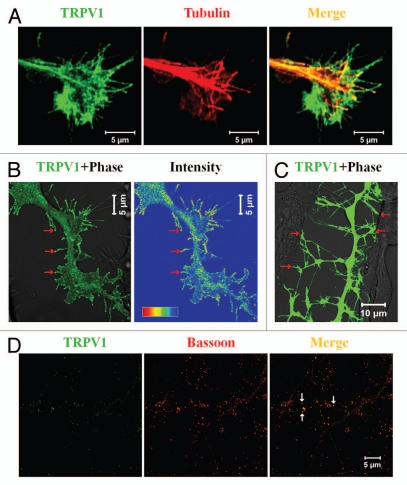
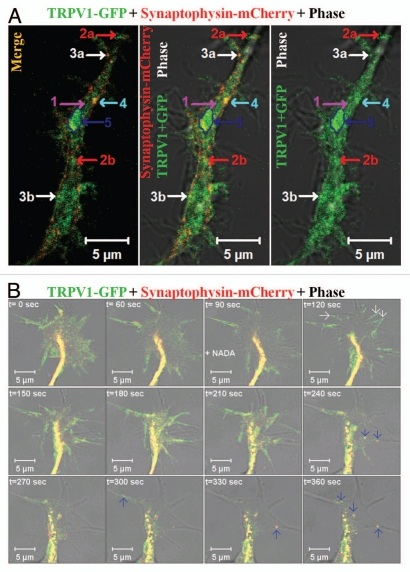
Specialized neuronal structures namely growth cones, filopodia and spines are important entities by which neurons communicate with each other, integrate multiple signaling events, consolidate interacting structures and exchange synaptic information. Recent studies confirmed that Transient Receptor Potential Vanilloid sub type 1 (TRPV1), alternatively known as capsaicin receptor, forms a signaling complex at the plasma membrane and integrate multiple exogenous and endogenous signaling cues there. This receptor localizes in the neuronal growth cones and also in filopodial tips. In addition, TRPV1 is endogenously present in synaptic structures and located both in pre- and post-synaptic spines of cortical neurons. Being nonselective Ca(2+)-channel, TRPV1 regulates the morphology and the functions of these structures by various mechanisms. Our studies indicated that physical interaction with signaling and structural molecules, modulation of different cytoskeleton, synaptic scaffolding structures and vesicle recycling by Ca(2+)-dependent and -independent events are the key mechanisms by which TRPV1 regulates growth cone, filopodia and spines in a coordinated manner. TRPV1 not only regulates the morphology, but also regulates the functions of these entities. Thus TRPV1 is important not only for the detection of noxious stimuli and transmission of pain signaling, but also are for the neuronal communications and network formation.
Keywords: NADA; TRPV1; cytoplasmic transport packet; filopodia; growth cone; microtubule; pain; synapse; synaptic vesicle; vesicle recycling.
Figures
Comment on
-
TRPV1 acts as a synaptic protein and regulates vesicle recycling.J Cell Sci. 2010 Jun 15;123(Pt 12):2045-57. doi: 10.1242/jcs.065144. Epub 2010 May 18. J Cell Sci. 2010. PMID: 20483957
References
-
- Caterina MJ, Schumacher MA, Tominaga M, Rosen TA, Levine JD, Julius D. The capsaicin receptor: a heat-activated ion channel in the pain pathway. Nature. 1997;389:816–824. - PubMed
-
- Tominaga M, Caterina MJ, Malmberg AB, Rosen TA, Gilbert H, Skinner K, et al. The cloned capsaicin receptor integrates multiple pain-producing stimuli. Neuron. 1998;21:531–543. - PubMed
-
- Szallasi A, Cortright DN, Blum CA, Eid SR. The vanilloid receptor TRPV1: 10 years from channel cloning to antagonist proof-of-concept. Nat Rev Drug Discov. 2007;6:357–372. - PubMed
-
- Cortright DN, Krause JE, Broom DC. TRP channels and pain. Biochim Biophys Acta. 2007;1772:978–988. - PubMed
-
- Suri A, Szallasi A. The emerging role of TRPV1 in diabetes and obesity. Trends Pharmacol Sci. 2008;29:29–36. - PubMed
LinkOut - more resources
Full Text Sources
Miscellaneous
