. 2010:2010:547179.
doi: 10.1155/2010/547179. Epub 2011 Feb 9.

Engagement of the mannose receptor by tumoral mucins activates an immune suppressive phenotype in human tumor-associated macrophages

Affiliations

Engagement of the mannose receptor by tumoral mucins activates an immune suppressive phenotype in human tumor-associated macrophages

P Allavena et al. Clin Dev Immunol. 2010.

Abstract

Tumor-Associated Macrophages (TAMs) are abundantly present in the stroma of solid tumors and modulate several important biological processes, such as neoangiogenesis, cancer cell proliferation and invasion, and suppression of adaptive immune responses. Myeloid C-type lectin receptors (CLRs) constitute a large family of transmembrane carbohydrate-binding receptors that recognize pathogens as well as endogenous glycoproteins. Several lines of evidence demonstrate that some CLRs can inhibit the immune response. In this study we investigated TAM-associated molecules potentially involved in their immune suppressive activity. We found that TAMs isolated from human ovarian carcinoma samples predominantly express the CLRs Dectin-1, MDL-1, MGL, DCIR, and most abundantly the Mannose Receptor (MR). Components of carcinomatous ascites and purified tumoral mucins (CA125 and TAG-72) bound the MR and induced its internalization. MR engagement by tumoral mucins and by an agonist anti-MR antibody modulated cytokine production by TAM toward an immune-suppressive profile: increase of IL-10, absence of IL-12, and decrease of the Th1-attracting chemokine CCL3. This study highlights that tumoral mucin-mediated ligation of the MR on infiltrating TAM may contribute to their immune suppressive phenotype.


Figures
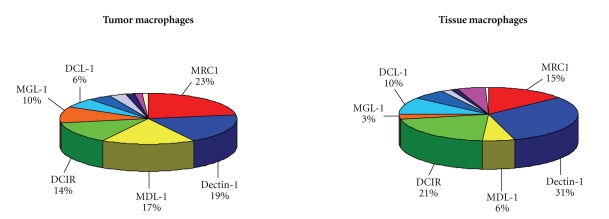
Figure 1
Figure 1
Schematic representation of the relative expression of the eleven CLRs shown in Table 1, in tumoral macrophages (TAM) from ovarian tumor samples and in nontumoral macrophages isolated from the peritoneal free-fluid of patients with benign diseases (ovarian cysts).
Figure 2
Figure 2
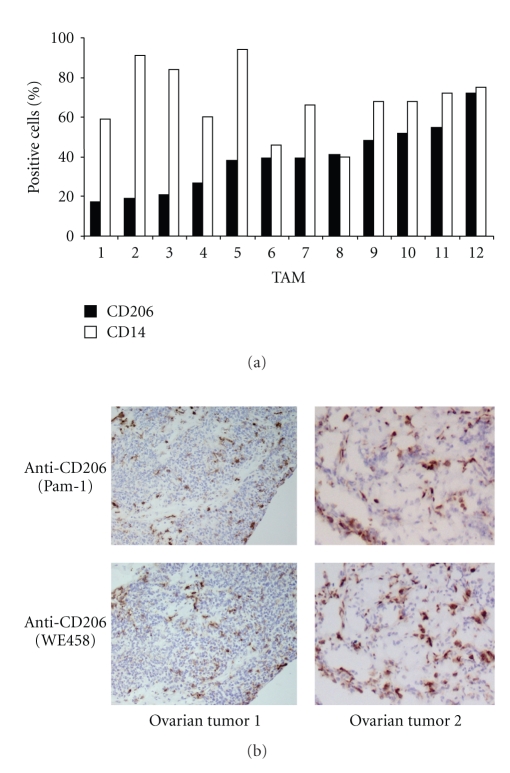
Expression of the Mannose Receptor (MR) by human TAM. (a) Flow cytometry analysis of purified preparations of TAM from carcinoumatous ascites of patients with ovarian cancer. TAMs were stained with anti-CD206 mAb (clone PAM-1) or with anti-CD14. Twelve different preparations were tested. (b) Immunohistochemistry of 2 tumor samples from ovarian cancer tissues stained with anti-CD206 mAbs (clone PAM-1, upper panels; clone WE458, lower panels). Positive cells are brown stained (magnification: left panels 40 x, right panels 100 x).
Figure 3
Figure 3
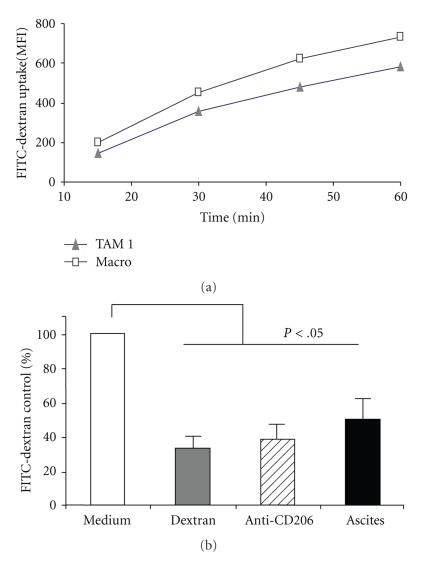
TAMs express a functional endocytic MR. (a) Endocytosis of FITC-Dextran by TAM (triangle) and by in vitro M-CSF-differentiated macrophages (square), evaluated as Mean Fluorescence Intensity (MFI) by flow cytometry. Shown is a representative experiment of 4 performed. (b) FITC-Dextran endocytosis in TAM is significantly inhibited (P < .05 Student's t tests) by pretreatment with MR-ligands: unconjugated Dextran (1 mg/mL), anti-CD206 mAb (10 ug/mL); and 33%v/v cell-free ascitic fluid from ovarian tumors. Results are expressed as % relative to values of FITC-Dextran uptake in control cells (medium) and are the mean +/− SD of 3 experiments with 3 different TAM preparations.
Figure 4
Figure 4
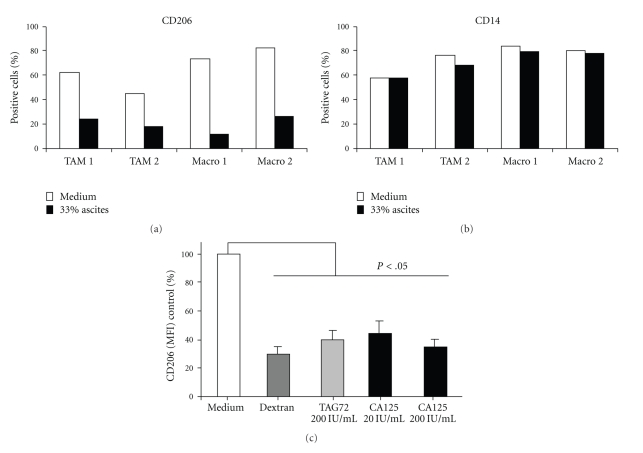
Tumoral mucins induce the internalization of the MR: flow cytometry expression of the MR/CD206 (a) and CD14 (b). Two different TAM preparations (TAM1 and TAM2) and 2 M-CSF-differentiated normal macrophages (Macro1 and Macro2) were pretreated (30 min. room temperature) with 33% v/v ascitic fluid from ovarian tumor patients, prior to staining with anti-CD206 or CD14 mAbs. Results are shown as % of positive cells. (c) Purified TAMs were pretreated with unconjugated Dextran (1 mg/mL); mucin Tag-72 (200 IU/mL); mucin CA125 (20–200 IU/mL) prior to staining with anti-CD206 mAb. Results are shown as % relative to values of Mean fluorescence Intensity (MFI) of CD206 in control cells (medium) and are the mean +/− SD of 4 experiments with 4 different TAM preparations (3 TAM preparations for CA125). P < .05 (Student's t-tests).
Figure 5
Figure 5
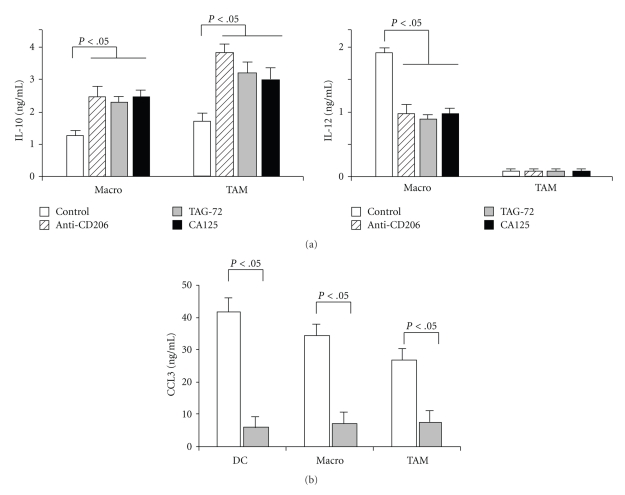
Modulation of cytokine production by tumoral mucin-engagement of the MR. (a) Purified TAM preparations or normal in vitro differentiated macrophages were pretreated (10 min. room temperature) with anti-CD206 (clone WE458, 2 ug/mL), TAG-72 (200 UI/mL), or CA125 (200 UI/mL) prior to stimulation with LPS (1 ug/mL, 24 hrs). Levels of IL-10 (upper panels) and IL-12 (lower panels) were measured in supernatants by ELISA. Results are mean +/− SE of 6 different TAM preparations for IL-10 and 3 for IL-12 (P < .05, Student's t-tests). (b) Purified TAM, normal in vitro differentiated macrophages, and mono-DC were pretreated (10 min. room temperature) with TAG-72 (200 UI/mL) prior to stimulation with LPS (1 ug/mL, 24 hrs). Levels of CCL3 were measured in supernatants by ELISA. Results are mean +/− SE of 4 different TAM preparations, 3 for macrophages, and mono-DC. P < .05 (Student's t-tests).

References

    1. Allavena P, Sica A, Garlanda C, Mantovani A. The Yin-Yang of tumor-associated macrophages in neoplastic progression and immune surveillance. Immunological Reviews. 2008;222(1):155–161. - PubMed
    1. Solinas G, Germano G, Mantovani A, Allavena P. Tumor-associated macrophages (TAM) as major players of the cancer-related inflammation. Journal of Leukocyte Biology. 2009;86(5):1065–1073. - PubMed
    1. Lewis CE, Pollard JW. Distinct role of macrophages in different tumor microenvironments. Cancer Research. 2006;66(2):605–612. - PubMed
    1. Galon J, Costes A, Sanchez-Cabo F, et al. Type, density, and location of immune cells within human colorectal tumors predict clinical outcome. Science. 2006;313(5795):1960–1964. - PubMed
    1. Laghi L, Bianchi P, Miranda E, et al. CD3+ cells at the invasive margin of deeply invading (pT3-T4) colorectal cancer and risk of post-surgical metastasis: a longitudinal study. The Lancet Oncology. 2009;10(9):877–884. - PubMed

Publication types

MeSH terms