


The pathogenesis of Alzheimer's disease: a reevaluation of the "amyloid cascade hypothesis"
- PMID: 21331369
- PMCID: PMC3038555
- DOI: 10.4061/2011/630865
The pathogenesis of Alzheimer's disease: a reevaluation of the "amyloid cascade hypothesis"
Abstract
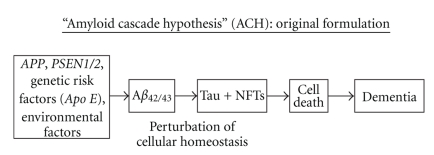
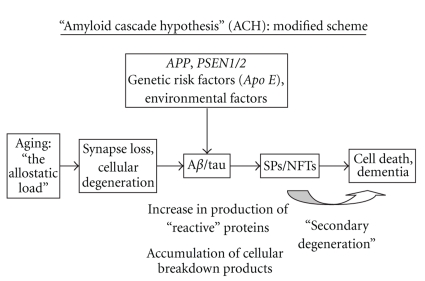
The most influential theory to explain the pathogenesis of Alzheimer's disease (AD) has been the "Amyloid Cascade Hypothesis" (ACH) first formulated in 1992. The ACH proposes that the deposition of β-amyloid (Aβ) is the initial pathological event in AD leading to the formation of senile plaques (SPs) and then to neurofibrillary tangles (NFTs) death of neurons, and ultimately dementia. This paper examines two questions regarding the ACH: (1) is there a relationship between the pathogenesis of SPs and NFTs, and (2) what is the relationship of these lesions to disease pathogenesis? These questions are examined in relation to studies of the morphology and molecular determinants of SPs and NFTs, the effects of gene mutation, degeneration induced by head injury, the effects of experimentally induced brain lesions, transgenic studies, and the degeneration of anatomical pathways. It was concluded that SPs and NFTs develop independently and may be the products rather than the causes of neurodegeneration in AD. A modification to the ACH is proposed which may better explain the pathogenesis of AD, especially of late-onset cases of the disease.
Figures
References
-
- Alzheimer A. On a peculiar disease of the cerebral cortex. Allgemeine Zeitschrift fur Psychiatrie und Psychish-Gerichtlich Medicin. 1907;64:146–148.
-
- Khachaturian ZS. Diagnosis of Alzheimer’s disease. Archives of Neurology. 1985;42(11):1097–1105. - PubMed
-
- Mirra SS, Heyman A, McKeel D, et al. The consortium to establish a registry for Alzheimer’s disease (CERAD). Part II. Standardization of the neuropathologic assessment of Alzheimer’s disease. Neurology. 1991;41(4):479–486. - PubMed
-
- Newell KL, Hyman BT, Growdon JH, Hedley-Whyte ET. Application of the National Institute on Aging (NIA)-Reagan Institute criteria for the neuropathological diagnosis of Alzheimer disease. Journal of Neuropathology and Experimental Neurology. 1999;58(11):1147–1155. - PubMed
-
- Graeber MB, Kösel S, Egensperger R, et al. Rediscovery of the case described by Alois Alzheimer in 1911: historical, histological and molecular genetic analysis. Neurogenetics. 1997;1(1):73–80. - PubMed
LinkOut - more resources
Full Text Sources
