


Randomized controlled trial on fluoride varnish application for treatment of white spot lesion after fixed orthodontic treatment
- PMID: 21331637
- PMCID: PMC5995463
- DOI: 10.1007/s00784-011-0520-4
Randomized controlled trial on fluoride varnish application for treatment of white spot lesion after fixed orthodontic treatment
Abstract
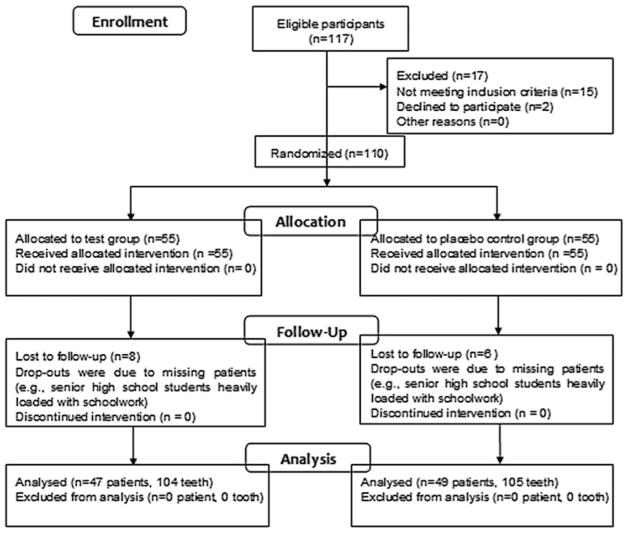
The purpose of this study was to determine the efficacy of fluoride varnish (5% sodium fluoride, Duraphat(®), Colgate) in reverting white spot lesions (WSLs) after fixed orthodontic treatment. This study was a randomized, parallel group, controlled clinical trial. Using saline solution as control, 110 participants (mean age ± standard deviation: 16.6 ± 3.2 years) ranging from 12 to 22 years old were randomly assigned to either the test group (group 1) or the control group (group 2). Application of fluoride varnish or saline was applied onto tooth surfaces with WSLs every month during the first 6 months after debonding. The labial (buccal) surfaces of the teeth were assessed by the use of a DIAGNOdent pen (DD) at the baseline, 3- and 6-month follow-up visits. After 6 months, 96 subjects with a total of 209 study teeth (47 subjects, 104 teeth in group 1; 49 subjects, 105 teeth in group 2) remained. The WSLs had a mean DD reading at baseline of 17.66 ± 5.36 in group 1 and 16.19 ± 5.70 in group 2, which decreased by 5.78 and 2.44, respectively, at the 3-month follow-up visit and decreased by 7.56 and 3.09, respectively, at the 6-month follow-up visit. The mean baseline DD readings in the two groups were similar (t test, P > 0.05). There was statistically significant differences between the mean DD readings of the two groups at the 3-month (P < 0.05) and at the 6-month follow-up visits (P < 0.01). Topical fluoride varnish application is effective in reversing WSLs after debonding and should be advocated as a routine caries prevention measure after orthodontic treatment.
Conflict of interest statement
Figures
Comment in
-
Fluoride varnish may improve white spot lesions.Evid Based Dent. 2011 Dec;12(4):104-5. doi: 10.1038/sj.ebd.6400823. Evid Based Dent. 2011. PMID: 22193651
References
-
- O’Reilly MM, Featherstone JDB. Decalcification and remineralization around orthodontic appliances: an in vivo study. Am J Orthod Dentofacial Orthop. 1985;92(1):33–40. - PubMed
-
- Gorelick L, Geiger AM, Gwinnett AJ. Incidence of white spot formation after bonding and banding. Am J Orthod. 1982;81:93–98. - PubMed
-
- Zachrisson BU. A posttreatment evaluation of direct bonding in orthodontics. Am J Orthod Dentofacial Orthop. 1977;71:173–189. - PubMed
-
- Summitt JB, Robbins JW, Schwartz RS. Fundamentals of operative dentistry: a contemporary approach. 3. Quintessence; Illinois: 2006. pp. 2–4.
-
- Samir E. White spot lesions: formation, prevention, and treatment. Semin Orthod. 2008;14:174–182.
Publication types
MeSH terms
Substances
Grants and funding
LinkOut - more resources
Full Text Sources
Medical
