


A comparative analysis of the NADPH thioredoxin reductase C-2-Cys peroxiredoxin system from plants and cyanobacteria
- PMID: 21335525
- PMCID: PMC3091103
- DOI: 10.1104/pp.110.171082
A comparative analysis of the NADPH thioredoxin reductase C-2-Cys peroxiredoxin system from plants and cyanobacteria
Abstract
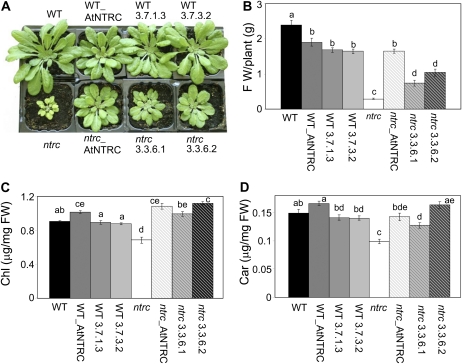
Redox regulation based on disulfide-dithiol conversion catalyzed by thioredoxins is an important component of chloroplast function. The reducing power is provided by ferredoxin reduced by the photosynthetic electron transport chain. In addition, chloroplasts are equipped with a peculiar NADPH-dependent thioredoxin reductase, termed NTRC, with a joint thioredoxin domain at the carboxyl terminus. Because NADPH can be produced by the oxidative pentose phosphate pathway during the night, NTRC is important to maintain the chloroplast redox homeostasis under light limitation. NTRC is exclusive for photosynthetic organisms such as plants, algae, and some, but not all, cyanobacteria. Phylogenetic analysis suggests that chloroplast NTRC originated from an ancestral cyanobacterial enzyme. While the biochemical properties of plant NTRC are well documented, little is known about the cyanobacterial enzyme. With the aim of comparing cyanobacterial and plant NTRCs, we have expressed the full-length enzyme from the cyanobacterium Anabaena species PCC 7120 as well as site-directed mutant variants and truncated polypeptides containing the NTR or the thioredoxin domains of the protein. Immunological and kinetic analysis showed a high similarity between NTRCs from plants and cyanobacteria. Both enzymes efficiently reduced 2-Cys peroxiredoxins from plants and from Anabaena but not from the cyanobacterium Synechocystis. Arabidopsis (Arabidopsis thaliana) NTRC knockout plants were transformed with the Anabaena NTRC gene. Despite a lower content of NTRC than in wild-type plants, the transgenic plants showed significant recovery of growth and pigmentation. Therefore, the Anabaena enzyme fulfills functions of the plant enzyme in vivo, further emphasizing the similarity between cyanobacterial and plant NTRCs.
Figures
References
-
- Baier M, Dietz K-J. (1997) The plant 2-Cys peroxiredoxin BAS1 is a nuclear-encoded chloroplast protein: its expressional regulation, phylogenetic origin, and implications for its specific physiological function in plants. Plant J 12: 179–190 - PubMed
-
- Bradford MM. (1976) A rapid and sensitive method for the quantitation of microgram quantities of protein utilizing the principle of protein-dye binding. Anal Biochem 72: 248–254 - PubMed
-
- Clough SJ, Bent AF. (1998) Floral dip: a simplified method for Agrobacterium-mediated transformation of Arabidopsis thaliana. Plant J 16: 735–743 - PubMed
Publication types
MeSH terms
Substances
LinkOut - more resources
Full Text Sources
Molecular Biology Databases
