. 2011 Apr 15;286(15):13669-80.
doi: 10.1074/jbc.M110.213728. Epub 2011 Feb 18.

The BRCA1-RAP80 complex regulates DNA repair mechanism utilization by restricting end resection

Affiliations

The BRCA1-RAP80 complex regulates DNA repair mechanism utilization by restricting end resection

Kara A Coleman et al. J Biol Chem. .

Abstract

The tumor suppressor protein BRCA1 is a constituent of several different protein complexes and is required for homology-directed repair (HDR) of DNA double strand breaks (DSBs). The most recently discovered BRCA1-RAP80 complex is recruited to ubiquitin structures on chromatin surrounding the break. Deficiency of any member of this complex confers hypersensitivity to DNA-damaging agents by undefined mechanisms. In striking contrast to other BRCA1-containing complexes that are known to promote HDR, we demonstrate that the BRCA1-RAP80 complex restricts end resection in S/G(2) phase of the cell cycle, thereby limiting HDR. RAP80 or BRCC36 deficiency resulted in elevated Mre11-CtIP-dependent 5' end resection with a concomitant increase in HDR mechanisms that rely on 3' single-stranded overhangs. We propose a model in which the BRCA1-RAP80 complex limits nuclease accessibility to DSBs, thus preventing excessive end resection and potentially deleterious homology-directed DSB repair mechanisms that can impair genome integrity.


Figures
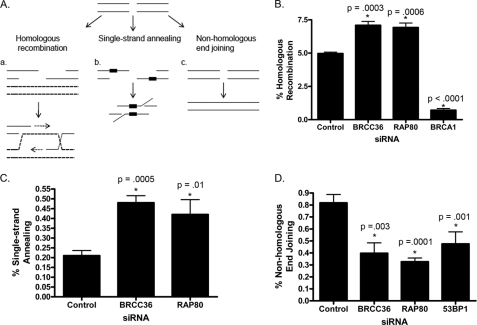
FIGURE 1.
FIGURE 1.
RAP80 and BRCC36 affect DSB repair pathway utilization. A, double strand breaks can be repaired by homologous recombination (a), single-strand annealing (b), or non-homologous end joining (c). Homologous recombination and single strand annealing involve 5′–3′ resection of the break and use of homologous sequences (heavy dashed lines) for repair, whereas non-homologous end joining does not. B, increased HR utilization in cells deficient for either RAP80 or BRCC36. Cells were treated with the indicated siRNAs and 72 h later were assayed for HR using a DR-GFP reporter cell line. Error bars, S.E. of three independent experiments. p values were calculated in comparison with control siRNA-treated cells. C, increase in SSA utilization in cells deficient for RAP80 or BRCC36. Cells were treated with the indicated siRNAs and assayed for SSA using flow cytometry. Data are representative of three independent experiments. Error bars, S.D. of replicates in one experiment. See supplemental Fig. S1D for an independent replicate experiment. p values were calculated in comparison with control siRNA-treated cells. D, decreased NHEJ utilization in cells deficient for either RAP80 or BRCC36. Cells were treated with the indicated siRNAs and assayed for NHEJ 72 h later. Data are representative of three independent experiments. Error bars, S.D. of replicates in one experiment. See supplemental Fig. S1E for an independent replicate experiment. p values were calculated in comparison with control siRNA-treated cells.
FIGURE 2.
FIGURE 2.
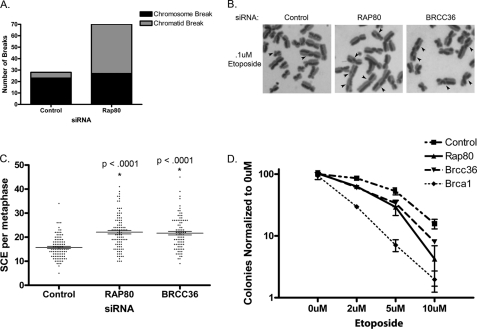
Genomic instability and sister chromatid exchange in cells with BRCA1-RAP80 deficiency. A, metaphases were collected from cells treated with RAP80 siRNA and analyzed for chromosome and chromatid breaks. Cells treated with RAP80 siRNA show an increase in chromatid breaks. Data are representative of three independent experiments. See supplemental Fig. S2C for an independent replicate experiment. B, representative images of SCE following knockdown of RAP80 or BRCC36 and subsequent etoposide treatment. C, quantification of images as in B. Cells treated with RAP80 or BRCC36 siRNA show a significant increase in etoposide-induced SCE formation. Error bars, S.E. from three independent experiments. p values were calculated in comparison with control siRNA-treated cells. D, clonogenic survival assay of cells treated with the indicated siRNAs after exposure to different doses of etoposide. Error bars, S.D. See supplemental Fig. S2F for an independent replicate experiment.
FIGURE 3.
FIGURE 3.
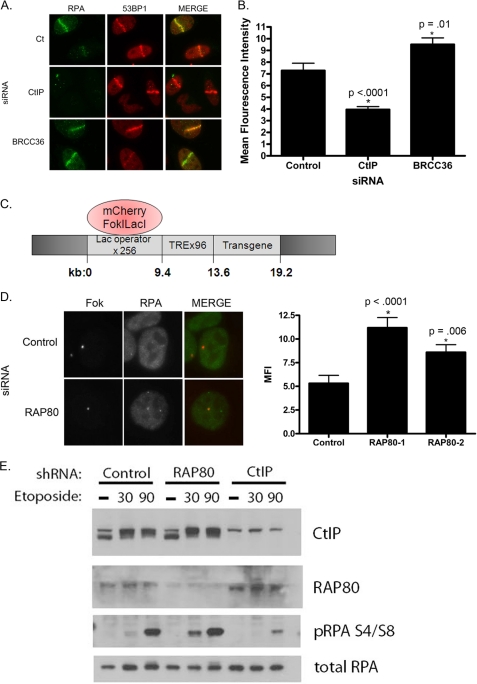
Increased end resection in cells with loss of RAP80 or BRCC36. A, cells were treated with the indicated siRNAs, and IF was performed for the indicated proteins 30 min after laser microirradiation. B, quantification of RPA mean fluorescence intensity from images as in A using ImageJ software. Loss of BRCC36 resulted in an increase in RPA fluorescence at breaks. Error bars, S.E. from three independent experiments. p values were calculated in comparison with control siRNA-treated cells. C, schematic of U2OS reporter containing Lac operator repeats and a downstream transgene. Expression of a mCherryFokILacI results in binding of lacI to the operator where the FokI endonuclease creates double strand breaks. D, U2OS reporter cells were treated with control or RAP80 siRNA 24 h prior to transduction with FokI. RPA accumulation was analyzed at the locus by immunofluorescence ∼60 h after siRNA transfection. RPA intensity from these experiments was quantified using ImageJ. Error bars, S.E. from three independent experiments. p values were calculated in comparison with control siRNA-treated cells. E, HeLa cells containing control, RAP80, or CtIP shRNA were untreated (−) or treated with 100 μm etoposide for 30 or 90 min. Nuclear extracts were analyzed for pRPA formation by immunoblot. Cells expressing the RAP80 shRNA show an increase in pRPA in comparison with controls, which is most prominent at the 30 min time point.
FIGURE 4.
FIGURE 4.
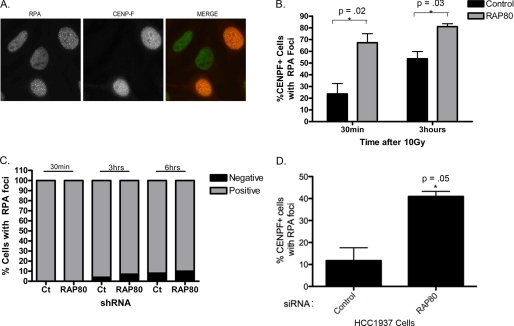
Loss of RAP80 causes an increase in DSB resection in S/G2 phase of the cell cycle. A, cells were irradiated with 10 grays and fixed after 3 h. Cells were stained for RPA and CENPF to demonstrate CENPF cell cycle specificity. B, cells stably expressing hairpins to luciferase or RAP80 were irradiated and stained for RPA and CENPF 30 min and 3 h later. Cells treated with RAP80 shRNA showed an increase in RPA focus formation in CENPF (S/G2)-positive cells. Error bars, S.E. of three independent experiments. p values were calculated in comparison with control siRNA-treated cells. C, cells expressing the indicated shRNAs were irradiated and subsequently fixed at 30 min, 3 h, or 6 h after DNA damage. Cells were stained for RPA and CENPF. Cells containing RPA foci were scored for CENPF positivity. D, HCC1937 cells, expressing a truncated BRCA1 protein that does not interact with RAP80 or accumulate at DSBs, were treated with control or RAP80 siRNA and analyzed for RPA focus formation after ionizing radiation. Loss of RAP80 resulted in an increase in RPA focus formation in BRCA1-mutated cells. Error bars, S.E. from two independent experiments. p values were calculated in comparison with control siRNA-treated cells.
FIGURE 5.
FIGURE 5.
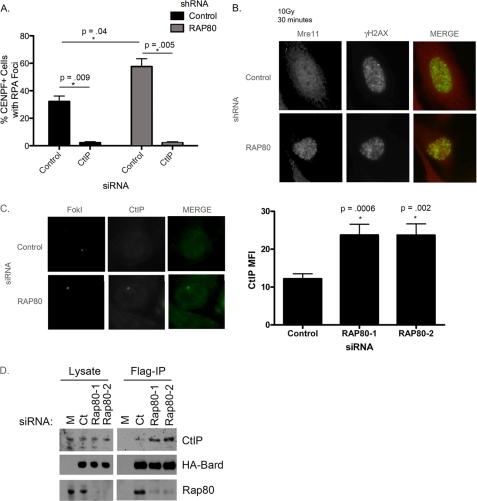
Loss of RAP80 results in increased accumulation of Mre11- and CtIP-dependent nuclease activity at breaks. A, cells expressing control or RAP80 shRNA were treated with control or CtIP siRNA, analyzed for RPA focus formation in CENPF-positive cells. CtIP is necessary for the increase in RPA focus formation observed following RAP80 knockdown. Error bars, S.E. of two independent experiments. p values were calculated in comparison with control siRNA-treated cells. B, cells expressing control or RAP80 shRNA were irradiated, fixed after 30 min, and evaluated for Mre11 focus formation following IF. Cells treated with RAP80 knockdown showed an increase in Mre11 focus formation. C, U2OS reporter cells were treated with control or RAP80 siRNA, transduced with FokI, and analyzed for CtIP recruitment to FokI-induced DSBs. Loss of RAP80 led to an increase in CtIP accumulation at damage sites, quantified on the right. Error bars, S.E. of two independent experiments. D, S3 cells expressing FLAG- and HA-tagged BARD1 were transfected with control or RAP80 siRNA. Cell lysates were subjected to FLAG immunoprecipitation (IP) and immunoblotted for CtIP to analyze the BRCA1-CtIP interaction. Loss of RAP80 resulted in increased BRCA1-CtIP complex formation.
FIGURE 6.
FIGURE 6.
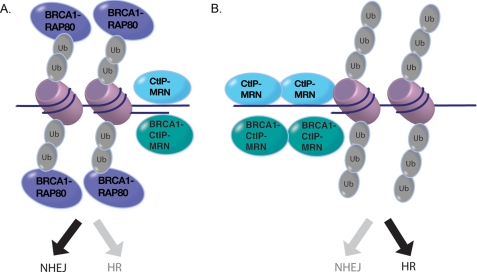
A, the BRCA1-RAP80 complex is recruited to Lys63-linked ubiquitin chains on chromatin surrounding DSBs. Occupancy of BRCA1-RAP80 at DSB chromatin prevents excessive recruitment of the MRN and CtIP nucleases and formation of the BRCA1-CtIP-MRN complex, thereby limiting end resection and maintaining an appropriate balance between HR DSB repair and NHEJ in S and G2 cell cycle phases. B, BRCA1-RAP80 complex deficiency enables increased access of MRN and CtIP nucleases to chromatin surrounding the DSB. Additionally, in the absence of RAP80, there is a compensatory increase in BRCA1-CtIP-MRN complex formation that may have a minor contribution to excessive end resection. Increased accumulation of MRN and CtIP leads to excessive end resection, with commensurate increases in single-stranded DNA, to favor utilization of HR at the expense of NHEJ in S and G2 cell cycle phases.

References

    1. Rahman N., Stratton M. R. (1998) Annu. Rev. Genet. 32, 95–121 - PubMed
    1. Scully R., Ganesan S., Vlasakova K., Chen J., Socolovsky M., Livingston D. M. (1999) Mol. Cell. 4, 1093–1099 - PubMed
    1. Stratton M. R., Rahman N. (2008) Nat. Genet. 40, 17–22 - PubMed
    1. Venkitaraman A. R. (2002) Cell 108, 171–182 - PubMed
    1. Karran P. (2000) Curr. Opin. Genet. Dev. 10, 144–150 - PubMed

Publication types

MeSH terms

LinkOut - more resources