


Comparison of CKD awareness in a screening population using the Modification of Diet in Renal Disease (MDRD) study and CKD Epidemiology Collaboration (CKD-EPI) equations
- PMID: 21338846
- PMCID: PMC3075598
- DOI: 10.1053/j.ajkd.2010.11.008
Comparison of CKD awareness in a screening population using the Modification of Diet in Renal Disease (MDRD) study and CKD Epidemiology Collaboration (CKD-EPI) equations
Abstract
Background: Low awareness of chronic kidney disease (CKD) may reflect uncertainty about the accuracy or significance of a CKD diagnosis in individuals otherwise perceived to be low risk. Whether reclassification of CKD severity using the CKD Epidemiology Collaboration (CKD-EPI) equation to estimate glomerular filtration rate (GFR) modifies estimates of CKD awareness is unknown.
Methods: In this cross-sectional study, we used data collected from 2000-2009 for 26,213 participants in the Kidney Early Evaluation Program (KEEP), a community-based screening program, with CKD based on GFR estimated using the 4-variable Modification of Diet in Renal Disease (MDRD) Study equation and measurement of albuminuria. We assessed CKD awareness after CKD stage was reclassified using the CKD-EPI equation.
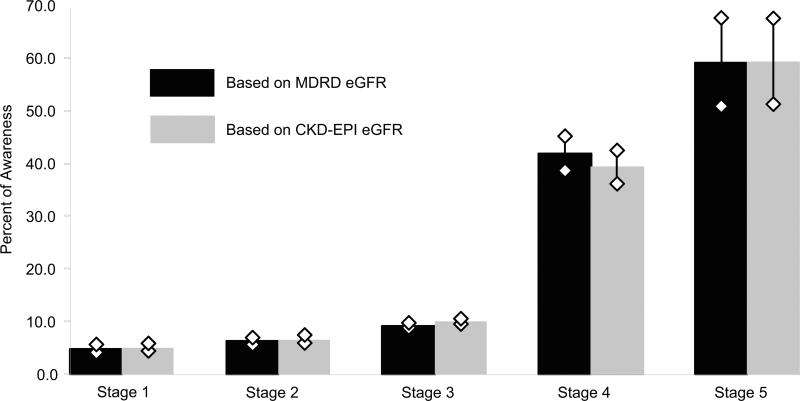
Results: Of 26,213 participants with CKD based on GFR estimated using the MRDR equation (eGFR(MDRD)), 23,572 (90%) also were classified with CKD based on eGFR(CKD-EPI). Based on eGFR(MDRD), 9.5% of participants overall were aware of CKD, as were 4.9%, 6.3%, 9.2%, 41.9%, and 59.2% with stages 1-5, respectively. Based on eGFR(CKD-EPI), 10.0% of participants overall were aware of CKD, as were 5.1%, 6.6%, 10.0%, 39.3%, and 59.4% with stages 1-5, respectively. Reclassification to a less advanced CKD stage using eGFR(CKD-EPI) was associated with lower odds for awareness (OR, 0.58; 95% CI, 0.50-0.67); reclassification to a more advanced stage was associated with higher odds for awareness (OR, 1.50; 95% CI, 1.05-2.13) after adjustment for confounding factors. Of participants unaware of CKD, 10.6% were reclassified as not having CKD using eGFR(CKD-EPI).
Conclusions: Using eGFR(CKD-EPI) led to a modest increase in overall awareness rates, primarily due to reclassification of low-risk unaware participants.
Keywords: CKD-EPI; awareness; chronic kidney disease; estimated glomerular filtration rate.
Copyright © 2011 National Kidney Foundation, Inc. Published by Elsevier Inc. All rights reserved.
Figures
References
-
- Coresh J, Selvin E, Stevens LA, et al. Prevalence of chronic kidney disease in the United States. JAMA. 2007;298:2038–2047. - PubMed
-
- Go AS, Chertow GM, Fan D, McCulloch CE, Hsu CY. Chronic kidney disease and the risks of death, cardiovascular events, and hospitalization. N Engl J Med. 2004;351:1296–1305. - PubMed
-
- Glassock RJ. Referrals for chronic kidney disease: real problem or nuisance? JAMA. 2010;303:1201–1203. - PubMed
-
- Hemmelgarn BR, Manns BJ, Lloyd A, et al. Relation between kidney function, proteinuria, and adverse outcomes. JAMA. 2010;303:423–429. - PubMed
Publication types
MeSH terms
Grants and funding
LinkOut - more resources
Full Text Sources
Medical
Research Materials
Miscellaneous
