


Who is the best player ever? A complex network analysis of the history of professional tennis
- PMID: 21339809
- PMCID: PMC3037277
- DOI: 10.1371/journal.pone.0017249
Who is the best player ever? A complex network analysis of the history of professional tennis
Abstract
We considered all matches played by professional tennis players between 1968 and 2010, and, on the basis of this data set, constructed a directed and weighted network of contacts. The resulting graph showed complex features, typical of many real networked systems studied in literature. We developed a diffusion algorithm and applied it to the tennis contact network in order to rank professional players. Jimmy Connors was identified as the best player in the history of tennis according to our ranking procedure. We performed a complete analysis by determining the best players on specific playing surfaces as well as the best ones in each of the years covered by the data set. The results of our technique were compared to those of two other well established methods. In general, we observed that our ranking method performed better: it had a higher predictive power and did not require the arbitrary introduction of external criteria for the correct assessment of the quality of players. The present work provides novel evidence of the utility of tools and methods of network theory in real applications.
Conflict of interest statement
Figures
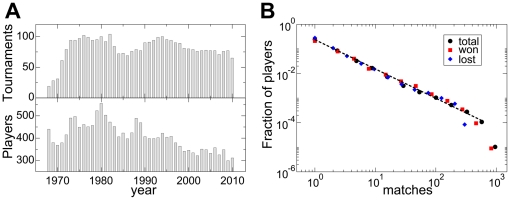
 .
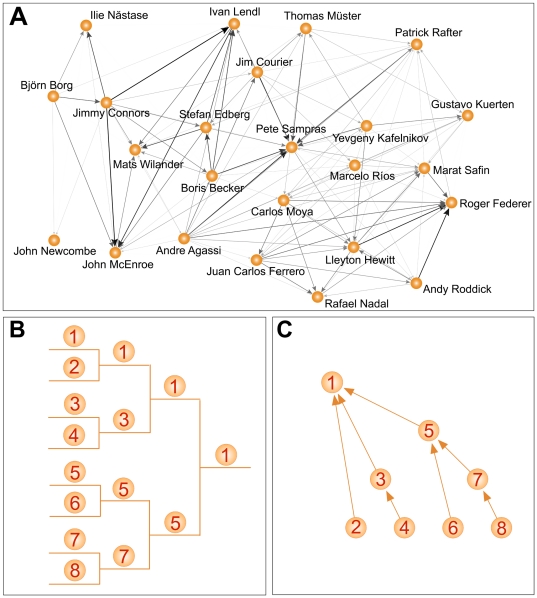
.
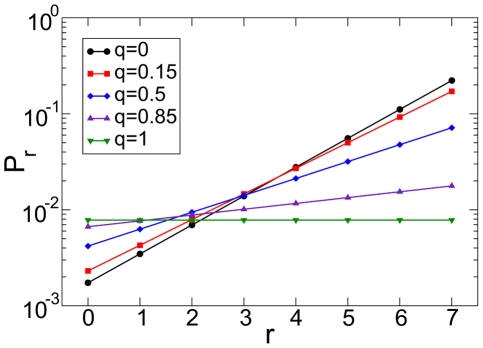
 as a function of the number of victories
  in a tournament with
  rounds (Grand Slam). Black circles are obtained from Eqs. (7) and valid for
  . All other values of
  have been calculated from Eqs. (6): red squares stand for
  , blue diamonds for
  , violet up-triangles for
  and green down-triangles for
  .
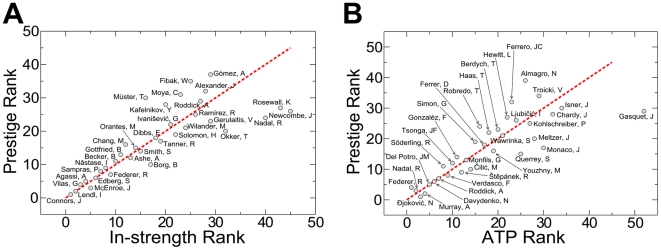
.
References
Publication types
MeSH terms
LinkOut - more resources
Full Text Sources
