


Secondary attack rate of tuberculosis in urban households in Kampala, Uganda
- PMID: 21339819
- PMCID: PMC3038854
- DOI: 10.1371/journal.pone.0016137
Secondary attack rate of tuberculosis in urban households in Kampala, Uganda
Abstract
Background: Tuberculosis is an ancient disease that continues to threaten individual and public health today, especially in sub-Saharan Africa. Current surveillance systems describe general risk of tuberculosis in a population but do not characterize the risk to an individual following exposure to an infectious case.
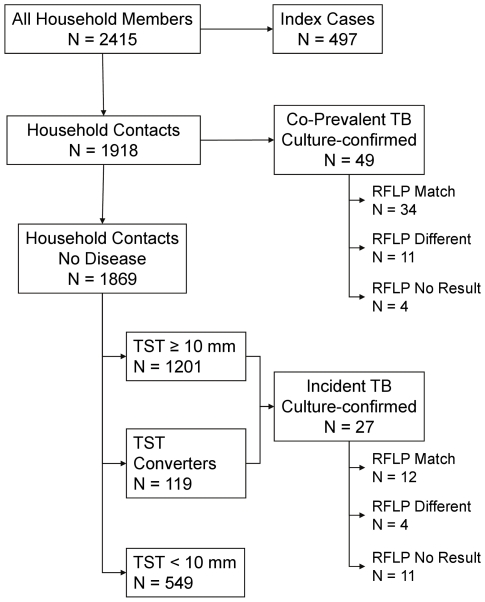
Methods: In a study of household contacts of infectious tuberculosis cases (n = 1918) and a community survey of tuberculosis infection (N = 1179) in Kampala, Uganda, we estimated the secondary attack rate for tuberculosis disease and tuberculosis infection. The ratio of these rates is the likelihood of progressive primary disease after recent household infection.
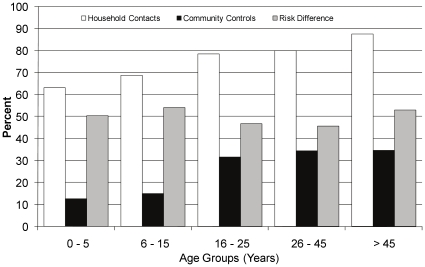
Results: The secondary attack rate for tuberculosis disease was 3.0% (95% confidence interval: 2.2, 3.8). The overall secondary attack rate for tuberculosis infection was 47.4 (95% confidence interval: 44.3, 50.6) and did not vary widely with age, HIV status or BCG vaccination. The risk for progressive primary disease was highest among the young or HIV infected and was reduced by BCG vaccination.
Conclusions: Early case detection and treatment may limit household transmission of M. tuberculosis. Household members at high risk for disease should be protected through vaccination or treatment of latent tuberculosis infection.
Conflict of interest statement
Figures
References
-
- Halloran ME. Concepts of Transmission and Dynamics. In: Thomas JC, Weber DJ, editors. Epidemiologic Methods for the Study of Infectious Diseases. New York: Oxford University Press; 2001. pp. 56–85.
-
- Ferebee SH, Mount FW. Tuberculosis morbidity in a controlled trial of the prophylactic use of isoniazid among household contacts. Am Rev Respir Dis. 1962;85:490–521. - PubMed
-
- Grzybowski S, Barnet GD, Styblo K. Contacts of cases of active pulmonary tuberculosis. Bull Int Union Tuber. 1975;50:90–106. - PubMed
-
- Fine PEM, Clarkson JA, Miller E. The efficacy of pertussis vaccines under conditions of household exposure. Int J Epidemiol. 1988;17:635–642. - PubMed
Publication types
MeSH terms
Grants and funding
LinkOut - more resources
Full Text Sources
Medical
