. 2010 Oct 1;2(5):529-545.
doi: 10.2217/iim.10.49.

Image reconstruction for PET/CT scanners: past achievements and future challenges

Affiliations

Image reconstruction for PET/CT scanners: past achievements and future challenges

Shan Tong et al. Imaging Med. .

Abstract

PET is a medical imaging modality with proven clinical value for disease diagnosis and treatment monitoring. The integration of PET and CT on modern scanners provides a synergy of the two imaging modalities. Through different mathematical algorithms, PET data can be reconstructed into the spatial distribution of the injected radiotracer. With dynamic imaging, kinetic parameters of specific biological processes can also be determined. Numerous efforts have been devoted to the development of PET image reconstruction methods over the last four decades, encompassing analytic and iterative reconstruction methods. This article provides an overview of the commonly used methods. Current challenges in PET image reconstruction include more accurate quantitation, TOF imaging, system modeling, motion correction and dynamic reconstruction. Advances in these aspects could enhance the use of PET/CT imaging in patient care and in clinical research studies of pathophysiology and therapeutic interventions.


Figures
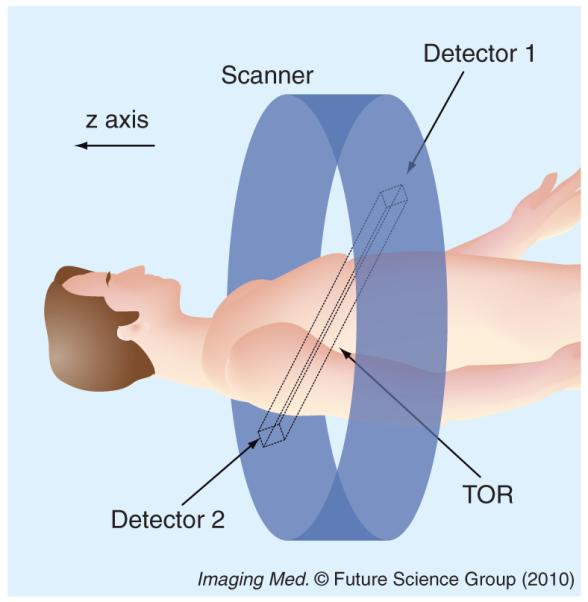
Figure 1
Figure 1. Tube of response between two detectors
TOR: Tube of response.
Figure 2
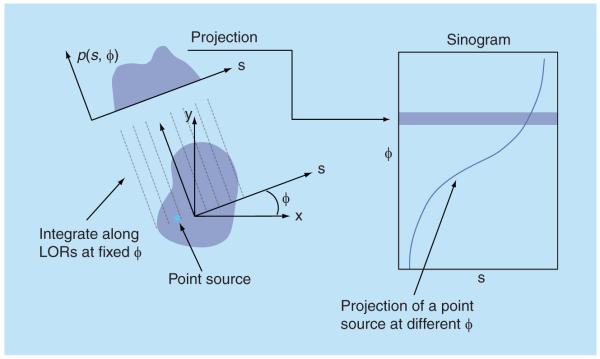
Figure 2. Sinogram data representation
A projection is formed through integration of the radiotracer distribution in the object along all LOR at the same angle. One projection fills one row in the sinogram. A point source traces a sine wave in the projection space. LOR: Lines of response.
Figure 3
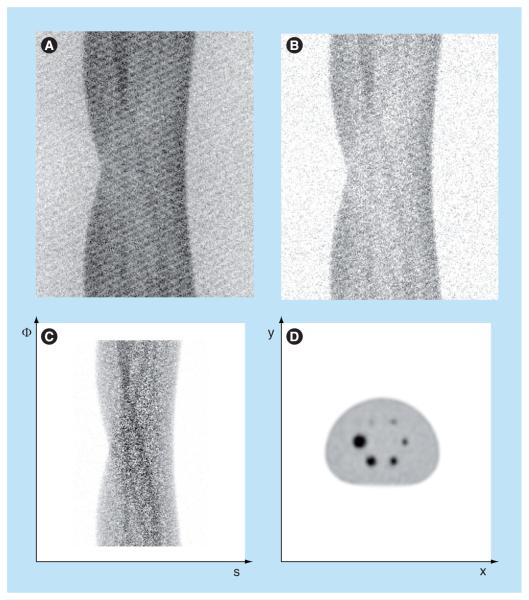
Figure 3. Sinogram example of an image quality phantom
(A) One oblique plane of 3D sinogram without corrections. (B) Sinogram after scatter and random event corrections. (C) Sinogram after scatter and random corrections, attenuation correction, normalization and deadtime correction. The window level in (C) is 10-times the window level in (A) and (B). (D) One transaxial slice of the image volume reconstructed from the sinogram.
Figure 4
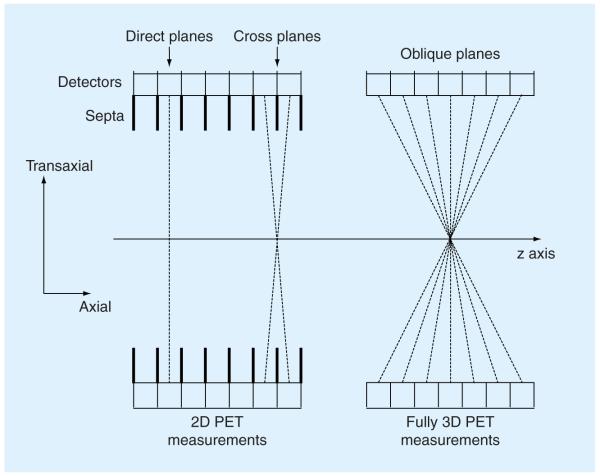
Figure 4. Axial section through a multiring PET scanner showing 2D and 3D acquisitions
In 2D mode, the scanner collects data from direct and cross planes. In 3D mode, the scanner collects data from all oblique planes.
Figure 5
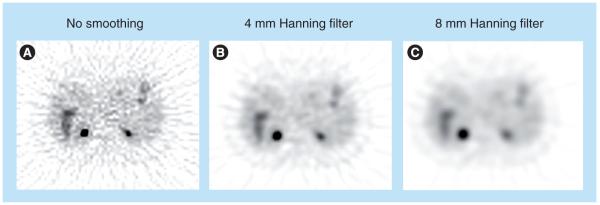
Figure 5. Comparison of filtered backprojection reconstruction of identical patient data with different noise control levels
No smoothing (A), a 4 mm Hanning filer (B) and a 8 mm Hanning filter (C). A broader Hanning filter in spatial domain (or equivalently a lower cutoff frequency in Fourier domain) leads to smoother images.
Figure 6
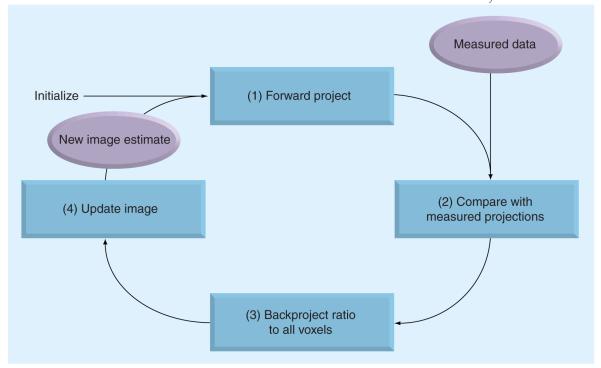
Figure 6. Flow diagram of maximum-likelihood expectation-maximization algorithm
Starting from the initialization in the upper left, the algorithm iteratively updates the image estimate and is stopped after reaching a preselected iteration.
Figure 7
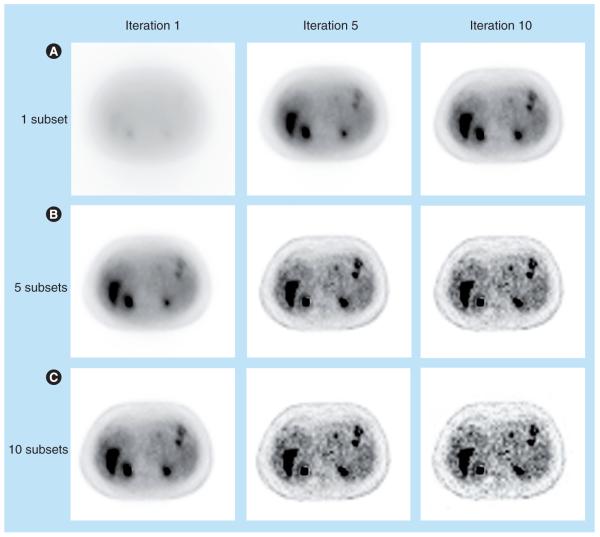
Figure 7. Ordered subsets expectation-maximization reconstruction of patient data for different iterations and number of subsets
(A) Ordered subsets expectation-maximization reconstruction with one subset, which is equivalent to the maximum-likelihood expectation-maximization algorithm; (B) ordered subsets expectation-maximization with five subsets; (C) ordered subsets expectation-maximization with ten subsets.
Figure 8
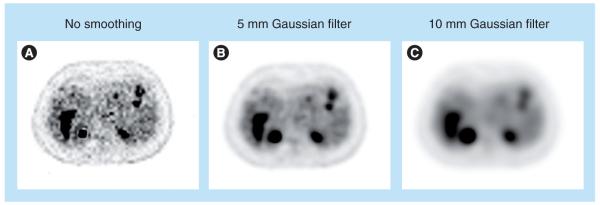
Figure 8. Comparison of ordered subsets expectation-maximization reconstruction of patient data with different smoothing parameters (iteration ten, with ten subsets)
No smoothing (A), a 5 mm Gaussian filter (B) and a 10 mm Gaussian filter are shown. Smoother, but more blurred images are obtained with increasing the amount of postfiltering (A–C).
Figure 9
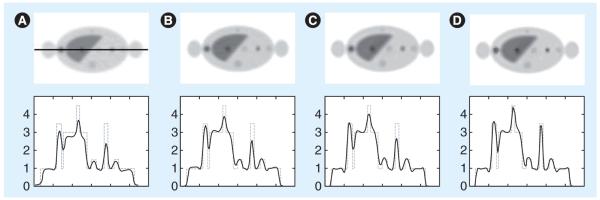
Figure 9. Transaxial slice from simulation of a PET image of the torso
The second row plots the horizontal profile through the slice with a solid line. Images reconstructed with (A) filtered backprojection, (B) conventional penalized weighted least square, (C) penalized weighted least square with improved system model and (D) penalized weighted least square with improved system model and anatomical prior. Reproduced from [73].
Figure 10
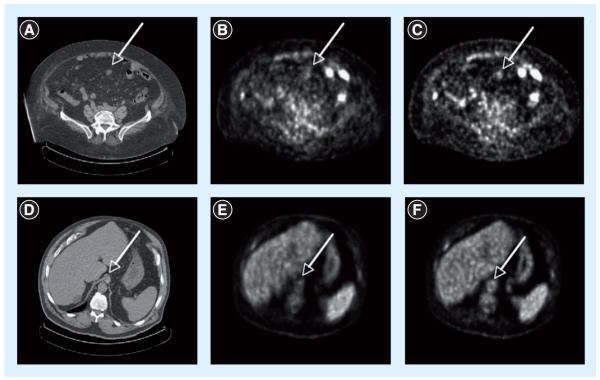
Figure 10. Representative transverse sections of two different patients
(A–C) Patient with colon cancer (119 kg, BMI = 46.5) shows a lesion (arrows) in abdomen seen in CT much more clearly in the TOF image than non-TOF image. (D–F) Patient with abdominal cancer (115 kg, BMI = 38) shows structure in the aorta (arrows) seen in CT much more clearly in the TOF image than in non-TOF image. Low dose CT (A & D), non-TOF PET with maximum-likelihood expectation-maximization reconstruction (B & E), and TOF PET with maximum-likelihood expectation-maximization reconstruction (C & F). Reprinted with permission from [83].
Figure 11
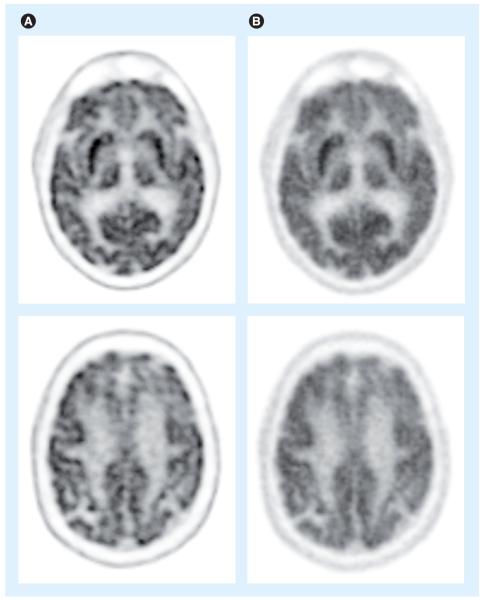
Figure 11. Two transaxial slices from a patient brain [18F] fluorodeoxyglucose study
(A) Reconstruction using point-spread function modeling and scanner line-of-response modeling. (B) Reconstruction with scanner line-of-response modeling and a 3 mm Gaussian postfilter. Images in (A) and (B) have matched pixel-to-pixel variability in central white matter. Point-spread function-based reconstruction can resolve the features more clearly.
Figure 12
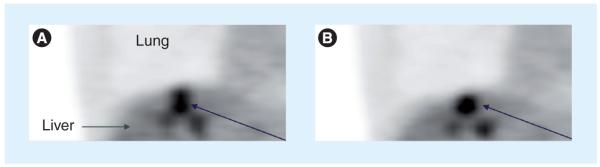
Figure 12. Liver lesion images from a whole-body FDG study
(A) Respiratory motion causes blurring of lesion (arrows) in the reconstructed image. (B) Respiratory motion correction reduces the blurring.

References

    1. Bailey D, Townsend D, Valk PE, et al. Positron Emission Tomography: Basic Sciences. Springer; London, UK: 2005.
    1. Phelps ME. PET: Molecular Imaging and Its Biological Applications. Springer; London, UK: 2004.
    1. Weber WA, Figlin R. Monitoring cancer treatment with PET/CT: does it make a difference? J. Nucl. Med. 2007;48(1):36S–44S. - PubMed
    1. Weber WA. Use of PET for monitoring cancer therapy and for predicting outcome. J. Nucl. Med. 2005;46(6):983–995. - PubMed
    1. Sorenson JA, Phelps ME. Physics in Nuclear Medicine. Grune & Stratton; FL, USA: 1987.

LinkOut - more resources