


Impact of exposure to interferon beta-1a on outcomes in patients with relapsing-remitting multiple sclerosis: exploratory analyses from the PRISMS long-term follow-up study
- PMID: 21339904
- PMCID: PMC3036958
- DOI: 10.1177/1756285610391693
Impact of exposure to interferon beta-1a on outcomes in patients with relapsing-remitting multiple sclerosis: exploratory analyses from the PRISMS long-term follow-up study
Abstract
Objective: To explore the effects of exposure to subcutaneous (sc) interferon (IFN) beta-1a on efficacy in patients with relapsing-remitting multiple sclerosis (RRMS) enrolled in the PRISMS (Prevention of Relapses and disability by Interferon beta-1a Subcutaneously in Multiple Sclerosis) study.
Methods: Patients with RRMS received IFN beta-1a, 44 or 22 µg sc three times weekly (tiw), or placebo, for 2 years, at which point placebo recipients were re-randomized to IFN beta-1a, 44 or 22 µg sc tiw, for a further 2-4 years. Long-term follow-up visits occurred 7-8 years after enrolment and allowed participation of patients who had previously discontinued treatment. Post hoc descriptive analyses were conducted within the lower (MIN) and upper (MAX) quartiles of patients divided according to cumulative dose of IFN beta-1a and cumulative time on treatment. Outcomes were explored in patients initially randomized to IFN beta-1a, 44 µg sc tiw, who had received continuous or noncontinuous therapy during the study.
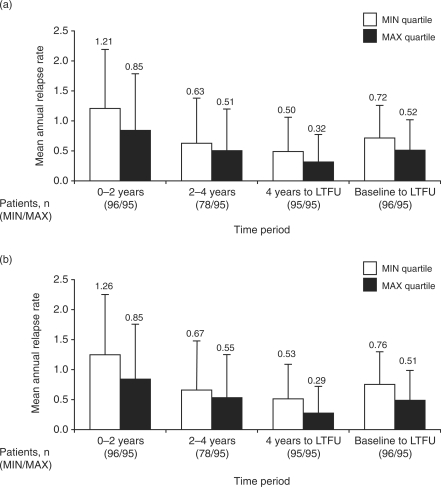
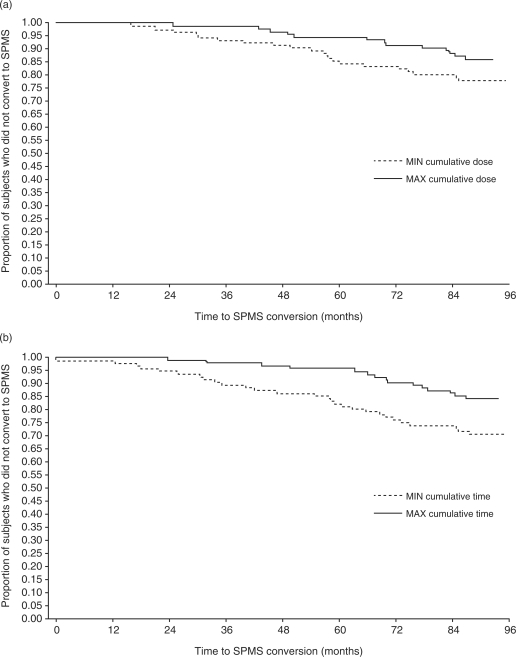
Results: For both cumulative dose and time analyses, the MIN and MAX groups comprised 96 and 95 patients, respectively. The continuous and noncontinuous groups included 45 and 91 patients, respectively. The MAX DOSE and MAX TIME groups had lower annualized relapse rates, lower rates of conversion to secondary progressive MS, lower percentages of patients with Expanded Disability Status Scale progression, higher percentages of relapse-free patients, and less T2 burden of disease than the MIN groups. The continuous therapy group had a lower annualized relapse rate and lower percentages of patients with Expanded Disability Status Scale progression or conversion to secondary progressive MS than the noncontinuous therapy group.
Conclusions: The findings of these post hoc analyses suggest that high exposure to sc IFN beta-1a may be associated with better clinical outcomes than low exposure, and also highlight the importance of maximizing adherence. Additional prospective investigation is warranted to evaluate further the effects of treatment exposure on outcomes and to determine the benefits of interventions to improve adherence.
Keywords: PRISMS; adherence; interferon beta-1a; long-term follow up; relapsing–remitting multiple sclerosis.
Figures
References
-
- Al-Sabbagh A., Bennet R., Kozma C., Dickson M., Meletiche D. (2008) Medication gaps in disease-modifying therapy for multiple sclerosis are associated with an increased risk of relapse: findings from a national managed care database. J Neurol 255(Suppl. 2): S79–S79
-
- Bermel R.A., Weinstock-Guttman B., Bourdette D., Foulds P., You X., Rudick R.A. (2010) Intramuscular interferon beta-1a therapy in patients with relapsing–remitting multiple sclerosis: a 15-year follow-up study. Mult Scler 16: 588–596 - PubMed
-
- Durelli L., Clerico M. (2005) The importance of maintaining effective therapy in multiple sclerosis. J Neurol 252(Suppl. 3): iii38–iii43 - PubMed
-
- Ebers G.C., Traboulsee A., Li D., Langdon D., Reder A.T., Goodin D.S., et al. (2010) Analysis of clinical outcomes according to original treatment groups 16 years after the pivotal IFNB-1b trial. J Neurol Neurosurg Psychiatry 81: 907–912 - PubMed
LinkOut - more resources
Full Text Sources
