. 2010;65(12):1305-9.
doi: 10.1590/s1807-59322010001200013.

Repercussions of training and detraining by water-based exercise on functional fitness and quality of life: a short-term follow-up in healthy older women

Affiliations

Repercussions of training and detraining by water-based exercise on functional fitness and quality of life: a short-term follow-up in healthy older women

Danilo Sales Bocalini et al. Clinics (Sao Paulo). 2010.

Abstract

Objective: To evaluate the effects of short-term exercise detraining on the functional fitness of older women after a 12-week water-based exercise (WE) program.

Methods: Healthy older women (trained (TR) group) were submitted to 12 weeks WE (three 45 min sessions per week) followed by a 6-week detraining period. A group of aged-matched women without any exercise training (UN group) were evaluated during the same period. The aerobic power, measured by VO₂max and 800 meters performance, and the neuromuscular fitness and quality of life were evaluated. All assessments were made at baseline, after 12 weeks of training and after 4 and 6 weeks of detraining.

Results: No changes were found for the UN group during the follow-up study, but WE induced significant improvement in aerobic capacity, neuromuscular fitness and quality of life score. However, the upper and lower body strength, agility, flexibility, and body balance returned to UN levels (p > 0.05) after 6 weeks of detraining.

Conclusions: The results confirmed that 12 weeks of WE improves the functional fitness parameters and quality of life of older women. However, after a short detraining period of 4-6 weeks, the neuromuscular parameters and the quality of life score returns to baseline or untrained subject levels.


Figures
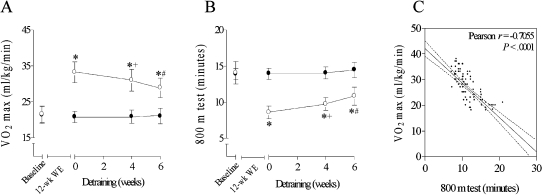
Figure 1
Figure 1
Aerobic fitness assessed by VO2max (A) and 800 m walking test (B) at baseline, after 12‐week water‐based exercise (WE) program and, with 4 and 6 weeks of detraining. (C) Correlation between these functional capacity evaluations. Open circles shows the trained group; closed circles shows the untrained group. Two‐way analysis of variance followed by a Tukey post hoc test was applied for comparisons. *p<0.05 vs. baseline and group without any exercise training; +p<0.05 vs. 12 weeks of WE; #p<0.05 vs. 4 weeks of detraining.
Figure 2
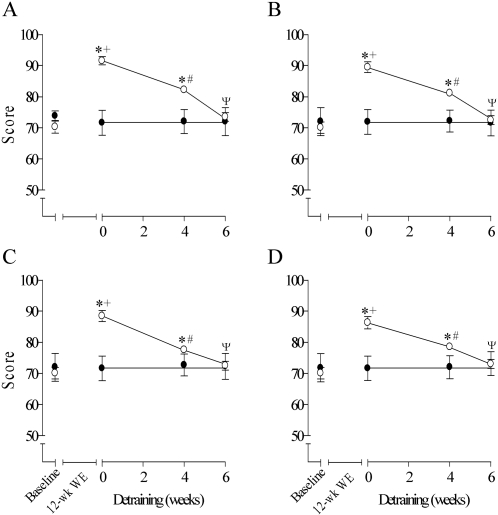
Figure 2
Quality of life evaluated by the multiple domain questionnaires in baseline, after 12‐week water‐based exercise (WE) program and with 4 and 6 weeks of detraining (Panel A: physical domain; Panel B: psychological domain; Panel C: social domain and Panel D: environmental domain). Open circles shows the trained group; closed circles shows the untrained group. Two‐way ANOVA followed by Tukey post hoc test was applied for comparisons. *p<0.05 vs. baseline; +p<0.05 vs. group without any training; #p<0.05 vs. 12 weeks of WE; Ψp<0.05 vs. 4 weeks of detraining.

References

    1. Chu KS, Eng JJ, Dawson AS, Harris A. Water‐based exercise for cardiovascular fitness in people with chronic stroke: a randomized controlled trial. Arch Phys Med Rehabil. 2004;85:870–4. - DOI - PMC - PubMed
    1. Bocalini DS, Serra AJ, Levy RF, Murad N. Water‐ vs walking land‐based exercise effects on the physical fitness in older women. Geriatr Gerontol Int. 2008;8:265–71. - DOI - PubMed
    1. Bocalini DS, Serra A, dos Santos L. Physical exercise improves functional capacity and quality of life in patients with heart failure. Clinics. 2008;63:437–42. - DOI - PMC - PubMed
    1. Gardner MM, Robertson MC, Campbell AJ. Exercise in preventing falls and fall related injuries in older people: a review of randomized controlled trials. Br J Sports Med. 2000;34:7–17. - DOI - PMC - PubMed
    1. Carral JMC, Pérez CA. Effects of high‐intensity combined training on women over 65. Gerontology. 2007;53:340–6. - DOI - PubMed