Review
. 2011 Apr 5;50(13):2403-10.
doi: 10.1021/bi200129s. Epub 2011 Mar 4.

"Molecular switches" on mGluR allosteric ligands that modulate modes of pharmacology

Affiliations
Review

"Molecular switches" on mGluR allosteric ligands that modulate modes of pharmacology

Michael R Wood et al. Biochemistry. .

Abstract

G-protein-coupled receptors (GPCRs) represent the largest class of drug targets, accounting for more than 40% of marketed drugs; however, discovery efforts for many GPCRs have failed to provide viable drug candidates. Historically, drug discovery efforts have focused on developing ligands that act at the orthosteric site of the endogenous agonist. Recently, efforts have focused on functional assay paradigms and the discovery of ligands that act at allosteric sites to modulate receptor function in either a positive, negative, or neutral manner. Allosteric modulators have numerous advantages over orthosteric ligands, including high subtype selectivity; the ability to mimic physiological conditions; the lack of densensitization, downregulation, and internalization; and reduced side effects. Despite these virtues, challenging issues have now arisen for allosteric modulators of metabotropic glutamate receptors (mGluRs): shallow SAR, ligand-directed trafficking, and the identification of subtle "molecular switches" that modulate the modes of pharmacology. Here, we will discuss the impact of modest structural changes to multiple mGluR allosteric ligands scaffolds that unexpectedly modulate pharmacology and raise concerns over metabolism and the pharmacology of metabolites.


Figures
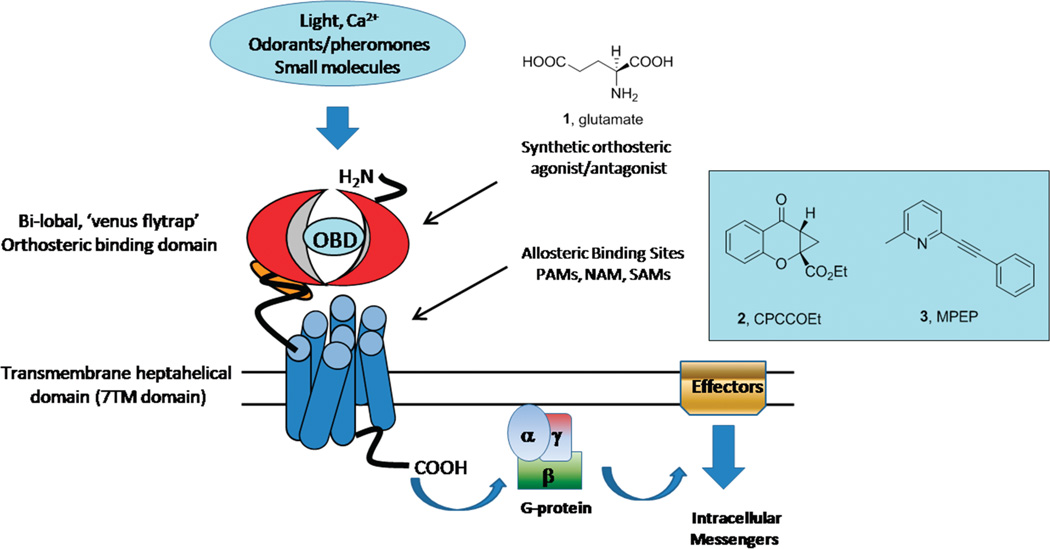
Figure 1
Figure 1
Cartoon structure of a class C (family 3) metabotropic glutamate receptor (mGluR) G-protein-coupled receptor (GPCR). mGluRs all have a common core composed of seven-transmembrane helices (the 7TM domain comprised of TM I—TM VII) with a large, bilobal Venus flytrap extracellular N-terminal domain and an intracellular C-terminal domain. The GPCR receives an extracellular stimulus (light, calcium, odorants, pheromones, small molecules, and proteins) that induces a conformational change in the receptor that either facilitates or inhibits the coupling of the receptor to a G-protein, comprised of α-, β-, and γ-subunits. The G-protein, in turn, interacts with a diverse group of effectors that control intracellular messengers. All orthosteric ligands bind in the bilobal orthosteric binding domain (OBD) and are analogues of glutamate 1. Allosteric ligands bind exclusively in the 7TM domain, far removed from the OBD, and are represented by novel, non-glutamate chemotypes such as CPCOOEt, 2 (mGlu1 NAM), and MPEP, 3 (mGlu5 NAM).
Figure 2
Figure 2
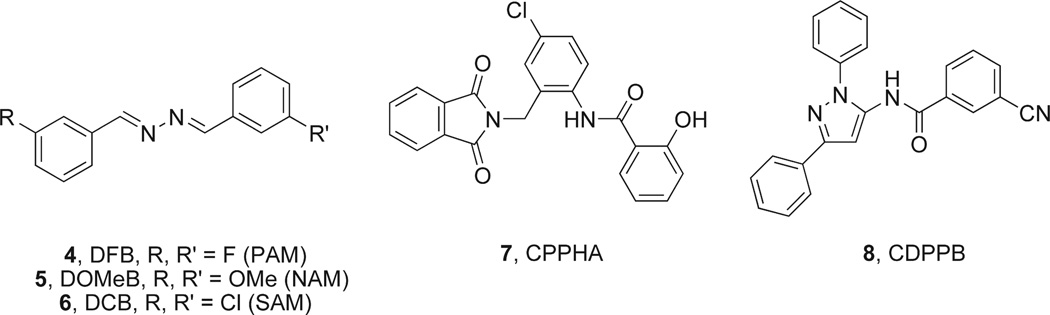
Structures of the first mGlu5 PAMs: DFB (4), CPPHA (7), and CDPPB (8). With vary subtle substitutions within the DFB series, the first molecular switches that modulated the mode of pharmacology to afford a NAM (DOMeB, 5) and a SAM (DCB, 6) were identified. Both the DFB (4–6) and CDPPB series (8) bind at the MPEP (3) allosteric site, whereas CPPHA (7) binds at a second, non-MPEP site.
Figure 3
Figure 3
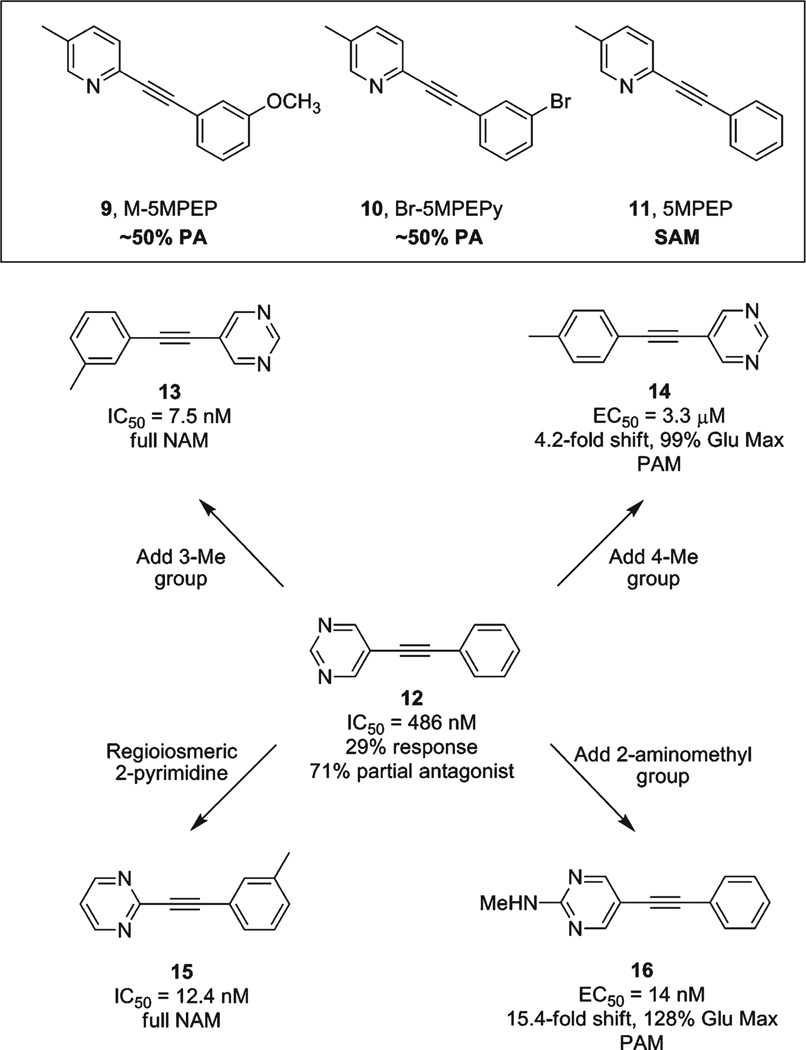
Structures (inset) of the first mGlu5 partial antagonists 9 and 10, and a molecular switch, the removal of the 3’-phenyl substituent, within this scaffold that afforded 5MPEP (11), a SAM. Optimization of partial antagonist 12 resulted in the identification of either simple methyl substitution (either 3’ or 4’) to afford both a full NAM 13 and a PAM 14. Further optimization provided NAM 15 and PAM 16, highly potent ligands that exhibited NAM and PAM activity, respectively, in vivo.
Figure 4
Figure 4
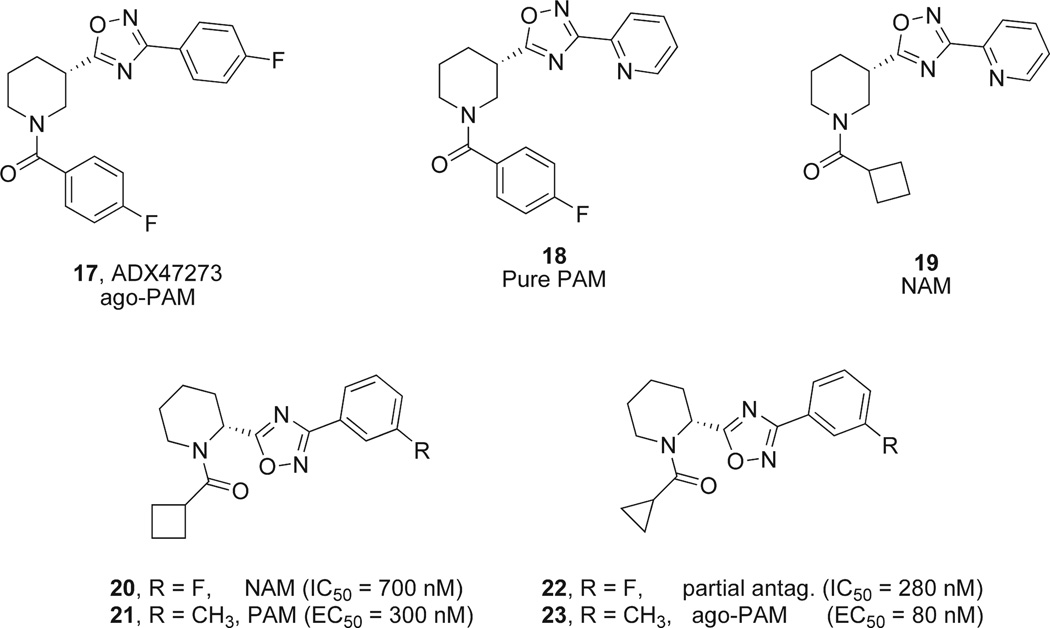
Structure of ago-PAM ADX47273 (17) and analogues with subtle molecular switches that modulate modes of pharmacology to provide mGlu5 allosteric ligands with the full breadth of potential pharmacology: pure PAM (18), weak NAM (19), full NAM (20), potent PAM (21), partial antagonist (22), and potent ago-PAM (23).
Figure 5
Figure 5
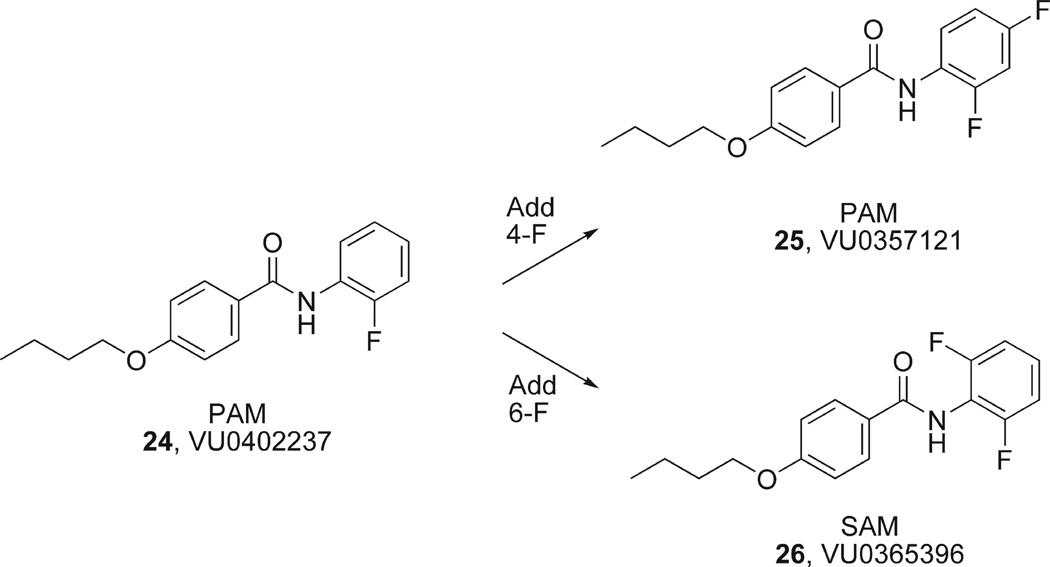
Novel series of mGlu5 PAMs that bind an as yet fully characterized third allosteric site, distinct from the MPEP and CPPHA sites. Optimization of PAM hit 24 led to a potent PAM 25 by the addition of a fluorine atom to the 4-position of the benzamide moiety. Unexpectedly, addition of a fluorine atom to the 6-position of 24 provided 26, a potent SAM.
Figure 6
Figure 6
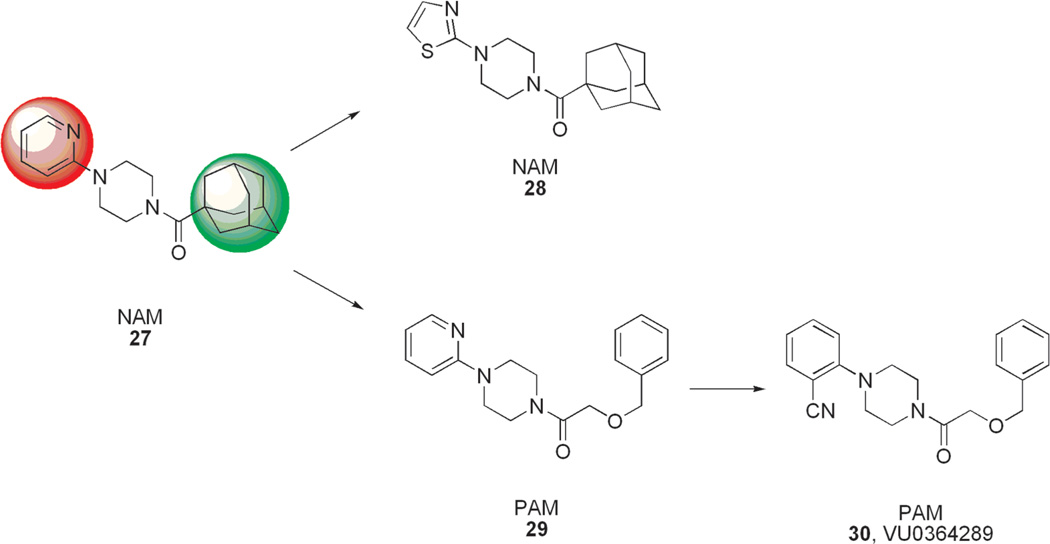
HTS mGlu5 NAM hit 27 displayed bidirectional SAR. Optimization of the heteroaryl moiety afforded additional, potent mGlu5 NAMs, such as 28. Optimization of the amide moiety identified the benzyloxy acetyl amide, as in 29, as a molecular switch engendering mGlu5 PAM activity. Further chemistry led to 30, a potent, centrally active, and important new mGlu5 PAM tool compound.
Figure 7
Figure 7
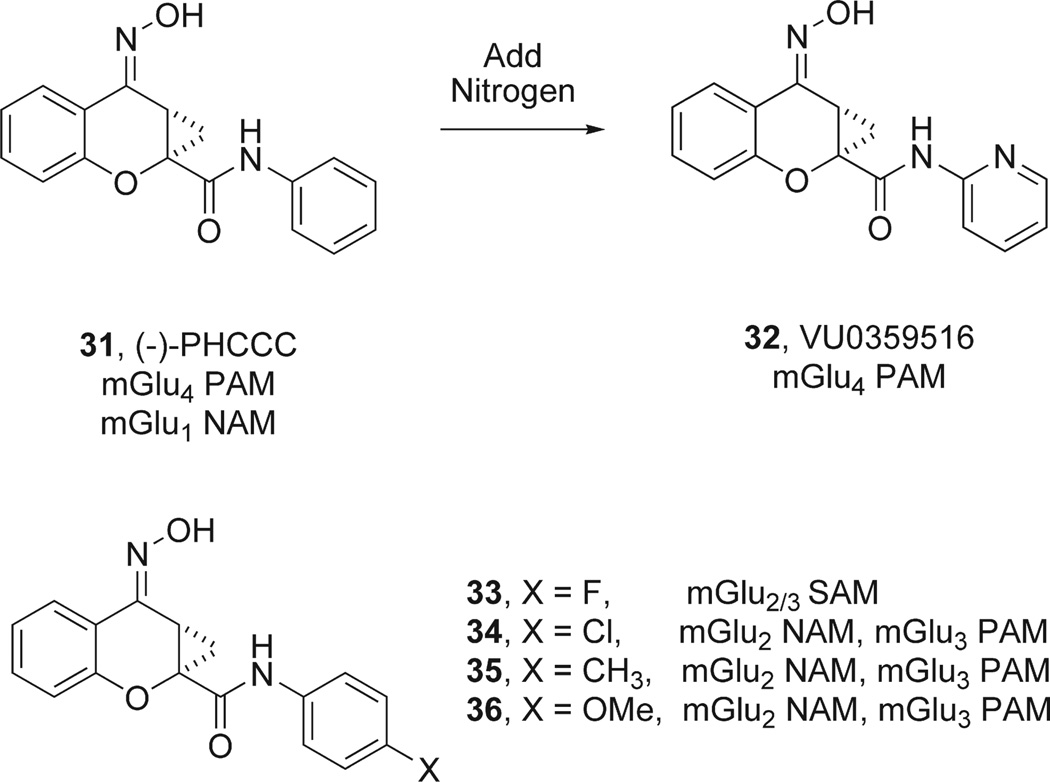
Identification of molecular switches that alter mGluR subtype selectivity. The prototypical mGlu4 PAM (−)-PHCCC 31 is a dual mGlu4 PAM/mGlu1 NAM. The addition of a moderately basic nitrogen atom to provide 32 abolishes mGlu1 NAM activity, providing a highly selective and 10-fold more potent mGlu4 PAM. A FRET assay identified 33, an mGlu2/3 SAM. Subtle substitution of the 4-fluoro moiety provided allosteric ligands 3436 with unprecedented dual mGlu2 NAM/mGlu3 PAM activity.

References

    1. George SR, O’Dowd BF, Lee SP. G-protein-coupled receptor oligomerization and its potential for drug discovery. Nat. Rev. Drug Discovery. 2002;1:808–820. - PubMed
    1. Filmore D. It’s a GPCR world. Mod. Drug Discovery. 2004;7:24–28.
    1. Hopkins AL, Groom CR. The druggable genome. Nat. Rev. Drug Discovery. 2002;1:727–730. - PubMed
    1. Cabrera-Vera TM, Vanhauwe J, Thomas TO, Medkova M, Preininger A, Mazzoni MR, Hamm HE. Insights into G protein structure, function and regulation. Endocr. Rev. 2003;24:765–781. - PubMed
    1. Bridges TM, Lindsley CW. G-protein coupled receptors: From classical modes of modulation to allosteric mechanisms. ACS Chem. Biol. 2008;3:530–542. - PubMed

MeSH terms

LinkOut - more resources