


doi: 10.1586/eri.10.158.
Adenosine modulates Toll-like receptor function: basic mechanisms and translational opportunities
Affiliations
- PMID: 21342073
- PMCID: PMC4052217
- DOI: 10.1586/eri.10.158
Item in Clipboard
Adenosine modulates Toll-like receptor function: basic mechanisms and translational opportunities
Expert Rev Anti Infect Ther.
2011 Feb.
Abstract
Adenosine is an endogenous purine metabolite whose concentration in human blood plasma rises from nanomolar to micromolar concentrations during the inflammatory process. Leukocytes express seven-transmembrane adenosine receptors whose engagement modulates Toll-like receptor-mediated cytokine responses, in part via modulation of intracellular cyclic adenosine monophosphate. Adenosine analogs are used clinically to treat arrhythmias and apnea of prematurity. Herein, we consider the potential of adenosine analogs as innate immune response modifiers to prevent and/or treat infection.
Figures
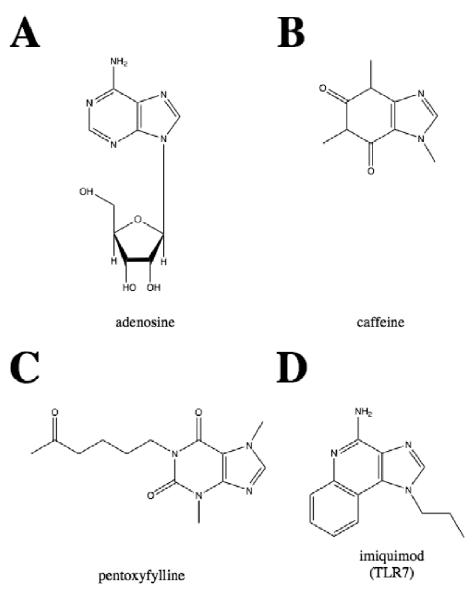
(A) adenosine, an endogenous purine metabolite also used to treat arrythmias, (B) caffeine, used to treat apnea of prematurity in preterm newborns and infants, whose administration is also associated with decreased incidence of bronchopulmonary dysplasia (C) pentoxifylline, which has been studied for treatment of neonatal sepsis (D) imiquimod, a TLR7 agonist that is FDA-approved for treatment of human papillioma virus (warts).
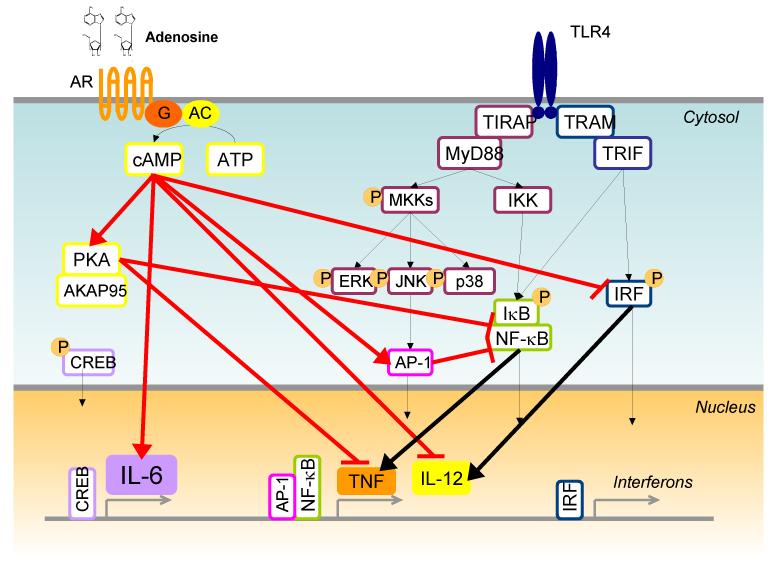
Endotoxin-induced activation of the TLR4 receptor complex results in activation of MyD88 and TRIF signaling cascades, leading to production of multiple cytokines, including TNF and interferons. Adenosine interferes with both these cascades. Adenosine binding to the A2A receptor increases intracellular cAMP, which induces expression of PKA. Targeting of PKA to NF-κB, through its scaffold AKAP95, inhibits NF-κB activation, and results in decreased transcription of TNF and increased production of IL-10. In addition, cAMP inhibits phosphorylation of p38 MAPK and activation of IRFs, which are required for production of pro-inflammatory cytokines. Several transcriptional and post-transcriptional mechanisms have been described by which cAMP enhances LPS-induced IL-10. It is not yet clear whether these effects are mediated through PKA or other downstream effectors. Ultimately, adenosine polarizes TLR4-mediated cytokine responses to a Th2-type response characterized by decreased production of pro-inflammatory cytokines such as TNF and IL-12p70 and increased production of IL-6 and IL-10.
References
-
- Sitkovsky MV, Lukashev D, Apasov S, et al. Physiological control of immune response and inflammatory tissue damage by hypoxia-inducible factors and adenosine A2A receptors. Annual Review of Immunology. 2004;22:657–682. - PubMed
-
- Martin C, Leone M, Viviand X, Ayem ML, Guieu R. High adenosine plasma concentration as a prognostic index for outcome in patients with septic shock. Critical Care Medicine. 2000;28(9):3198–3202. - PubMed
-
- Hasko G, Cronstein BN. Adenosine: an endogenous regulator of innate immunity. Trends in Immunology. 2004;25(1):33–39. - PubMed
Publication types
MeSH terms
Substances
Grants and funding
LinkOut - more resources
Full Text Sources
Other Literature Sources
