


Long-term persistence of prevalently detected human papillomavirus infections in the absence of detectable cervical precancer and cancer
- PMID: 21343148
- PMCID: PMC3071125
- DOI: 10.1093/infdis/jiq116
Long-term persistence of prevalently detected human papillomavirus infections in the absence of detectable cervical precancer and cancer
Abstract
Background: Detailed descriptions of long-term persistence of human papillomavirus (HPV) in the absence of cervical precancer are lacking.
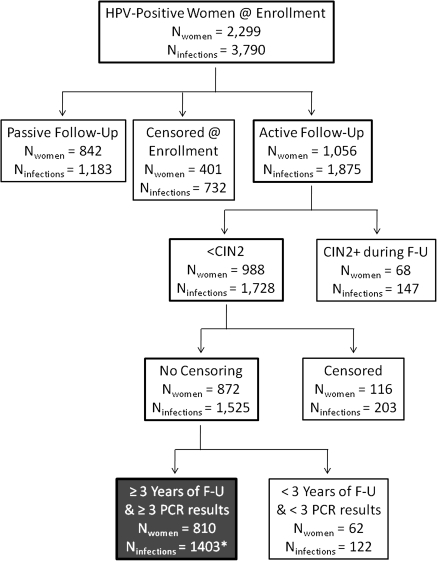
Methods: In a large, population-based natural study conducted in Guanacaste, Costa Rica, we studied a subset of 810 initially HPV-positive women with ≥ 3 years of active follow-up with ≥ 3 screening visits who had no future evidence of cervical precancer. Cervical specimens were tested for >40 HPV genotypes using a MY09/11 L1-targeted polymerase chain reaction method.
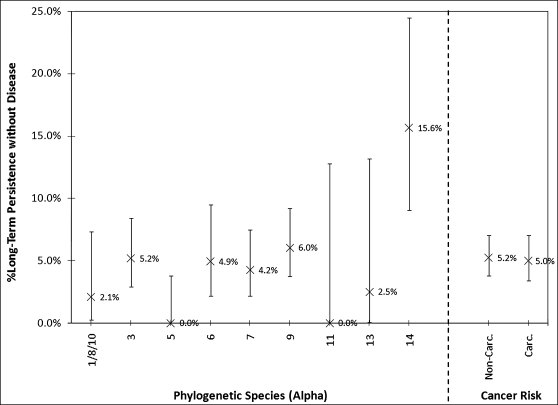
Results: Seventy-two prevalently-detected HPV infections (5%) in 58 women (7%) persisted until the end of the follow-up period (median duration of follow-up, 7 years) without evidence of cervical precancer. At enrollment, women with long-term persistence were more likely to have multiple prevalently-detected HPV infections (P < .001) than were women who cleared their baseline HPV infections during follow-up. In a logistic regression model, women with long-term persistence were more likely than women who cleared infections to have another newly-detected HPV infection detectable at ≥ 3 visits (odds ratio, 2.6; 95% confidence interval, 1.2-5.6).
Conclusions: Women with long-term persistence of HPV infection appear to be generally more susceptible to other HPV infections, especially longer-lasting infections, than are women who cleared their HPV infections.
Figures
References
-
- McCredie MR, Sharples KJ, Paul C, et al. Natural history of cervical neoplasia and risk of invasive cancer in women with cervical intraepithelial neoplasia 3: a retrospective cohort study. Lancet Oncol. 2008;9:425–34. - PubMed
-
- Ostor AG. Natural history of cervical intraepithelial neoplasia: a critical review. Int J Gynecol Pathol. 1993;12:186–92. - PubMed
-
- Nasiell K, Roger V, Nasiell M. Behavior of mild cervical dysplasia during long-term follow-up. Obstet Gynecol. 1986;67:665–9. - PubMed
-
- Nasiell K, Nasiell M, Vaclavinkova V. Behavior of moderate cervical dysplasia during long-term follow-up. Obstet Gynecol. 1983;61:609–14. - PubMed
-
- Plummer M, Schiffman M, Castle PE, Maucort-Boulch D, Wheeler CM. A 2-year prospective study of human papillomavirus persistence among women with a cytological diagnosis of atypical squamous cells of undetermined significance or low-grade squamous intraepithelial lesion. J Infect Dis. 2007;195:1582–9. - PubMed
Publication types
MeSH terms
Grants and funding
LinkOut - more resources
Full Text Sources
Medical
