Specific insulin-like peptides encode sensory information to regulate distinct developmental processes
- PMID: 21343369
- PMCID: PMC3042873
- DOI: 10.1242/dev.060905
Specific insulin-like peptides encode sensory information to regulate distinct developmental processes
Abstract
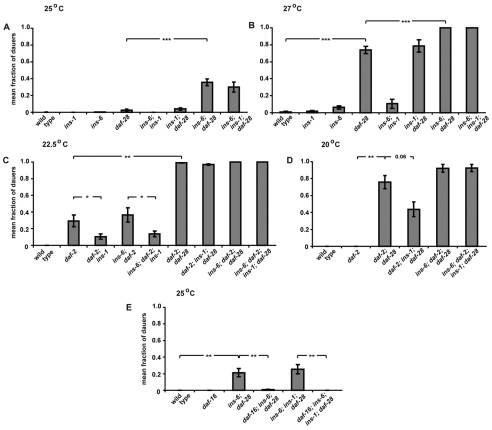
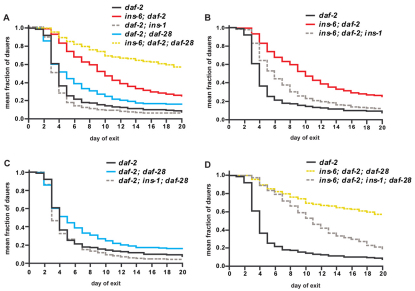
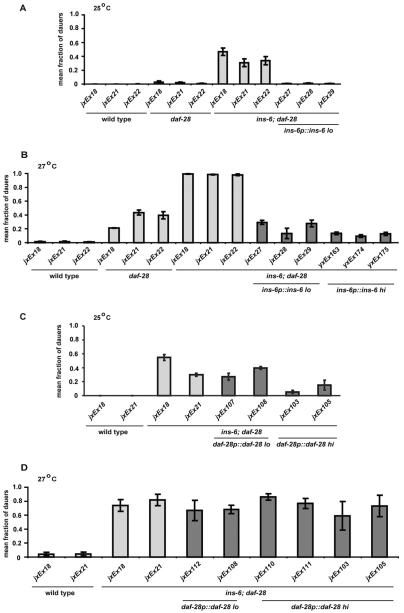
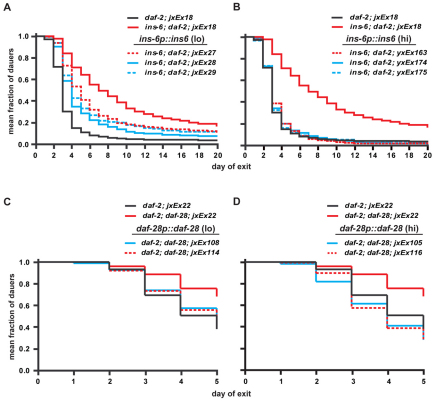
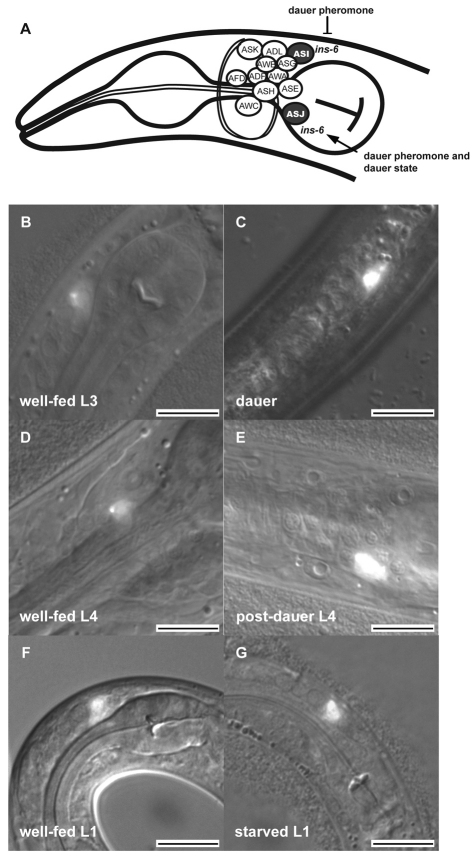
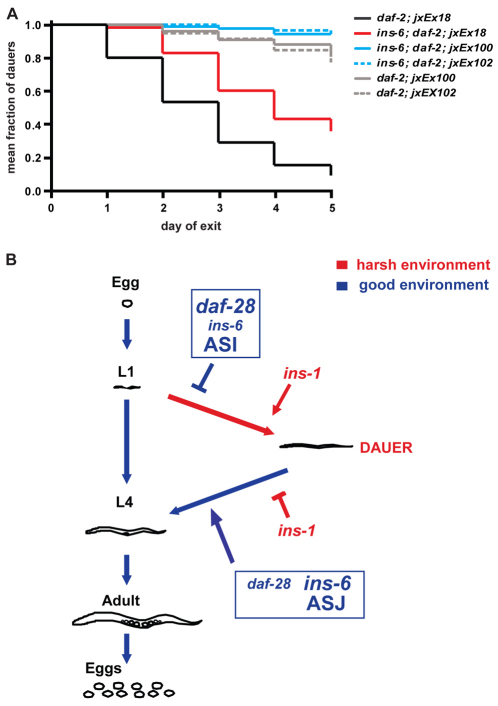
An insulin-like signaling pathway mediates the environmental influence on the switch between the C. elegans developmental programs of reproductive growth versus dauer arrest. However, the specific role of endogenous insulin-like peptide (ILP) ligands in mediating the switch between these programs remains unknown. C. elegans has 40 putative insulin-like genes, many of which are expressed in sensory neurons and interneurons, raising the intriguing possibility that ILPs encode different environmental information to regulate the entry into, and exit from, dauer arrest. These two developmental switches can have different regulatory requirements: here we show that the relative importance of three different ILPs varies between dauer entry and exit. Not only do we find that one ILP, ins-1, ensures dauer arrest under harsh environments and that two other ILPs, daf-28 and ins-6, ensure reproductive growth under good conditions, we also show that daf-28 and ins-6 have non-redundant functions in regulating these developmental switches. Notably, daf-28 plays a more primary role in inhibiting dauer entry, whereas ins-6 has a more significant role in promoting dauer exit. Moreover, the switch into dauer arrest surprisingly shifts ins-6 transcriptional expression from a set of dauer-inhibiting sensory neurons to a different set of neurons, where it promotes dauer exit. Together, our data suggest that specific ILPs generate precise responses to dauer-inducing cues, such as pheromones and low food levels, to control development through stimulus-regulated expression in different neurons.
Figures
References
-
- Alcedo J., Kenyon C. (2004). Regulation of C. elegans longevity by specific gustatory and olfactory neurons. Neuron 41, 45-55 - PubMed
-
- Apfeld J., Kenyon C. (1998). Cell nonautonomy of C. elegans daf-2 function in the regulation of diapause and life span. Cell 95, 199-210 - PubMed
-
- Apfeld J., Kenyon C. (1999). Regulation of lifespan by sensory perception in Caenorhabditis elegans. Nature 402, 804-809 - PubMed
-
- Ayer-le Lievre C., Stahlbom P. A., Sara V. R. (1991). Expression of IGF-I and -II mRNA in the brain and craniofacial region of the rat fetus. Development 111, 105-115 - PubMed
-
- Bargmann C. I., Horvitz H. R. (1991). Control of larval development by chemosensory neurons in Caenorhabditis elegans. Science 251, 1243-1246 - PubMed
Publication types
MeSH terms
Substances
Grants and funding
LinkOut - more resources
Full Text Sources
Other Literature Sources
Molecular Biology Databases
Research Materials
Miscellaneous