. 2011 Apr;17(4):639-51.
doi: 10.1261/rna.2310111. Epub 2011 Feb 22.

Effect of life history on microRNA expression during C. elegans development

Affiliations

Effect of life history on microRNA expression during C. elegans development

Xantha Karp et al. RNA. 2011 Apr.

Abstract

Animals have evolved mechanisms to ensure the robustness of developmental outcomes to changing environments. MicroRNA expression may contribute to developmental robustness because microRNAs are key post-transcriptional regulators of developmental gene expression and can affect the expression of multiple target genes. Caenorhabditis elegans provides an excellent model to study developmental responses to environmental conditions. In favorable environments, C. elegans larvae develop rapidly and continuously through four larval stages. In contrast, in unfavorable conditions, larval development may be interrupted at either of two diapause stages: The L1 diapause occurs when embryos hatch in the absence of food, and the dauer diapause occurs after the second larval stage in response to environmental stimuli encountered during the first two larval stages. Dauer larvae are stress resistant and long lived, permitting survival in harsh conditions. When environmental conditions improve, dauer larvae re-enter development, and progress through two post-dauer larval stages to adulthood. Strikingly, all of these life history options (whether continuous or interrupted) involve an identical pattern and sequence of cell division and cell fates. To identify microRNAs with potential functions in buffering development in the context of C. elegans life history options, we used multiplex real-time PCR to assess the expression of 107 microRNAs throughout development in both continuous and interrupted life histories. We identified 17 microRNAs whose developmental profile of expression is affected by dauer life history and/or L1 diapause, compared to continuous development. Hence these microRNAs could function to regulate gene expression programs appropriate for different life history options in the developing worm.


Figures
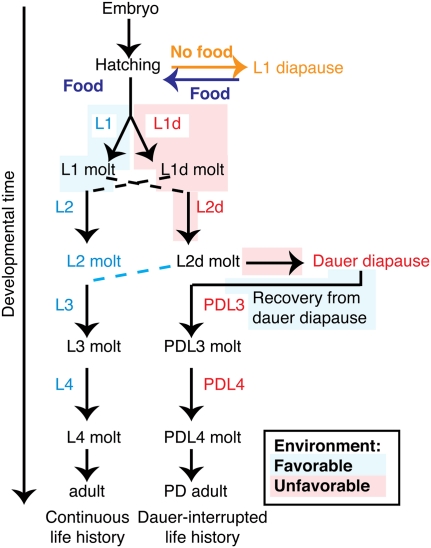
FIGURE 1.
FIGURE 1.
Schematic representation of continuous and interrupted life history options. C. elegans larvae develop continuously through four larval stages in favorable environmental conditions, but can interrupt their development by entry to the stress-resistant L1 diapause or dauer diapause in unfavorable environmental conditions. (Red shading) Unfavorable or (blue shading) favorable environmental conditions sensed by larvae. These environmental conditions drive larvae to either continuous or diapause-interrupted life histories. (Dashed lines) Junctures where larvae may switch between diapause-interrupted and continuous life history depending on the severity of the conditions encountered. Developmental stages at which miRNA levels were assessed in each life history: (blue) stages are within the continuous life history; (red) stages are within the dauer-interrupted life history. Developmentally equivalent stages were compared (Table 1); these are the red and blue stages at the same point along the vertical axis. (Orange) L1 diapause, which can lead to either continuous or dauer life histories, was compared to both embryos and continuously developing L1 larvae (Table 2).
FIGURE 2.
FIGURE 2.
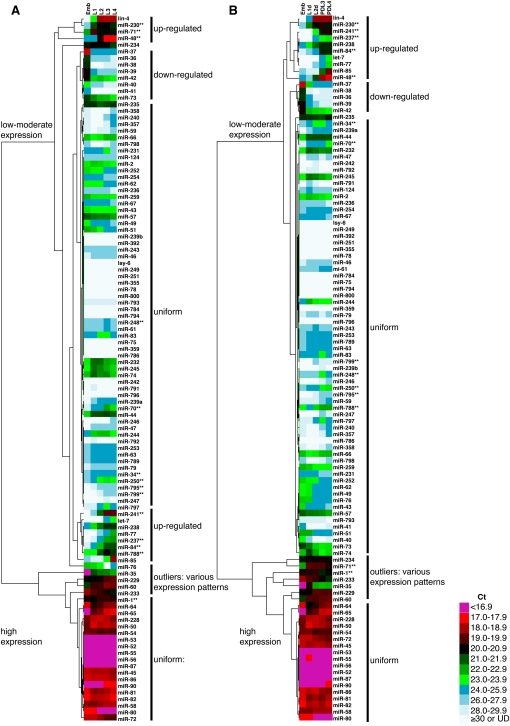
Hierarchical clustering of miRNA expression profiles during developmental progression. Hierarchical clustering was carried out using Cluster 3.0 and visualized using Java TreeView programs (Materials and Methods) on (A) embryo (Emb), L1, L2, L3, and L4 staged continuously developing larvae or (B) embryo (Emb), L1d, L2d, PDL3, and PDL4 staged larvae progressing through the dauer life history. Note that a 1-Ct difference corresponds to a twofold change in expression level. (**) An miRNA whose expression changes significantly and substantially between life histories (see Fig. 3; Table 1).
FIGURE 3.
FIGURE 3.
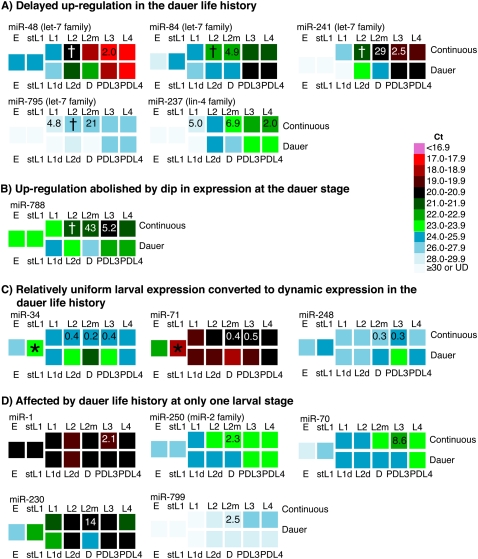
Developmental trajectory of miRNAs whose expression is significantly different between life histories. Four different effects on developmental trajectory were observed (A–D). See text for details. The expression of miRNAs whose expression is substantially and significantly affected at one or more larval stages (Table 1) was represented by the same color-coding scheme as in Figure 2. To directly compare progression through continuous and dauer-interrupted life histories, the corresponding developmental stages are shown in parallel, with the continuous life history on the top and the dauer life history on the bottom. Developmental diapauses are also shown, including L1 diapause (stL1) and dauer diapause (D). Note that embryo and stL1 stages can lead to either continuous or dauer life history. Numbers within squares indicate the fold-change in expression between continuous and dauer life histories (continuous/dauer). Note that in some cases, an approximately twofold change in expression does not cause a change in the color, or conversely that a small change in Ct can cause a color change if the Ct was near the boundary defined. Also note that a 1-Ct difference is a twofold change in miRNA level. See Supplemental Table S3 for a complete list of the fold-change in miRNA expression between different life histories at all larval stages for all 107 miRNAs, including the error, and P-value, Supplemental Table S5 for a list of miRNAs that change significantly but not substantially (1.5–1.9-fold), and Supplemental Table S4 for a list of miRNAs that are affected differently in independent experiments. (*) A statistically significant fold-change is observed when the miRNA level in stL1 is compared to the miRNA level in both embryo and continuously developing L1 stages (see Table 2). (†) The substantial fold-change observed at this stage is not statistically significant in this analysis (Supplemental Table S3). These miRNAs are dramatically up-regulated in L2 staged larvae (Supplemental Table S2; Abbott et al. 2005), causing any small variation in the stage of each sample to lead to a large variation in the amount of miRNA present in different biological replicates. However, when these same samples were compared using methods to assess fold-change for cultures grown side by side, we did find a statistically significant difference at this stage (Hammell et al. 2009; Pradervand et al. 2009).
FIGURE 4.
FIGURE 4.
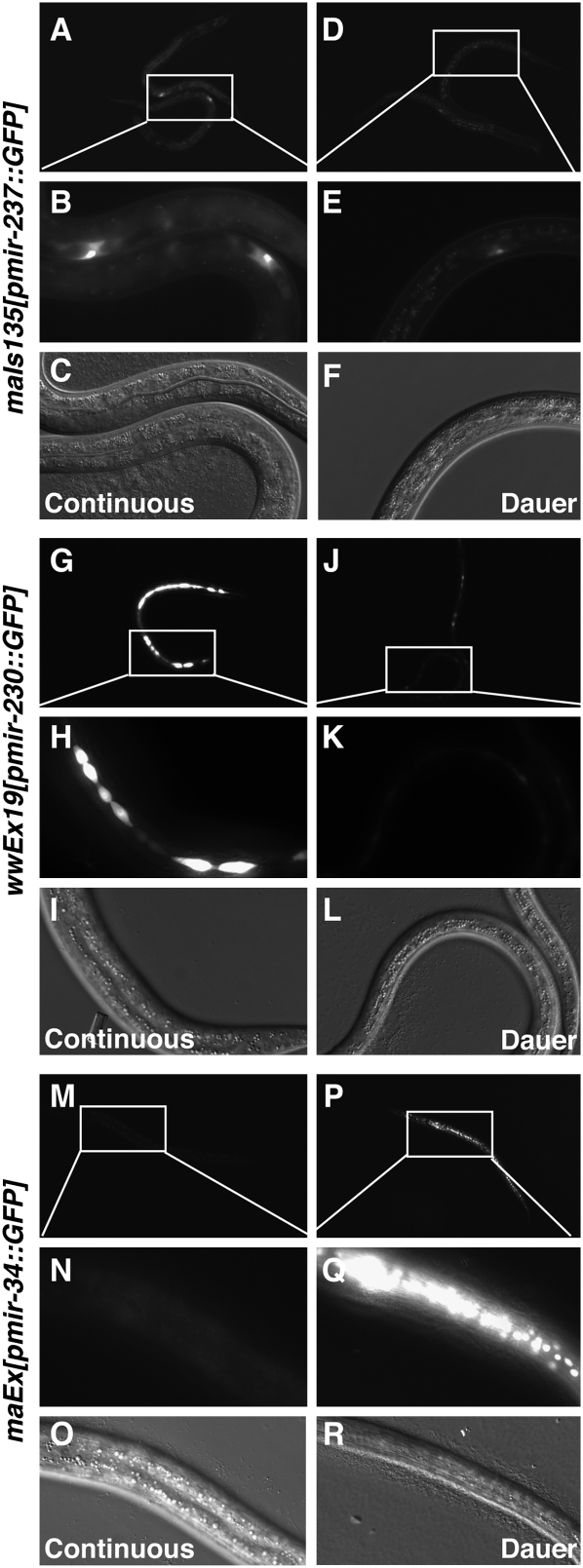
Transcriptional regulation of miRNA expression in dauer diapause. Expression of transcriptional reporters of miRNA expression during continuous development (L2 molt or early L3 stage, prior to VPC division) or during dauer diapause. (A–F) Expression of a mir-237∷GFP reporter (Martinez et al. 2008b). (A,D) GFP fluorescence observed at a 200-msec exposure time using a 10× objective. (B,E) Magnification of the boxed region in A and D. Fluorescence observed at a 19-msec exposure time using a 40× objective. (C,F) DIC images corresponding to B and E, respectively. (G–L) Expression of a mir-230∷GFP reporter (Martinez et al. 2008b). (G,J) GFP fluorescence observed at a 100-msec exposure time using a 10× objective. (H,K) Magnification of the boxed region in G and J, respectively. Fluorescence observed at a 3-msec exposure time using a 40× objective. (I,L) DIC images corresponding to H and K, respectively. (M–R) Expression of an mir-34∷GFP reporter containing 5 kb of promoter sequence. (M,P) GFP fluorescence observed at a 200-msec exposure time using a 10× objective. (N,Q) Magnification of the boxed region in M and P, respectively. Fluorescence observed at a 50-msec exposure time using a 40× objective. (O,R) DIC images corresponding to N and Q, respectively.

References

    1. Abbott AL, Alvarez-Saavedra E, Miska EA, Lau NC, Bartel DP, Horvitz HR, Ambros V 2005. The let-7 microRNA family members mir-48, mir-84, and mir-241 function together to regulate developmental timing in Caenorhabditis elegans. Dev Cell 9: 403–414 - PMC - PubMed
    1. Alvarez-Saavedra E, Horvitz HR 2010. Many families of C. elegans microRNAs are not essential for development or viability. Curr Biol 20: 367–373 - PMC - PubMed
    1. Antebi A, Yeh WH, Tait D, Hedgecock EM, Riddle DL 2000. daf-12 encodes a nuclear receptor that regulates the dauer diapause and developmental age in C. elegans. Genes Dev 14: 1512–1527 - PMC - PubMed
    1. AppliedBiosystems 2008. Guide to performing relative quantitation of gene expression using real-time quantitative PCR. http://www3.appliedbiosystems.com/cms/groups/mcb_support/documents/gener...
    1. Barriere A, Felix MA 2005. High local genetic diversity and low outcrossing rate in Caenorhabditis elegans natural populations. Curr Biol 15: 1176–1184 - PubMed

Publication types

MeSH terms

LinkOut - more resources