. 2011 Apr;155(4):2010-22.
doi: 10.1104/pp.110.170878. Epub 2011 Feb 22.

Vacuole-localized berberine bridge enzyme-like proteins are required for a late step of nicotine biosynthesis in tobacco

Affiliations

Vacuole-localized berberine bridge enzyme-like proteins are required for a late step of nicotine biosynthesis in tobacco

Masataka Kajikawa et al. Plant Physiol. 2011 Apr.

Abstract

Tobacco (Nicotiana tabacum) plants synthesize nicotine and related pyridine-type alkaloids, such as anatabine, in their roots and accumulate them in their aerial parts as chemical defenses against herbivores. Herbivory-induced jasmonate signaling activates structural genes for nicotine biosynthesis and transport by way of the NICOTINE (NIC) regulatory loci. The biosynthesis of tobacco alkaloids involves the condensation of an unidentified nicotinic acid-derived metabolite with the N-methylpyrrolinium cation or with itself, but the exact enzymatic reactions and enzymes involved remain unclear. Here, we report that jasmonate-inducible tobacco genes encoding flavin-containing oxidases of the berberine bridge enzyme family (BBLs) are expressed in the roots and regulated by the NIC loci. When expression of the BBL genes was suppressed in tobacco hairy roots or in tobacco plants, nicotine production was highly reduced, with a gradual accumulation of a novel nicotine metabolite, dihydromethanicotine. In the jasmonate-elicited cultured tobacco cells, suppression of BBL expression efficiently inhibited the formation of anatabine and other pyridine alkaloids. Subcellular fractionation and localization of green fluorescent protein-tagged BBLs showed that BBLs are localized in the vacuoles. These results indicate that BBLs are involved in a late oxidation step subsequent to the pyridine ring condensation reaction in the biosynthesis of tobacco alkaloids.


Figures
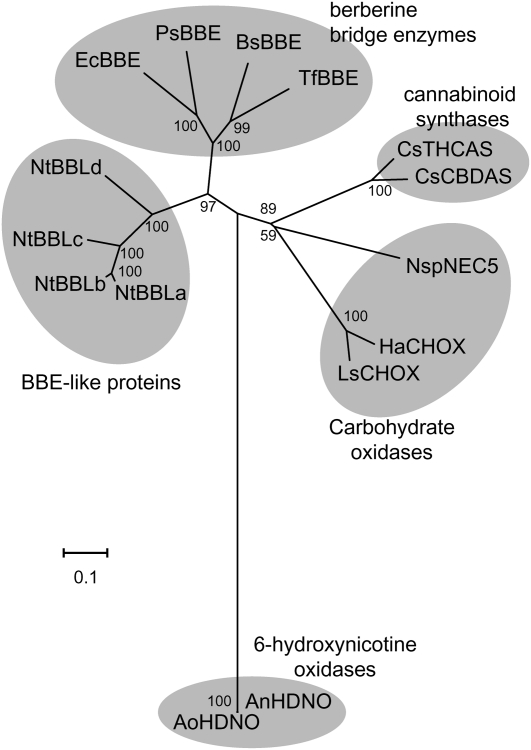
Figure 1.
Figure 1.
Phylogenetic tree of BBE-like proteins. Shown is an unrooted neighbor-joining phylogenetic tree of tobacco BBE-like proteins (NtBBLs) and of related proteins belonging to four subgroups: BBEs, 6-hydroxynicotine oxidases, cannabinoid synthases, and carbohydrate oxidases. The tree was generated using MEGA4 software (Tamura et al., 2007) with the neighbor-joining algorithm. Bootstrap values (1,000 replicates) are indicated at branch nodes, and the scale bar indicates the number of amino acid substitutions per site. Species are as follows: NtBBLa (N. tabacum), NtBBLb (N. tabacum), NtBBLc (N. tabacum), NtBBLd (N. tabacum), EcBBE (Eschscholzia californica), BsBBE (Berberis stolonifera), PsBBE (Papaver somniferum), TfBBE (Thalictrum flavum), AoHDNO (Arthrobacter oxidans), AnHDNO (Arthrobacter nicotinovorans), CsCBDAS (C. sativa), CsTHCAS (C. sativa), HaCHOX (Helianthus annuus), LsCHOX (Lactuca sativa), and NspNEC5 (Nicotiana langsdorffii × Nicotiana sanderae).
Figure 2.
Figure 2.
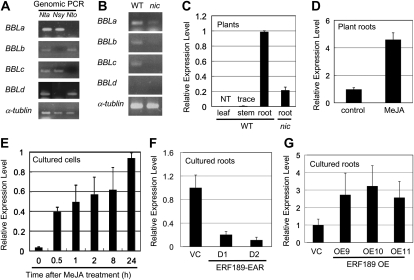
Expression profiles of tobacco BBL genes. A and B, PCR primers specific to each BBL member were used, and the tobacco α-Tubulin gene was amplified as a control. A, Genomic PCR analysis of N. tabacum (Nta) and its probable progenitors, N. sylvestris (Nsy) and N. tomentosiformis (Nto). B, Transcript levels of each BBL gene were assessed by RT-PCR in the roots of wild-type (WT) and nic1nic2 mutant (nic) tobacco plants. C to G, Quantitative RT-PCR analysis of BBL genes using BBL-consensus PCR primers. Transcript levels are shown as relative values. C, Organ-specific expression pattern in the wild-type plant and expression level in the nic root. NT, Not detectable. D, Treatment of tobacco roots with 100 μm MeJA for 24 h. E, Treatment of cultured tobacco cells with 50 μm MeJA for the periods indicated. F, BBL transcript levels in cultured tobacco roots of the VC line and two transgenic lines expressing a dominant-negative ERF189 form (ERF189-EAR, D1 and D1; Shoji et al., 2010). G, BBL transcript levels in cultured tobacco roots of the VC line and three transgenic lines overexpressing ERF189 (OE9, OE10, and OE11; Shoji et al., 2010).
Figure 3.
Figure 3.
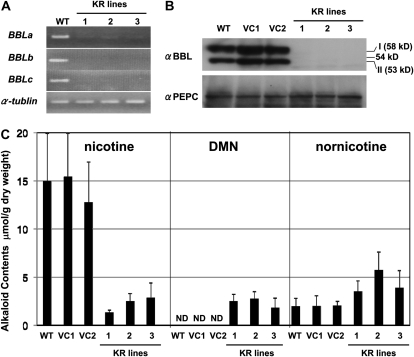
Down-regulation of BBL genes in transgenic tobacco roots. Tobacco hairy roots of the wild type (WT), two vector-transformed control lines (VC1 and VC2), and three RNAi lines (KR1, KR2, and KR3) were analyzed. A, RT-PCR analysis of BBLa, BBLb, and BBLc as well as the control α-Tubulin gene. B, Immunoblot analysis using the antisera against BBL and PEPC (loading control). BBLs existed in two forms with different molecular masses (I, 60 kD; II, 53 kD). C, Alkaloid contents of hairy roots. Data indicate mean values ± sd from three biological replicates. ND, Not detected.
Figure 4.
Figure 4.
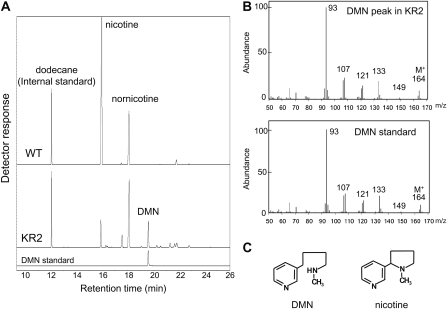
Identification of DMN in the BBL-suppressed tobacco roots. A, Gas-liquid chromatograms of alkaloid fractions from the cell extracts of the wild type (WT) and the KR2 line, along with the DMN standard. DMN (retention time, 19.7 min) accumulated in the KR2 roots but not in wild-type roots. B, Mass fragment patterns of the DMN peak in the KR2 roots and of the authentic DMN. C, Chemical structures of DMN and nicotine.
Figure 5.
Figure 5.
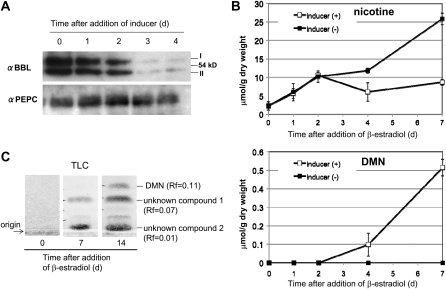
Time courses of inducible BBL suppression and alkaloid accumulation in transgenic tobacco roots. A, Immunoblot analysis of BBL and PEPC proteins in the inducible BBL RNAi root line (XN1) after the roots were treated with β-estradiol for the period indicated. B, Accumulation of nicotine and DMN in XN1 roots cultured in the absence or presence of β-estradiol. Data indicate mean values ± sd from three biological replicates. C, Metabolite analysis by thin-layer chromatography (TLC). Nitrogen-containing compounds were detected using Dragendorff’s reagent. At least two unidentified compounds (RF values of 0.01 and 0.07), in addition to DMN (RF of 0.11), were detectable after the inducer treatment.
Figure 6.
Figure 6.
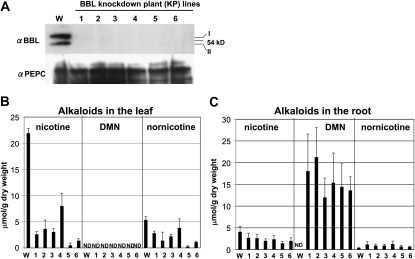
BBL down-regulation in tobacco plants. Tobacco plants of the wild type (W) and six independent BBL RNAi lines (KP1–KP6) were grown for 1 month after germination and analyzed for gene expression and alkaloids. A, Immunoblot analysis of BBL and PEPC (control) proteins in the root. B and C, Levels of nicotine, DMN, and nornicotine in the fourth newest leaf (B) and the root (C). Data indicate mean values ± sd from three replicates. ND, Not detected.
Figure 7.
Figure 7.
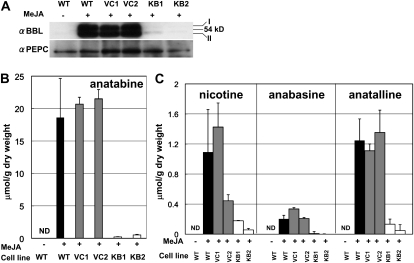
BBL down-regulation in cultured tobacco cells. Cultured BY-2 cells of the wild type (WT), two vector-transformed control cell lines (VC1 and VC2), and two BBL RNAi lines (KB1 and KB2) were treated with 50 μm MeJA for 48h (+), and their protein levels and alkaloid contents were analyzed. Wild-type BY-2 cells were also cultured in the absence of MeJA (−). A, Immunoblot analysis of BBL and PEPC (control) proteins. B, Anatabine content. C, Levels of nicotine, anabasine, and anatalline. Note that the scale is different from that in B. Data indicate mean values ± sd from three replicates. ND, Not detected.
Figure 8.
Figure 8.
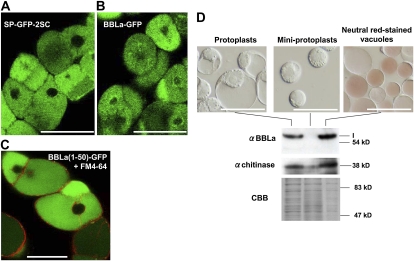
Subcellular localization of BBLa protein in cultured tobacco cells. A, Full-length BBLa protein was fused at its C terminus to GFP and stably expressed in cultured BY-2 cells. Fluorescence was observed with a laser scanning confocal microscope. B, Confocal image of BY-2 cells expressing SP-GFP-2SC, which had been shown to be located in the vacuoles (Mitsuhashi et al., 2000). C, An N-terminal 50-amino acid fragment of BBLa was fused to GFP and stably expressed in the tobacco cells. The transformed tobacco cells were pulse labeled by the fluorescent dye FM4-64 and inspected 10 h later when the dye had been shown to primarily label the vacuolar membrane (Shoji et al., 2009). Bars = 50 μm. D, Immunoblots of subcellular fractions. Vacuoles and cytoplasm-rich miniprotoplasts were prepared from protoplasts of a BBLa-overexpressing tobacco cell line by Percoll gradient centrifugation. Vacuoles were stained with a 10 μg mL−1 neutral red solution for 10 min. Immunoblots probed with antisera against BBL and class I chitinase (vacuolar resident protein) are shown, together with a Coomassie Brilliant Blue (CBB)-stained gel as a loading control. Bars = 100 μm. [See online article for color version of this figure.]
Figure 9.
Figure 9.
Biochemical characterization of the recombinant BBLa protein produced in the Pichia cell culture. A, BBLa purified from the culture medium of P. pastoris was glycosylated. The purified protein was treated with (+) the endoglycosidase EndoHf and analyzed by SDS-PAGE. Separated proteins were stained with Coomassie Brilliant Blue (CBB) or the carbohydrate-staining PAS reagent after being transferred to a polyvinylidene difluoride membrane. Approximately 1 μg of the native protein and approximately 5 μg of the deglycosylated protein were loaded in the lanes. B, Immunoblot analysis of the deglycosylated recombinant BBLa protein produced from the Pichia culture (lane 1) and BBL proteins present in MeJA-treated wild-type BY-2 cells (lane 2). The antiserum against BBL was used for detection. C, Absorbance spectra of the deglycosylated recombinant BBLa protein (0.23 mg mL−1 in 10 mm sodium phosphate buffer, pH 7.0) and a standard solution of FAD. D, Fluorescence emission spectra of the deglycosylated recombinant BBLa protein before (control) and after the treatment with sodium dithionite. The protein samples (0.23 mg mL−1 in 10 mm sodium citrate buffer, pH 4.0) were irradiated at 450 nm.

References

    1. Alexeev I, Sultana A, Mäntsälä P, Niemi J, Schneider G. (2007) Aclacinomycin oxidoreductase (AknOx) from the biosynthetic pathway of the antibiotic aclacinomycin is an unusual flavoenzyme with a dual active site. Proc Natl Acad Sci USA 104: 6170–6175 - PMC - PubMed
    1. An G. (1985) High efficiency transformation of cultured tobacco cells. Plant Physiol 79: 568–570 - PMC - PubMed
    1. Baldwin IT. (2001) An ecologically motivated analysis of plant-herbivore interactions in native tobacco. Plant Physiol 127: 1449–1458 - PMC - PubMed
    1. Bird DA, Facchini PJ. (2001) Berberine bridge enzyme, a key branch-point enzyme in benzylisoquinoline alkaloid biosynthesis, contains a vacuolar sorting determinant. Planta 213: 888–897 - PubMed
    1. Brandsch R, Hinkkanen AE, Mauch L, Nagursky H, Decker K. (1987) 6-Hydroxy-D-nicotine oxidase of Arthrobacter oxidans: gene structure of the flavoenzyme and its relationship to 6-hydroxy-L-nicotine oxidase. Eur J Biochem 167: 315–320 - PubMed

Publication types

LinkOut - more resources