


TET2 mutations improve the new European LeukemiaNet risk classification of acute myeloid leukemia: a Cancer and Leukemia Group B study
- PMID: 21343549
- PMCID: PMC3084003
- DOI: 10.1200/JCO.2010.32.7742
TET2 mutations improve the new European LeukemiaNet risk classification of acute myeloid leukemia: a Cancer and Leukemia Group B study
Abstract
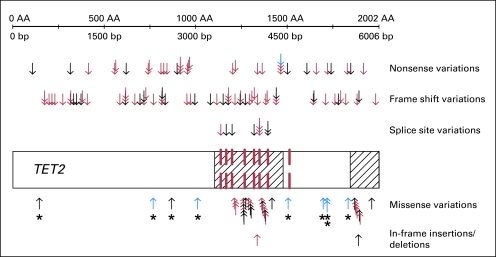
Purpose: To determine the frequency of TET2 mutations, their associations with clinical and molecular characteristics and outcome, and the associated gene- and microRNA-expression signatures in patients with primary cytogenetically normal acute myeloid leukemia (CN-AML).
Patients and methods: Four-hundred twenty-seven patients with CN-AML were analyzed for TET2 mutations by polymerase chain reaction and direct sequencing and for established prognostic gene mutations. Gene- and microRNA-expression profiles were derived using microarrays.
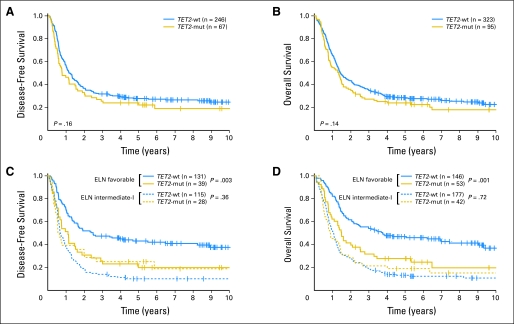
Results: TET2 mutations, found in 23% of patients, were associated with older age (P < .001) and higher pretreatment WBC (P = .04) compared with wild-type TET2 (TET2-wt). In the European LeukemiaNet (ELN) favorable-risk group (patients with CN-AML who have mutated CEBPA and/or mutated NPM1 without FLT3 internal tandem duplication [FLT3-ITD]), TET2-mutated patients had shorter event-free survival (EFS; P < .001) because of a lower complete remission (CR) rate (P = .007), and shorter disease-free survival (DFS; P = .003), and also had shorter overall survival (P = .001) compared with TET2-wt patients. TET2 mutations were not associated with outcomes in the ELN intermediate-I-risk group (CN-AML with wild-type CEBPA and wild-type NPM1 and/or FLT3-ITD). In multivariable models, TET2 mutations were associated with shorter EFS (P = .004), lower CR rate (P = .03), and shorter DFS (P = .05) only among favorable-risk CN-AML patients. We identified a TET2 mutation-associated gene-expression signature in favorable-risk but not in intermediate-I-risk patients and found distinct mutation-associated microRNA signatures in both ELN groups.
Conclusion: TET2 mutations improve the ELN molecular-risk classification in primary CN-AML because of their adverse prognostic impact in an otherwise favorable-risk patient subset. Our data suggest that these patients may be candidates for alternative therapies.
Conflict of interest statement
Authors' disclosures of potential conflicts of interest and author contributions are found at the end of this article.
Figures
References
Publication types
MeSH terms
Substances
Grants and funding
- U10 CA033601/CA/NCI NIH HHS/United States
- U24 CA114725/CA/NCI NIH HHS/United States
- U10 CA101140/CA/NCI NIH HHS/United States
- P30 CA016058/CA/NCI NIH HHS/United States
- CA77658/CA/NCI NIH HHS/United States
- CA31946/CA/NCI NIH HHS/United States
- CA140158/CA/NCI NIH HHS/United States
- CA33601/CA/NCI NIH HHS/United States
- P50 CA140158/CA/NCI NIH HHS/United States
- CA16058/CA/NCI NIH HHS/United States
- CA101140/CA/NCI NIH HHS/United States
- U10 CA077658/CA/NCI NIH HHS/United States
- U10 CA031946/CA/NCI NIH HHS/United States
- R21 CA129657/CA/NCI NIH HHS/United States
- CA129657/CA/NCI NIH HHS/United States
- CA114725/CA/NCI NIH HHS/United States
LinkOut - more resources
Full Text Sources
Other Literature Sources
Medical
Miscellaneous
