


Fish oil concentrate delays sensitivity to thermal nociception in mice
- PMID: 21345372
- PMCID: PMC3081986
- DOI: 10.1016/j.phrs.2011.02.004
Fish oil concentrate delays sensitivity to thermal nociception in mice
Abstract
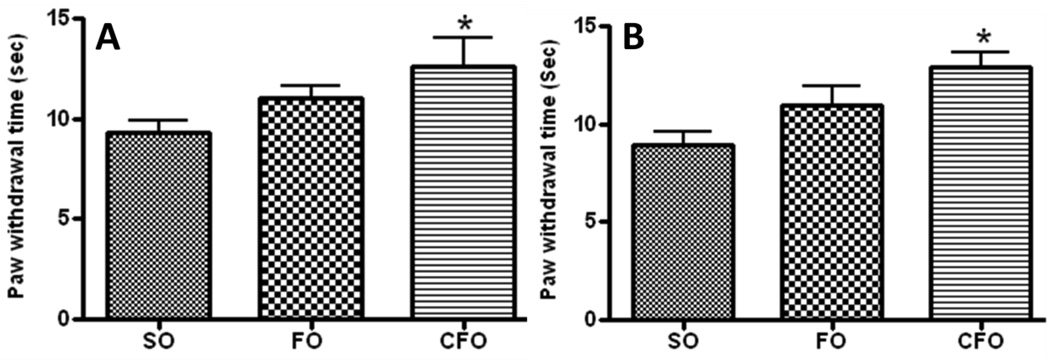
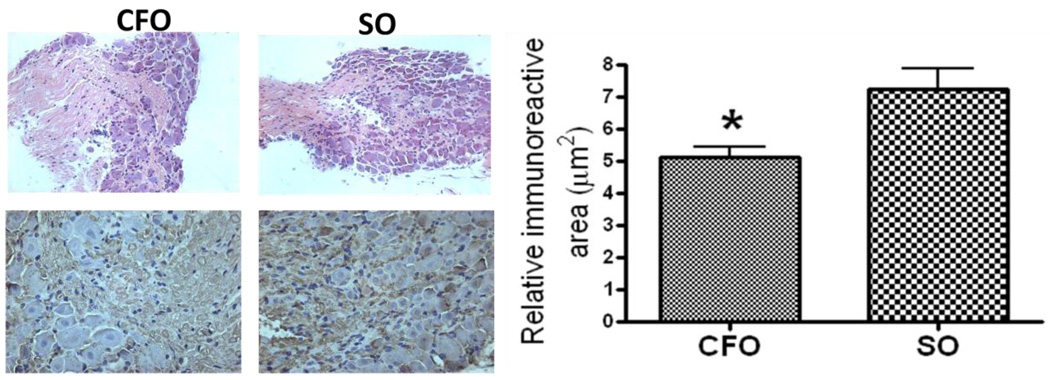
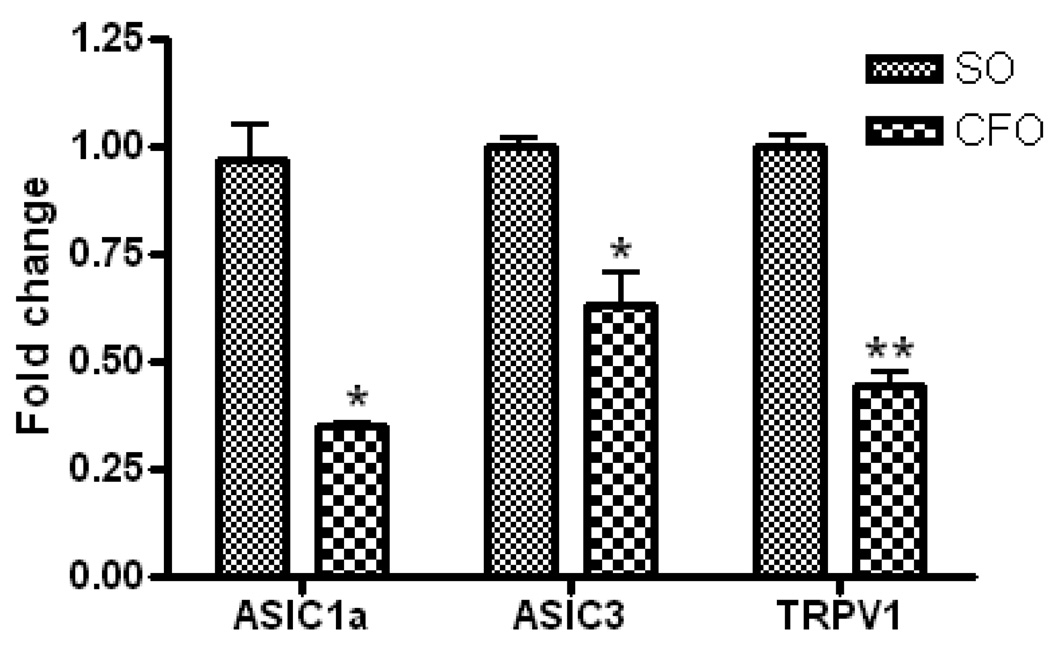
Fish oil has been used to alleviate pain associated with inflammatory conditions such as rheumatoid arthritis. The anti-inflammatory property of fish oil is attributed to the n-3 fatty acids docosahexaenoic acid and eicosapentaenoic acid. Contrarily, vegetable oils such as safflower oil are rich in n-6 fatty acids which are considered to be mediators of inflammation. This study investigates the effect of n-3 and n-6 fatty acids rich oils as dietary supplements on the thermally induced pain sensitivity in healthy mice. C57Bl/6J mice were fed diet containing regular fish oil, concentrated fish oil formulation (CFO) and safflower oil (SO) for 6 months. Pain sensitivity was measured by Plantar test and was correlated to the expression of acid sensing ion channels (ASICs), transient receptor potential vanilloid 1 (TRPV1) and c-fos in dorsal root ganglion cells. Significant delay in sensitivity to thermal nociception was observed in mice fed CFO compared to mice fed SO (p<0.05). A significant diminution in expression of ion channels such as ASIC1a (64%), ASIC13 (37%) and TRPV1 (56%) coupled with reduced expression of c-fos, a marker of neuronal activation, was observed in the dorsal root ganglion cells of mice fed CFO compared to that fed SO. In conclusion, we describe here the potential of fish oil supplement in reducing sensitivity to thermal nociception in normal mice.
Copyright © 2011 Elsevier Ltd. All rights reserved.
Figures
References
-
- Sulindro-Ma MIC, Isenhart AC. Nutrition and supplements for pain management. In: Audette JABA, editor. Integrative pain medicine. USA: Humana Press; 2008. pp. 417–445.
-
- Bhattacharya A, Rahman M, Banu J, Lawrence RA, McGuff HS, Garrett IR, Fischbach M, Fernandes G. Inhibition of osteoporosis in autoimmune disease prone mrl/mpj-fas(lpr) mice by n-3 fatty acids. Journal of the American College of Nutrition. 2005;24:200–209. - PubMed
-
- Chandrasekar B, Troyer DA, Venkatraman JT, Fernandes G. Dietary omega-3 lipids delay the onset and progression of autoimmune lupus nephritis by inhibiting transforming growth-factor-beta messenger-rna and protein expression. Journal of Autoimmunity. 1995;8:381–393. - PubMed
Publication types
MeSH terms
Substances
Grants and funding
LinkOut - more resources
Full Text Sources
Medical
