


Monocyte migration to the synovium in rheumatoid arthritis patients treated with adalimumab
- PMID: 21345816
- PMCID: PMC3086080
- DOI: 10.1136/ard.2010.141549
Monocyte migration to the synovium in rheumatoid arthritis patients treated with adalimumab
Abstract
Objectives: The mechanism of action of treatment with tumour necrosis factor (TNF) blockers in rheumatoid arthritis (RA) is still not completely understood. The aim of this study was to test if adalimumab treatment could affect the influx of monocytes into the synovium.
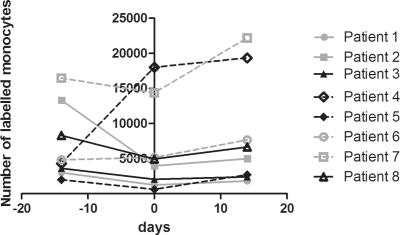
Methods: A novel technique was used to analyse the migration of labelled autologous monocytes before and 14 days after initiation of adalimumab treatment using scintigraphy. CD14 monocytes were isolated from patients with RA, using a positive selection procedure with magnetic-activated cell sorting, and labelled with technetium-99m-hexamethylpropylene-amino-oxime. Scintigraphic scans were made 1, 2 and 3 h after re-infusion.
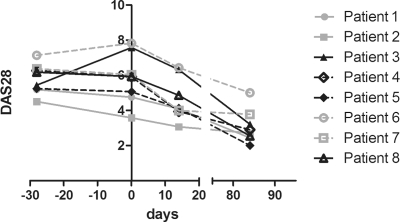
Results: As early as 14 days after the start of treatment with adalimumab a significant decrease in disease activity score evaluated in 28 joints was shown. There was no significant decrease in the influx of monocytes into the joint at this time.
Conclusions: This study indicates that adalimumab treatment does not reduce the influx of monocytes into the synovium early after initiation of treatment. As previous studies showed a rapid decrease in macrophage infiltration after TNF-antibody therapy, which could not be explained by increased cell death, this points to an important role for enhanced efflux of inflammatory cells from the synovium.
Conflict of interest statement
Figures
References
-
- Tracey D, Klareskog L, Sasso EH, et al. Tumor necrosis factor antagonist mechanisms of action: a comprehensive review. Pharmacol Ther 2008;117:244–79 - PubMed
-
- Tak PP, Taylor PC, Breedveld FC, et al. Decrease in cellularity and expression of adhesion molecules by anti-tumor necrosis factor alpha monoclonal antibody treatment in patients with rheumatoid arthritis. Arthritis Rheum 1996;39:1077–81 - PubMed
-
- Taylor PC, Peters AM, Paleolog E, et al. Reduction of chemokine levels and leukocyte traffic to joints by tumor necrosis factor alpha blockade in patients with rheumatoid arthritis. Arthritis Rheum 2000;43:38–47 - PubMed
Publication types
MeSH terms
Substances
LinkOut - more resources
Full Text Sources
Other Literature Sources
Medical
Research Materials
