


Luminal flow regulates NO and O2(-) along the nephron
- PMID: 21345976
- PMCID: PMC3094045
- DOI: 10.1152/ajprenal.00724.2010
Luminal flow regulates NO and O2(-) along the nephron
Abstract
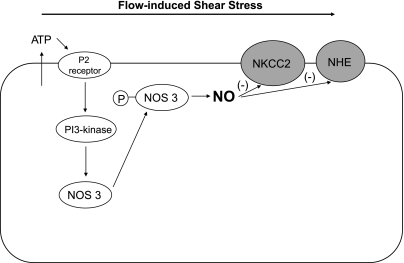
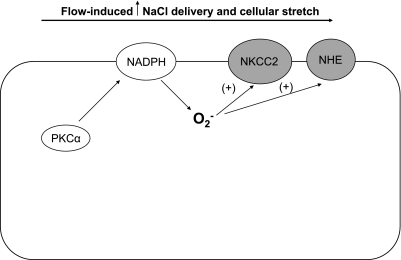
Urinary flow is not constant but in fact highly variable, altering the mechanical forces (shear stress, stretch, and pressure) exerted on the epithelial cells of the nephron as well as solute delivery. Nitric oxide (NO) and superoxide (O(2)(-)) play important roles in various processes within the kidney. Reductions in NO and increases in O(2)(-) lead to abnormal NaCl and water absorption and hypertension. In the last few years, luminal flow has been shown to be a regulator of NO and O(2)(-) production along the nephron. Increases in luminal flow enhance fluid, Na, and bicarbonate transport in the proximal tubule. However, we know of no reports directly addressing flow regulation of NO and O(2)(-) in this segment. In the thick ascending limb, flow-stimulated NO and O(2)(-) formation has been extensively studied. Luminal flow stimulates NO production by nitric oxide synthase type 3 and its translocation to the apical membrane in medullary thick ascending limbs. These effects are mediated by flow-induced shear stress. In contrast, flow-induced stretch and NaCl delivery stimulate O(2)(-) production by NADPH oxidase in this segment. The interaction between flow-induced NO and O(2)(-) is complex and involves more than one simply scavenging the other. Flow-induced NO prevents flow from increasing O(2)(-) production via cGMP-dependent protein kinase in thick ascending limbs. In macula densa cells, shear stress increases NO production and this requires that the primary cilia be intact. The role of luminal flow in NO and O(2)(-) production in the distal tubule is not known. In cultured inner medullary collecting duct cells, shear stress enhances nitrite accumulation, a measure of NO production. Although much progress has been made on this subject in the last few years, there are still many unanswered questions.
Figures
References
-
- Abe M, O'connor P, Kaldunski M, Liang M, Roman RJ, Cowley AW., Jr Effect of sodium delivery on superoxide and nitric oxide in the medullary thick ascending limb. Am J Physiol Renal Physiol 291: F350–F357, 2006 - PubMed
-
- Babior BM. NADPH oxidase: an update. Blood 93: 1464–1476, 1999 - PubMed
-
- Baer PG, Bianchi G, Liliana D. Renal micropuncture study of normotensive and Milan hypertensive rats before and after development of hypertension. Kidney Int 13: 452–466, 1978 - PubMed
-
- Bredt DS, Snyder SH. Nitric oxide: a physiologic messenger molecule. Annu Rev Biochem 63: 175–95, 175–195, 1994 - PubMed
Publication types
MeSH terms
Substances
Grants and funding
LinkOut - more resources
Full Text Sources
