


Targeted therapies for the treatment of metastatic renal cell carcinoma: clinical evidence
- PMID: 21346036
- PMCID: PMC3868199
- DOI: 10.1634/theoncologist.2011-S2-14
Targeted therapies for the treatment of metastatic renal cell carcinoma: clinical evidence
Abstract
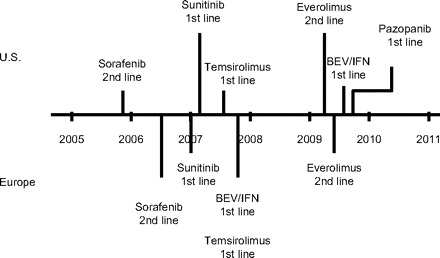
Although systemic therapy for patients with metastatic renal cell carcinoma (mRCC) was once limited to the cytokines interleukin-2 and interferon (IFN)-α, in recent years several targeted therapies have become available for first- and second-line use. These include sorafenib, sunitinib, bevacizumab (plus IFN-α), temsirolimus, everolimus, and, most recently, pazopanib. This expanded list of treatment options arose from molecular biological research that revealed aberrant signal transduction activities in RCC, enabling the identification of specific molecular targets for therapy. Molecular-targeted therapies have better efficacy and tolerability than cytokine therapy, and many are administered orally. The superior outcomes achieved with molecular-targeted agents are prompting investigators to reconsider overall survival as a primary endpoint in clinical trials, given the inherent complications of a required long duration of follow-up, a required large population, and confounding caused by crossover trial designs or effects of subsequent therapy after progression on the agent of interest. In mRCC trials, progression-free survival has become a popular primary endpoint and has served as the basis of approval for several targeted therapies. In addition to the identification of new agents, current research is focused on the evaluation of combination therapy with targeted agents. As more information regarding mechanisms of disease and drug resistance becomes available, new targets, new targeted agents, and new combinations will be studied with the goal of providing maximal efficacy with minimal toxicity. This article reviews the clinical evidence supporting the benefits of targeted agents in mRCC treatment, discusses survival endpoints used in their pivotal clinical trials, and outlines future research directions.
Conflict of interest statement
The content of this article has been reviewed by independent peer reviewers to ensure that it is balanced, objective, and free from commercial bias. No financial relationships relevant to the content of this article have been disclosed by the independent peer reviewers.
Figures
References
-
- National Comprehensive Cancer Network. NCCN Clinical Practice Guidelines in Oncology™. Kidney Cancer. [accessed March 26, 2010]. V. 2.2010. Available at http://www.nccn.org/professionals/physician_gls/PDF/kidney.pdf.
-
- Oudard S, George D, Medioni J, et al. Treatment options in renal cell carcinoma: Past, present and future. Ann Oncol. 2007;18(suppl 10):x25–x31. - PubMed
-
- Escudier B, Chevreau C, Lasset C, et al. Cytokines in metastatic renal cell carcinoma: Is it useful to switch to interleukin-2 or interferon after failure of a first treatment? J Clin Oncol. 1999;17:2039–2043. - PubMed
-
- Mulders P. Vascular endothelial growth factor and mTOR pathways in renal cell carcinoma: Differences and synergies of two targeted mechanisms. BJU Int. 2009;104:1585–1589. - PubMed
Publication types
MeSH terms
Substances
LinkOut - more resources
Full Text Sources
Other Literature Sources
Medical
Molecular Biology Databases
Research Materials
