


Dietary B vitamin intake and incident premenstrual syndrome
- PMID: 21346091
- PMCID: PMC3076657
- DOI: 10.3945/ajcn.110.009530
Dietary B vitamin intake and incident premenstrual syndrome
Abstract
Background: Thiamine, riboflavin, niacin, vitamin B-6, folate, and vitamin B-12 are required to synthesize neurotransmitters that are potentially involved in the pathophysiology of premenstrual syndrome (PMS).
Objective: The objective was to evaluate whether B vitamin intake from food sources and supplements is associated with the initial development of PMS.
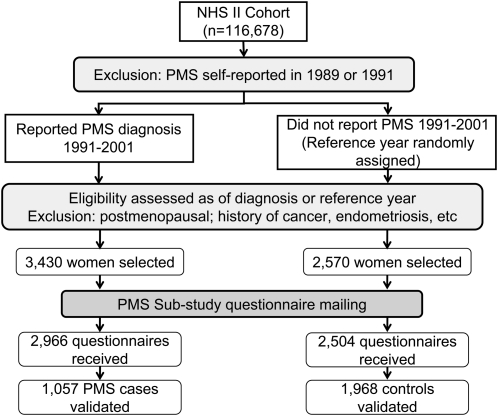
Design: We conducted a case-control study nested within the Nurses' Health Study II cohort. Participants were free of PMS at baseline (1991). After 10 y of follow up, 1057 women were confirmed as cases and 1968 were confirmed as controls. Dietary information was collected in 1991, 1995, and 1999 by using food-frequency questionnaires.
Results: Intakes of thiamine and riboflavin from food sources were each inversely associated with incident PMS. For example, women in the highest quintile of riboflavin intake 2-4 y before the diagnosis year had a 35% lower risk of developing PMS than did those in the lowest quintile (relative risk: 0.65; 95% CI: 0.45, 0.92; P for trend = 0.02). No significant associations between incident PMS and dietary intakes of niacin, vitamin B-6, folate, and vitamin B-12 were observed. Intake of B vitamins from supplements was not associated with a lower risk of PMS.
Conclusions: We observed a significantly lower risk of PMS in women with high intakes of thiamine and riboflavin from food sources only. Further research is needed to evaluate the effects of B vitamins in the development of premenstrual syndrome.
Figures
Similar articles
-
B-Vitamin Intake from Diet and Supplements and Breast Cancer Risk in Middle-Aged Women: Results from the Prospective NutriNet-Santé Cohort.Nutrients. 2017 May 13;9(5):488. doi: 10.3390/nu9050488. Nutrients. 2017. PMID: 28505069 Free PMC article.
-
Calcium and vitamin D intake and risk of incident premenstrual syndrome.Arch Intern Med. 2005 Jun 13;165(11):1246-52. doi: 10.1001/archinte.165.11.1246. Arch Intern Med. 2005. PMID: 15956003
-
Protein intake and the risk of premenstrual syndrome.Public Health Nutr. 2019 Jul;22(10):1762-1769. doi: 10.1017/S1368980018004019. Epub 2019 Feb 18. Public Health Nutr. 2019. PMID: 30774065 Free PMC article.
-
Vitamins, minerals and supplements: part two.Community Pract. 2005 Oct;78(10):366-8. Community Pract. 2005. PMID: 16245676 Review.
-
Relationships between Premenstrual Syndrome (PMS) and Diet Composition, Dietary Patterns and Eating Behaviors.Nutrients. 2024 Jun 17;16(12):1911. doi: 10.3390/nu16121911. Nutrients. 2024. PMID: 38931266 Free PMC article. Review.
Cited by
-
Patterns of premenstrual syndrome in collegiate women: A cross-sectional study.Medicine (Baltimore). 2022 Sep 2;101(35):e30186. doi: 10.1097/MD.0000000000030186. Medicine (Baltimore). 2022. PMID: 36107511 Free PMC article.
-
Association of Premenstrual Syndrome with Blood Pressure in Young Adult Women.J Womens Health (Larchmt). 2016 Nov;25(11):1122-1128. doi: 10.1089/jwh.2015.5636. Epub 2016 Jul 15. J Womens Health (Larchmt). 2016. PMID: 27420549 Free PMC article.
-
Dietary Reference Values for riboflavin.EFSA J. 2017 Aug 7;15(8):e04919. doi: 10.2903/j.efsa.2017.4919. eCollection 2017 Aug. EFSA J. 2017. PMID: 32625611 Free PMC article.
-
Intake of selected minerals and risk of premenstrual syndrome.Am J Epidemiol. 2013 May 15;177(10):1118-27. doi: 10.1093/aje/kws363. Epub 2013 Feb 26. Am J Epidemiol. 2013. PMID: 23444100 Free PMC article.
-
Association of the Anxiety/Depression with Nutrition Intake in Stroke Patients.Clin Nutr Res. 2018 Jan;7(1):11-20. doi: 10.7762/cnr.2018.7.1.11. Epub 2018 Jan 30. Clin Nutr Res. 2018. PMID: 29423385 Free PMC article.
References
-
- American College of Obstetrics and Gynecology Practice Bulletin Clinical management guidelines for obstetricians-gynecologists. Obstet Gynecol 2000;95:1–9 - PubMed
-
- Backstrom T, Andreen L, Birzniece V, et al. The role of hormones and hormonal treatments in premenstrual syndrome. CNS Drugs 2003;17:325–42 - PubMed
-
- Halbreich U. The etiology, biology, and evolving pathology of premenstrual syndromes. Psychoneuroendocrinology 2003;28(suppl 3):55–99 - PubMed
-
- Stipanuk MH. Biochemical, physiological, & molecular aspects of human nutrition. 2nd ed. St Louis, MO: Saunders Elsevier, 2006
-
- Frankenburg FR. The role of one-carbon metabolism in schizophrenia and depression. Harv Rev Psychiatry 2007;15:146. - PubMed
Publication types
MeSH terms
Substances
LinkOut - more resources
Full Text Sources
Medical
