


Statistical Mining of Potential Drug Interaction Adverse Effects in FDA's Spontaneous Reporting System
- PMID: 21346985
- PMCID: PMC3041376
Statistical Mining of Potential Drug Interaction Adverse Effects in FDA's Spontaneous Reporting System
Abstract
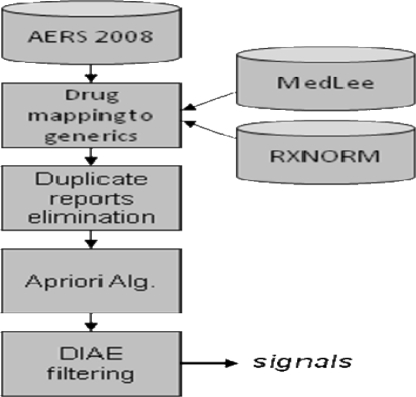
Many adverse drug effects (ADEs) can be attributed to drug interactions. Spontaneous reporting systems (SRS) provide a rich opportunity to detect novel post-marketed drug interaction adverse effects (DIAEs), as they include populations not well represented in clinical trials. However, their identification in SRS is nontrivial. Most existing research have addressed the statistical issues used to test or verify DIAEs, but not their identification as part of a systematic large scale database-wide mining process as discussed in this work. This paper examines the application of a highly optimized and tailored implementation of the Apriori algorithm, as well as methods addressing data quality issues, to the identification of DIAEs in FDAs SRS.
References
-
- Hauben M, Madigan D, Gerrits CM, Walsh L, van Puijenbroek EP. The role of data mining in pharmacovigilance. Expert Opin Drug Saf. 2005 Sep;4(5):929–48. - PubMed
-
- Almenoff J, Tonning JM, Gould AL, et al. Perspectives on the use of data mining in pharmaco-vigilance. Drug Saf. 2005;28(11):981–1007. - PubMed
-
- Bate A, Evans SJ. Quantitative signal detection using spontaneous ADR reporting. Pharmacoepidemiol Drug Saf. 2009 Jun;18(6):427–36. - PubMed
-
- Szarfman A, Machado SG, O’Neill RT. Use of screening algorithms and computer systems to efficiently signal higher-than-expected combinations of drugs and events in the US FDA’s spontaneous reports database. Drug Saf. 2002;25(6):381–92. - PubMed
MeSH terms
Grants and funding
LinkOut - more resources
Full Text Sources