


Leveraging biomedical ontologies and annotation services to organize microbiome data from Mammalian hosts
- PMID: 21347072
- PMCID: PMC3041364
Leveraging biomedical ontologies and annotation services to organize microbiome data from Mammalian hosts
Abstract
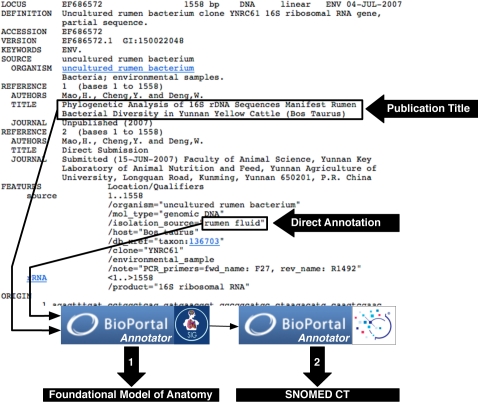
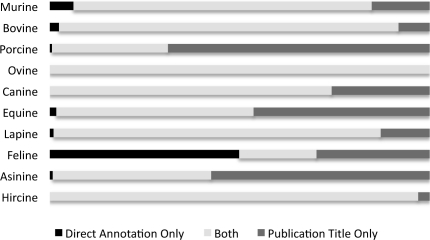
A better understanding of commensal microbiotic communities ("microbiomes") may provide valuable insights to human health. Towards this goal, an essential step may be the development of approaches to organize data that can enable comparative hypotheses across mammalian microbiomes. The present study explores the feasibility of using existing biomedical informatics resources - especially focusing on those available at the National Center for Biomedical Ontology - to organize microbiome data contained within large sequence repositories, such as GenBank. The results indicate that the Foundational Model of Anatomy and SNOMED CT can be used to organize greater than 90% of the bacterial organisms associated with 10 domesticated mammalian species. The promising findings suggest that the current biomedical informatics infrastructure may be used towards the organizing of microbiome data beyond humans. Furthermore, the results identify key concepts that might be organized into a semantic structure for incorporation into subsequent annotations that could facilitate comparative biomedical hypotheses pertaining to human health.
Figures
References
-
- Ley RE, Peterson DA, Gordon JI. Ecological and evolutionary forces shaping microbial diversity in the human intestine. Cell. 2006 Feb 24;124(4):837–48. - PubMed
-
- Tsai F, Coyle WJ. The microbiome and obesity: is obesity linked to our gut flora? Curr Gastroenterol Rep. 2009 Aug;11(4):307–13. - PubMed
-
- Kinross JM, von Roon AC, Holmes E, Darzi A, Nicholson JK. The human gut microbiome: implications for future health care. Curr Gastroenterol Rep. 2008 Aug;10(4):396–403. - PubMed
MeSH terms
Grants and funding
LinkOut - more resources
Full Text Sources