


Effects of body fat on the associations of high-molecular-weight adiponectin, leptin and soluble leptin receptor with metabolic syndrome in Chinese
- PMID: 21347230
- PMCID: PMC3039650
- DOI: 10.1371/journal.pone.0016818
Effects of body fat on the associations of high-molecular-weight adiponectin, leptin and soluble leptin receptor with metabolic syndrome in Chinese
Abstract
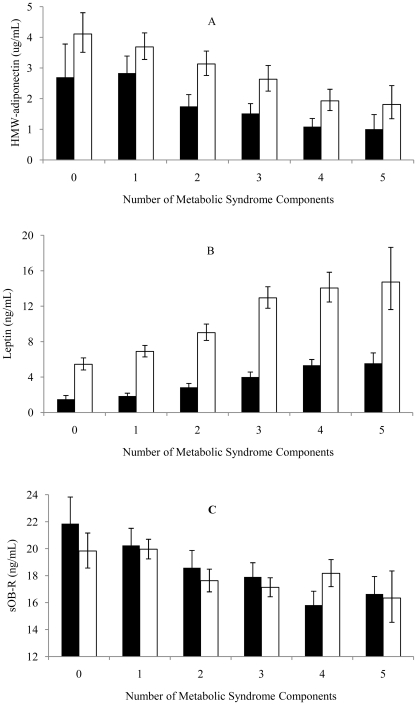
Background: Little is known regarding the associations between high-molecular-weight (HMW-) adiponectin, leptin and soluble leptin receptor (sOB-R) and metabolic syndrome (MetS) in Chinese. Also few studies elucidate the effects of inflammation and body fat mass on the relations.
Methods: Plasma HMW-adiponectin, leptin and sOB-R were measured among 1055 Chinese men and women (35∼54 yrs). Whole body and trunk fat mass were determined by Dual-energy X-ray absorptiometry. MetS was defined by the updated NCEP/ATPIII criterion for Asian-Americans.
Results: HMW-adiponectin was inversely associated with MetS in multivariate model including fat mass index (FMI), inflammatory markers, leptin and sOB-R (OR in the highest quartile= 0.30, 95%CI 0.18∼0.50, P<.0001). Plasma sOB-R was also inversely associated with MetS independent of body fatness and inflammatory markers, whereas the association was somewhat attenuated after adjusting HMW-adiponectin (OR for the highest quartile = 0.78, 95%CI 0.47∼1.32, P = 0.15). In contrast, leptin was associated with increased odds of MetS independent of inflammatory markers, HMW-adiponectin, and sOB-R (OR for the highest quartile= 2.64, 95%CI 1.35∼5.18, P = 0.006), although further adjustment for FMI abolished this association.
Conclusions: HMW-adiponectin exhibited strong inverse associations with MetS independent of body composition, inflammation, leptin and sOB-R; while the associations of leptin and sOB-R were largely explained by fat mass or HMW-adiponectin, respectively.
Conflict of interest statement
Figures
References
-
- Van Gaal LF, Mertens IL, De Block CE. Mechanisms linking obesity with cardiovascular disease. Nature. 2006;444:875–880. - PubMed
-
- Tilg H, Moschen AR. Adipocytokines: mediators linking adipose tissue, inflammation and immunity. Nat Rev Immunol. 2006;6:772–783. - PubMed
-
- Maury E, Brichard SM. Adipokine dysregulation, adipose tissue inflammation and metabolic syndrome. Mol Cell Endocrinol. 2010;314:1–16. - PubMed
-
- Wang J, Li H, Franco OH, Yu Z, Liu Y, et al. Adiponectin and metabolic syndrome in middle-aged and elderly Chinese. Obesity (Silver Spring) 2008;16:172–178. - PubMed
-
- Li S, Shin HJ, Ding EL, van Dam RM. Adiponectin levels and risk of type 2 diabetes: a systematic review and meta-analysis. JAMA. 2009;302:179–188. - PubMed
Publication types
MeSH terms
Substances
LinkOut - more resources
Full Text Sources
Medical
