


Antibody dynamics of 2009 influenza A (H1N1) virus in infected patients and vaccinated people in China
- PMID: 21347418
- PMCID: PMC3036653
- DOI: 10.1371/journal.pone.0016809
Antibody dynamics of 2009 influenza A (H1N1) virus in infected patients and vaccinated people in China
Abstract
Background: To evaluate the risk of the recurrence and the efficiency of the vaccination, we followed-up antibody responses in patients with the 2009 pandemic H1N1 influenza and persons who received the pandemic H1N1 vaccine in Guangzhou China.
Methods: We collected serum samples from 129 patients and 86 vaccinated persons at day 0, 15, 30, 180 after the disease onset or the vaccination, respectively. Antibody titers in these serum samples were determined by haemagglutination inhibition (HI) assay using a local isolated virus strain A/Guangdong Liwan/SWL1538/2009(H1N1).
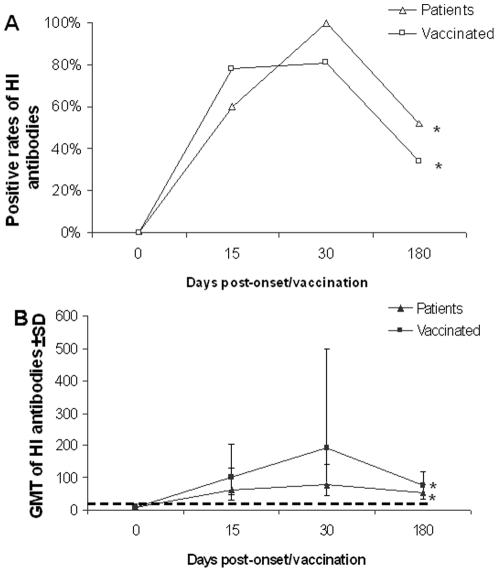
Results: HI antibody positive rate of the patients increased significantly from 0% to 60% at day 15 (χ(2) = 78, P<0.001) and 100% at day 30 (χ(2) = 23, P<0.001), but decreased significantly to 52% at day 180 (χ(2) = 38, P<0.001), while that of vaccinated subjects increased from 0% to 78% at day 15 (χ(2) = 110, P<0.001) and 81% at day 30 (χ(2) = 0.32, P = 0.57), but decreased significantly to 34% at day 180 (χ(2) = 39, P<0.001). Geometric mean titers (GMT) of HI antibodies in positive samples from the patients did not change significantly between day 15 and day 30 (T = 0.92, P = 0.36), but it decreased significantly from 80 at day 30 to 52 at day 180 (T = 4.5, P<0.001). GMT of vaccinated persons increased significantly from 100 at day 15 to 193 at day 30 (T = 4.5, P<0.001), but deceased significantly to 74 at day 180 (T = 5.1, P<0.001). Compared to the patients, the vaccinated subjects showed lower seroconversion rate (χ(2) = 11, P<0.001; χ(2) = 5.9, P = 0.015), but higher GMT (T = 6.0, P<0.001; T = 3.6, P = 0.001) at day 30 and day 180, respectively.
Conclusion: Vaccination of 2009 influenza A (H1N1) was effective. However, about half or more recovered patients and vaccinated persons might have lost sufficient immunity against the recurrence of the viral infection after half a year. Vaccination or re-vaccination may be necessary for prevention of the recurrence.
Conflict of interest statement
Figures
References
-
- WHO. In focus: H1N1 now in the post-pandemic period. 2010. 10 August 2010. Available: http://www.who.int/csr/disease/swineflu/en/. Accessed 4 September 2010.
-
- WHO. 2010. Director-General statement following the seventh meeting of the Emergency Committee. 24 February 2010. Available: http://www.who.int/csr/disease/swineflu/7th_meeting_ihr/en/. Accessed 5 July 2010.
-
- Wang M, Fu CX, Zheng BJ. Antibodies against H5 and H9 avian influenza among poultry workers in China. N Engl J Med. 2009;360:2583–4. - PubMed
-
- Girard MP, Tam JS, Assossou OM, Kieny MP. The 2009 A (H1N1) influenza virus pandemic: A review. Vaccine. 2010;28:4895–4902. - PubMed
Publication types
MeSH terms
Substances
LinkOut - more resources
Full Text Sources
Other Literature Sources
Medical
