. 2011 Jun;20(3):335-45.
doi: 10.1111/j.1365-2583.2011.01068.x. Epub 2011 Feb 23.

Neuropeptide Y-like signalling and nutritionally mediated gene expression and behaviour in the honey bee

Affiliations

Neuropeptide Y-like signalling and nutritionally mediated gene expression and behaviour in the honey bee

S A Ament et al. Insect Mol Biol. 2011 Jun.

Abstract

Previous research has led to the idea that derived traits can arise through the evolution of novel roles for conserved genes. We explored whether neuropeptide Y (NPY)-like signalling, a conserved pathway that regulates food-related behaviour, is involved in a derived, nutritionally-related trait, the division of labour in worker honey bees. Transcripts encoding two NPY-like peptides were expressed in separate populations of brain neurosecretory cells, consistent with endocrine functions. NPY-related genes were upregulated in the brains of older foragers compared with younger bees performing brood care ('nurses'). A subset of these changes can be attributed to nutrition, but neuropeptide F peptide treatments did not influence sugar intake. These results contrast with recent reports of more robust associations between division of labour and the related insulin-signalling pathway and suggest that some elements of molecular pathways associated with feeding behaviour may be more evolutionarily labile than others.


Figures

Figure 1
Figure 1. npf and snpf are expressed in distinct populations of neurosecreotry cells in the honey bee brain
In situ hybridization of digoxigenin-labeled probes specific to npf (A) and snpf (B) to 10μm coronal cryosections of forager brains. The mushroom body calyces are shown at top in each image. npf-containing cells are located within a population of large cells located dorsally at the midline (within the pars intercerebralis) that can be identified from their position and morphology as neurosecretory cells. snpf-containing cells are located in a separate population lateral to the mushroom body calyces that resemble the lateral population of neurosecretory cells. Scale bar = 400um.
Figure 2
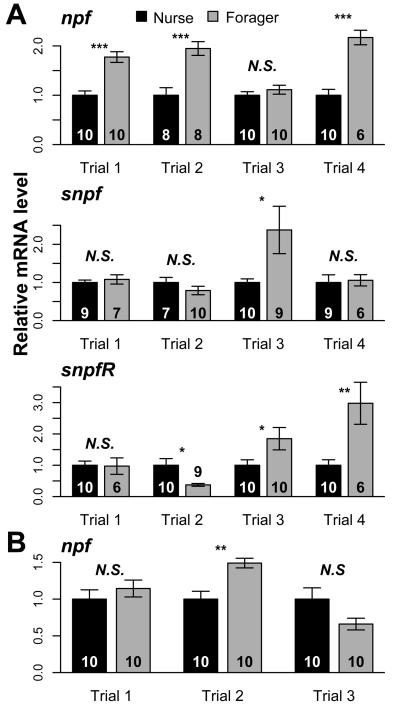
Figure 2. Expression of NPY-like signaling genes in nurses and foragers
RT-qPCR was used to measure the expression of npf, snpf, and snpfR in whole brains (A) and of npf in whole abdomens (B) of nurses and foragers from typical honey bee colonies. Expression values for nurse and forager in each trial are shown as fold changes relative to nurse (mean set at 1 for each trial). Mixed Model ANOVA for combined trials: npf: Pgroup < 0.0001, Pgroup × colony < 0.0001; snpf: Pgroup > 0.05, Pgroup × colony > 0.05; snpfR: Pgroup > 0.05, Pgroup × colony < 0.0001. Student's t-test for individual trials: * P < 0.05, ** P < 0.01, *** P < 0.001.
Figure 3
Figure 3. Effects of nutritional manipulations on NPY-like signaling genes
(A) Expression of npf, snpf, and snpfR in brains of worker honey bees following manipulations of diet quality. Bees were placed into cages at one day of age and fed either a nutrient poor diet (“sugar”) or a nutrient-rich also containing pollen/honey paste (“sugar+pollen”). N = 9-10 bees / trial. (B) Expression of npf, snpf, and snpfR in brains of worker honey bees following colony food deprivation. One-day-olds were placed into miniature colonies in the field and were either “well-fed” with ad libitum pollen and honey or “food-deprived” by feeding only honey for two days followed by two days without food. N = 9-10 bees / trial. Mixed Model ANOVA for food-deprivation: npf: Ptrt(1,42) > 0.05, Ptrt × trial(2, 42) > 0.05; snpf: Ptrt(1,27) > 0.05, Ptrt × trial(2,27) < 0.01; snpfR: Ptrt(1,44) < 0.0001, Ptrt × trial (2,44) > 0.05. Student's t-test for individual trials: * P < 0.05, ** P < 0.01, *** P < 0.001.
Figure 4
Figure 4. Maturational differences in brain snpfR expression depend on nutrition
One-day-olds (“young bees”), nurses, and foragers were collected from a typical colony and placed into cages. Bees were fed for five days with one of three diets: sugar syrup (“sugar”), sugar syrup and pollen/honey paste (“sugar+pollen”), or sugar syrup and soy protein/honey paste (“sugar+soy”). Transcript abundance for npf, snpf, and snpfR was measured in brains. Pooled data are shown from two independent trials. N = 20 bees. Mixed-model ANOVA for all groups, followed by planned contrasts between nurses and foragers with Bonferroni corrections for multiple comparisons: * P < 0.05, ** P < 0.01, *** P < 0.001.
Figure 5
Figure 5. Injection of NPF peptide into the brain does not influence food intake
Sugar syrup intake of foragers after injection with 1ug NPF peptide into the brain via the ocellar tract; controls were injected with vehicle only (water). Results represent the aggregate food intake of 10 bees placed together in a cage. n=5 trials / group.

References

    1. Amdam GV, Norberg K, Hagen A, Omholt SW. Social exploitation of vitellogenin. Proc Natl Acad Sci USA. 2003;100:1799–1802. - PMC - PubMed
    1. Ament SA, Corona M, Pollock HS, Robinson GE. Insulin signaling is involved in the regulation of worker division of labor in honey bee colonies. Proc Natl Acad Sci USA. 2008;105:4226–4231. - PMC - PubMed
    1. Ament SA, Wang Y, Robinson GE. Nutritional regulation of division of labor in honey bees: toward a systems biology perspective. 2010;2:566–576. - PubMed
    1. Ben-Shahar Y, Dudek NL, Robinson GE. Phenotypic deconstruction reveals involvement of manganese transporter malvolio in honey bee division of labor. J Exp Biol. 2004;207:3281–3288. - PubMed
    1. Ben-Shahar Y, Robichon A, Sokolowski MB, Robinson GE. Influence of gene action across different time scales on behavior. Science. 2002;296:741–744. - PubMed

Publication types

LinkOut - more resources