. 2011 Mar 15;10(6):999-1009.
doi: 10.4161/cc.10.6.14966. Epub 2011 Mar 15.

Stochastic exit from mitosis in budding yeast: model predictions and experimental observations

Affiliations

Stochastic exit from mitosis in budding yeast: model predictions and experimental observations

David A Ball et al. Cell Cycle. .

Abstract

Unlike many mutants that are completely viable or inviable, the CLB2-dbΔ clb5Δ mutant of Saccharomyces cerevisiae is inviable in glucose but partially viable on slower growth media such as raffinose. On raffinose, the mutant cells can bud and divide but in each cycle there is a chance that a cell will fail to divide (telophase arrest), causing it to exit the cell cycle. This effect gives rise to a stochastic phenotype that cannot be explained by a deterministic model. We measure the inter-bud times of wild type and mutant cells growing on raffinose and compute statistics and distributions to characterize the mutant's behavior. We convert a detailed deterministic model of the budding yeast cell cycle to a stochastic model and determine the extent to which it captures the stochastic phenotype of the mutant strain. Predictions of the mathematical model are in reasonable agreement with our experimental data and suggest directions for improving the model. Ultimately, the ability to accurately model stochastic phenotypes may prove critical to understanding disease and therapeutic interventions in higher eukaryotes.


Figures
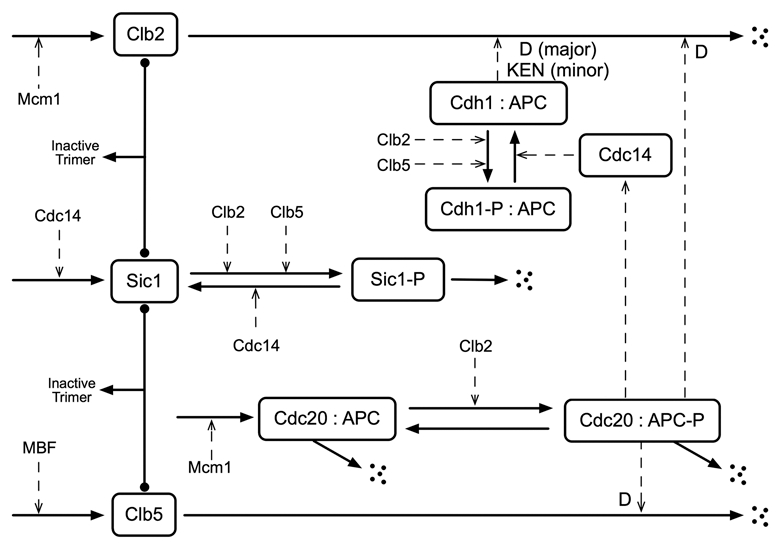
Figure 1
Figure 1
Wiring diagram of the interactions involving Clb2 and Clb5 at the exit from mitosis. Solid lines indicate reactions, solid lines with filled balls at the ends indicate reversible association reactions and dashed lines indicate the influences of transcription factors or enzymes. A : indicates a complex. We assume that Clb2 and Clb5 are always complexed with Cdc28 and do not denote this explicitly. D denotes degradation by targeting the destruction box and KEN denotes degradation by targeting the KEN box.
Figure 2
Figure 2
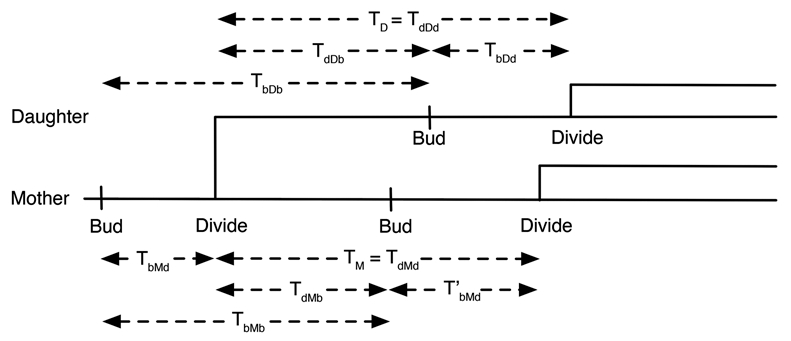
Depiction of time intervals defining inter-division and inter-bud times. The cell cycle time from division to division of the daughter, TD and mother, TM, are related to the division to bud times of the daughter and mother, TdDb and TdMb respectively and to the bud to division times, TbDd and TbMd respectively. This allows us to conclude that the bud to bud times for the daughter and mother, TbDb and TbMb respectively, should have approximately the same statistics as the corresponding division to division times.
Figure 3
Figure 3
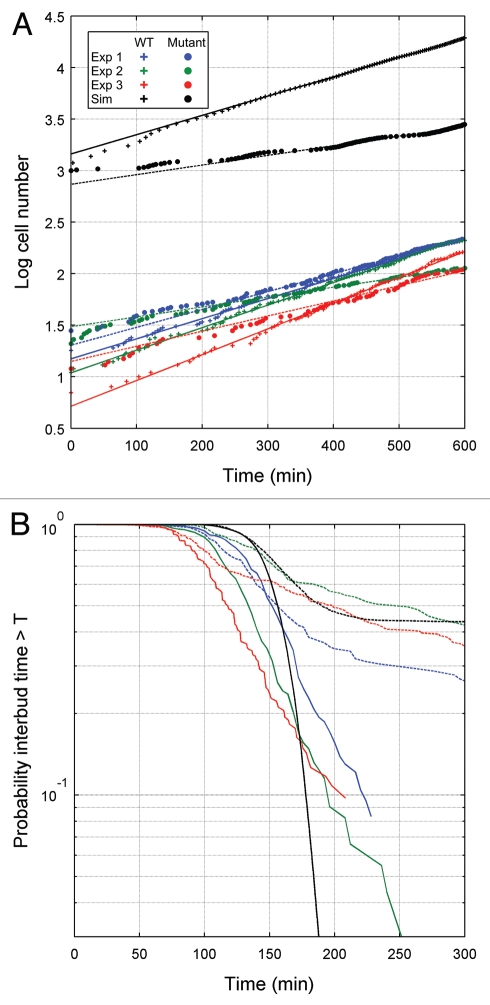
Comparison of wild-type and mutant cell growth in raffinose in experiments and simulations. (A) For each of three separate experiments (1 = blue, 2 = green, 3 = red) and simulation (black) the initial number of cells is plotted at t =-and at each bud event (division event for simulations) thereafter the number of cells is increased by one for wild-type (+) and mutant strains (•). The lines are least-squares fits to the points for t > 300 min (solid: wild-type, dashed: mutant). (B) Probability that the time between buds is greater than a specified time for the three experiments and a simulation depicted in (A). Line colors and styles correspond to the same datasets shown in (A).
Figure 4
Figure 4
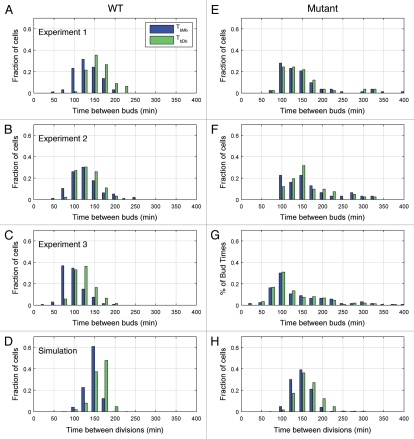
Histograms of cell cycle duration in mother and daughter cells. Budding events were tabulated manually and the time between the emergence of consecutive buds was calculated for wild-type cells (A–C) and for mutant cells (E–G) in experiments 1–3, respectively. For simulated data (D and H), the time between division events, rather than budding events, was used for wild-type cells (D) and for mutant cells (H).
Figure 5
Figure 5
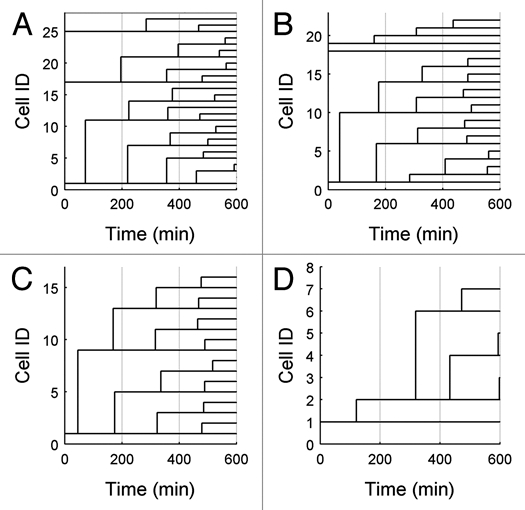
Dendrographs for typical cells. Example lineages of three wild-type cells (A) and three mutant cells (B), demonstrating the various proliferation patterns observed. Dendrographs from simulated wild-type and mutant cells are shown in (C and D), respectively, for comparison. In the figure, branch points occur at new budding events, for the experimental data, and at division events for simulations. Cell ID is an arbitrary identifier used for cell tracking.

Comment in

  • Two legs are better than one.
    Freire P, Zhang T. Freire P, et al. Cell Cycle. 2011 Apr 15;10(8):1189-90. doi: 10.4161/cc.10.8.15298. Epub 2011 Apr 15. Cell Cycle. 2011. PMID: 21436620 No abstract available.

References

    1. Weinberg RA. The biology of cancer. London: Garland Science; 2006.
    1. Lorincz A, Carter BLA. Control of cell size at bud initiation in Saccharomyces cerevisiae. Journal of General Microbiology. 1979;113:287–295.
    1. Sinclair DA, Mills K, Guarente L. Molecular mechanisms of yeast aging. Trends Biochem Sci. 1998;23:131–134. - PubMed
    1. Wäsch R, Cross FR. Apc-dependent proteolysis of the mitotic cyclin clb2 is essential for mitotic exit. Nature. 2002;418:556–562. - PubMed
    1. Cross FR. Two redundant oscillatory mechanisms in the yeast cell cycle. Dev Cell. 2003;4:741–752. - PubMed

Publication types

MeSH terms

LinkOut - more resources