


Brief report: no association between parental age and extreme social-communicative autistic traits in the general population
- PMID: 21350918
- PMCID: PMC3160499
- DOI: 10.1007/s10803-011-1202-4
Brief report: no association between parental age and extreme social-communicative autistic traits in the general population
Abstract
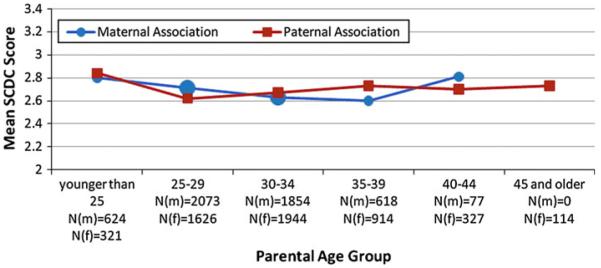
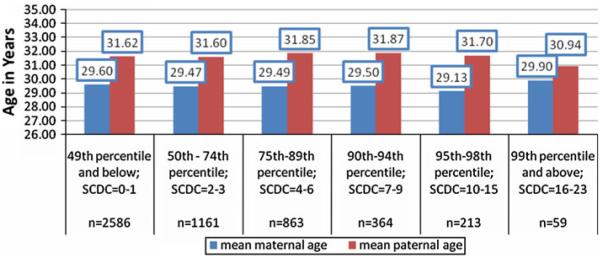
This is the first investigation of the relationship between parental age and extreme social-communicative autistic traits in the general population. The parents of 5,246 children in the Avon Longitudinal Study of Parents and Children (ALSPAC) completed the Social and Communication Disorders Checklist (SCDC). The association between parental age and SCDC scores was assessed in the full sample and among high scoring individuals (e.g. top 5%, 1%). There was no association between parental age and social-communicative autistic traits in the general population. Neither maternal nor paternal age was associated with extreme scores. These findings suggest that advanced parental age does not confer increased risk for extreme social and communication impairment assessed quantitatively.
Figures
References
-
- Cantor RM, Yoon JL, Furr J, Lajonchere CM. Paternal age and autism are associated in a family-based sample. Molecular Psychiatry. 2007;12(5):419–421. - PubMed
-
- Cohen P, Cohen J. The clinician’s illusion. Archives of General Psychiatry. 1984;41:1178–1182. - PubMed
-
- Croen LA, Najjar DV, Fireman B, Grether JK. Maternal and paternal age and risk of autism spectrum disorders. Archives of Pediatrics and Adolescent Medicine. 2007;161(4):334–340. - PubMed
-
- Fraser AM, Brockert JE, Ward RH. Association of young maternal age with adverse reproductive outcomes. New England Journal of Medicine. 1995;332(17):1113–1117. - PubMed
Publication types
MeSH terms
Grants and funding
LinkOut - more resources
Full Text Sources
