


Chronic intermittent ethanol exposure in early adolescent and adult male rats: effects on tolerance, social behavior, and ethanol intake
- PMID: 21352250
- PMCID: PMC3135755
- DOI: 10.1111/j.1530-0277.2011.01474.x
Chronic intermittent ethanol exposure in early adolescent and adult male rats: effects on tolerance, social behavior, and ethanol intake
Abstract
Background: Given the prevalence of alcohol use in adolescence, it is important to understand the consequences of chronic ethanol exposure during this critical period in development. The purpose of this study was to assess possible age-related differences in susceptibility to tolerance development to ethanol-induced sedation and withdrawal-related anxiety, as well as voluntary ethanol intake after chronic exposure to relatively high doses of ethanol during adolescence or adulthood.
Methods: Juvenile/adolescent and adult male Sprague-Dawley rats were assigned to one of five 10-day exposure conditions: chronic ethanol (4 g/kg every 48 hours), chronic saline (equivalent volume every 24 hours), chronic saline/acutely challenged with ethanol (4 g/kg on day 10), nonmanipulated/acutely challenged with ethanol (4 g/kg on day 10), or nonmanipulated. For assessment of tolerance development, duration of the loss of righting reflex (LORR) and blood ethanol concentrations (BECs) upon regaining of righting reflex (RORR) were tested on the first and last ethanol exposure days in the chronic ethanol group, with both saline and nonmanipulated animals likewise challenged on the last exposure day. Withdrawal-induced anxiety was indexed in a social interaction test 24 hours after the last ethanol exposure, with ethanol-naïve chronic saline and nonmanipulated animals serving as controls. Voluntary intake was assessed 48 hours after the chronic exposure period in chronic ethanol, chronic saline and nonmanipulated animals using an 8-day 2 bottle choice, limited-access ethanol intake procedure.
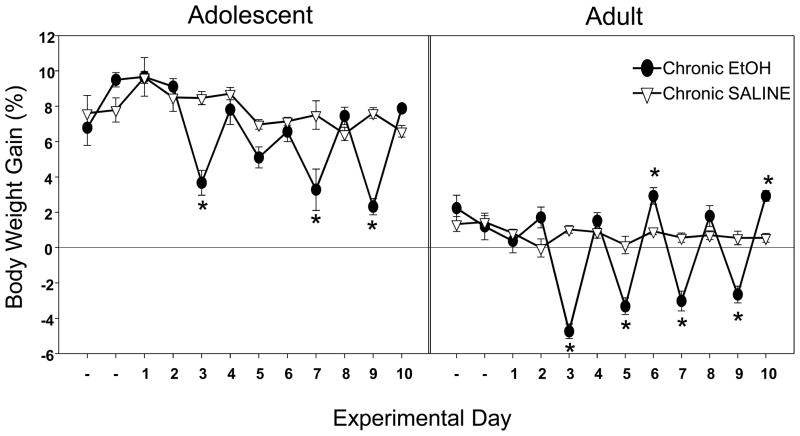
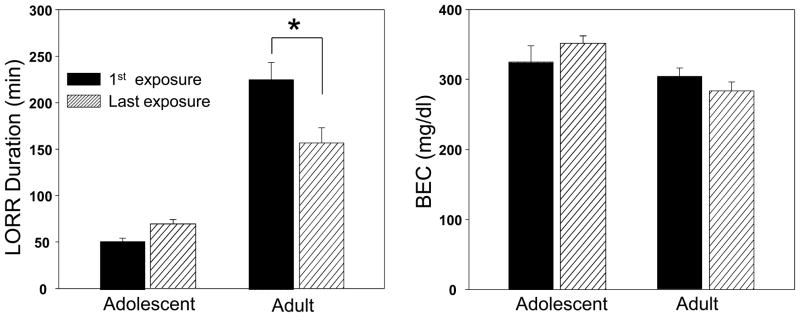
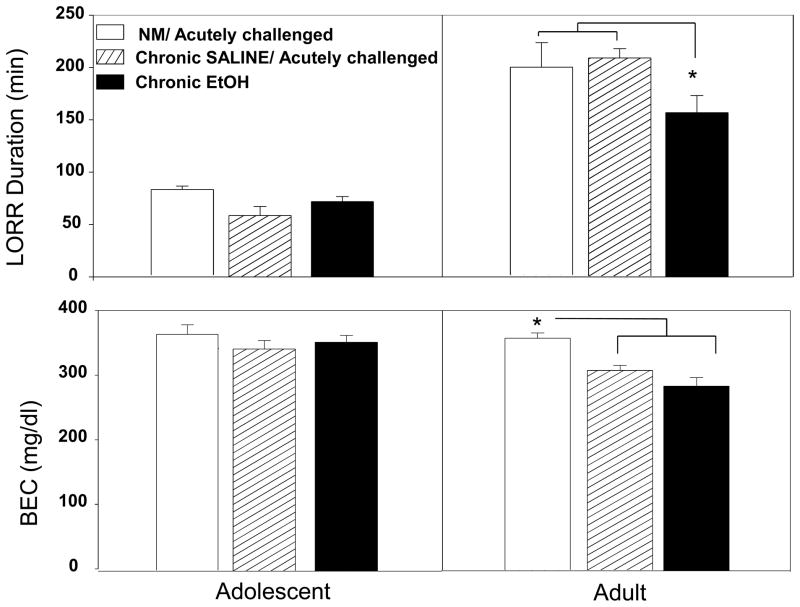
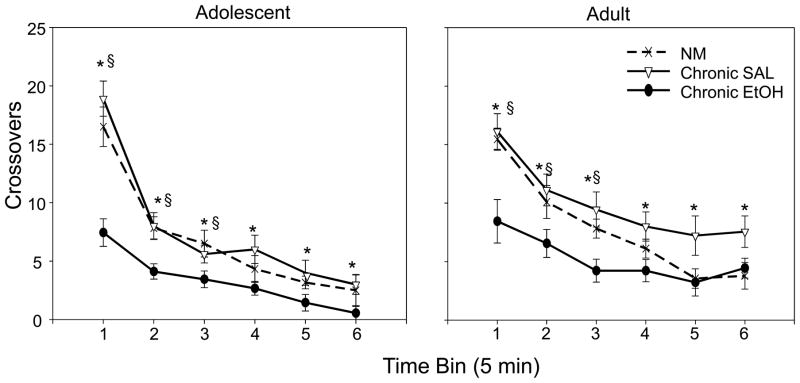
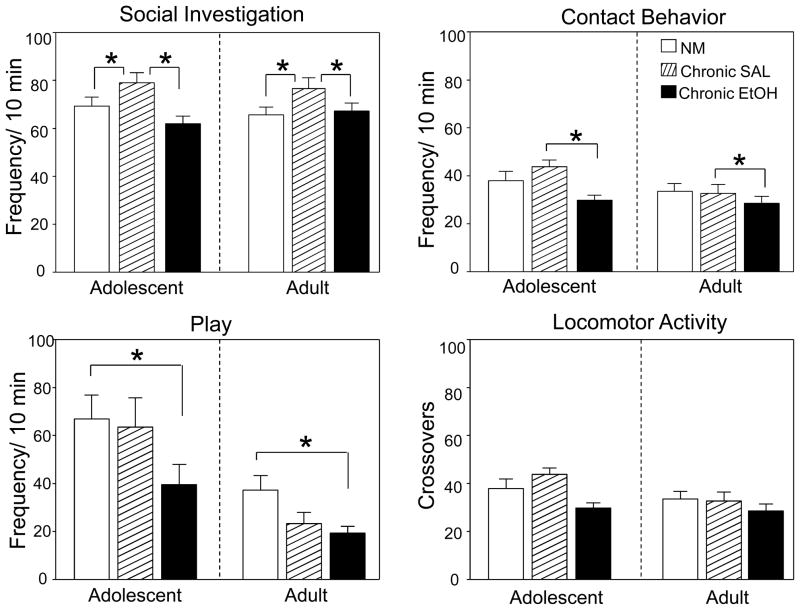
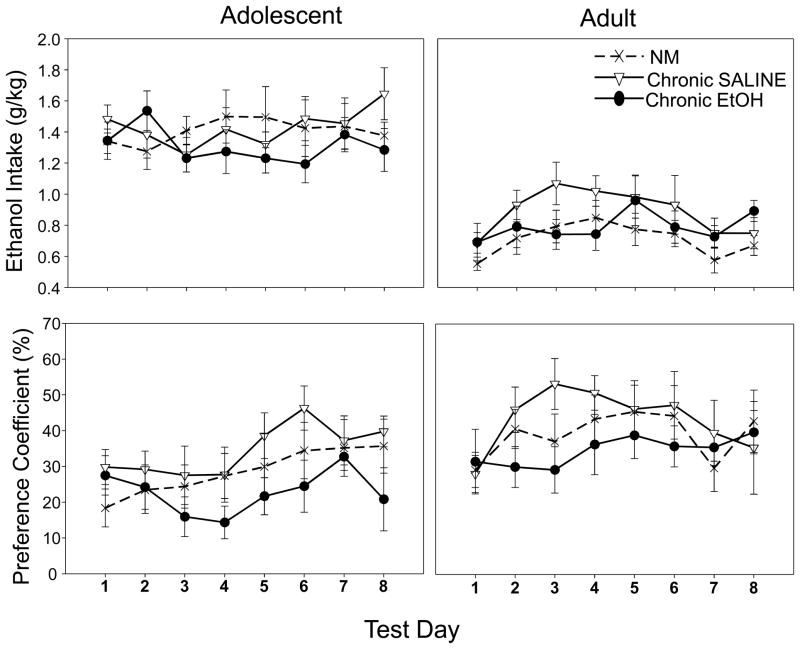
Results: In general, adolescent animals showed shorter durations of LORR and higher BECs upon RORR than adults on the first and last ethanol exposure days, regardless of chronic exposure condition. Adults, but not adolescents, developed chronic tolerance to the sedative effects of ethanol, tolerance that appeared to be metabolic in nature. Social deficits were observed after chronic ethanol in both adolescents and adults. Adolescents drank significantly more ethanol than adults on a gram per kilogram basis, with intake uninfluenced by prior ethanol exposure at both ages.
Conclusions: Adolescents and adults may differ in their ability and/or propensity to adapt to chronic ethanol exposure, with adults, but not adolescents, developing chronic metabolic tolerance. However, this chronic exposure regimen was sufficient to disrupt baseline levels of social behavior at both ages. Taken together, these results suggest that, despite the age-related differences in tolerance development, adolescents are as susceptible as adults to consequences of chronic ethanol exposure, particularly in terms of disruptions in social behavior. Whether these effects would last into adulthood remains to be determined.
Copyright © 2011 by the Research Society on Alcoholism.
Figures
References
-
- Bell RL, Rodd ZA, Lumeng L, Murphy JM, McBride WJ. The alcohol-preferring P rat and animal models of excessive alcohol drinking. Addiction Biology. 2006;11(3–4):270–288. - PubMed
-
- Brunell SC, Spear LP. Effect of stress on the voluntary intake of a sweetened ethanol solution in pair-housed adolescent and adult rats. Alcoholism: Clinical and Experimental Research. 2005;29(9):1641–1653. - PubMed
-
- Cao W, Wehner JM, Collins AC. Chronic intragastric infusion produces tolerance to ethanol in LS and SS mice. Alcohol (Fayetteville, NY) 1995;12(3):241–246. - PubMed
-
- Crews FT, Braun CJ, Hoplight B, RCS, Knapp DJ. Binge Ethanol Consumption Causes Differential Brain Damage in Young Adolescent Rats Compared With Adult Rats. Alcoholism: Clinical and Experimental Research. 2000;24(11):1712–1723. - PubMed
-
- Doremus TL, Brunell SC, Rajendran P, Spear LP. Factors influencing elevated ethanol consumption in adolescent relative to adult rats. Alcoholism, Clinical And Experimental Research. 2005;29(10):1796–1808. - PubMed
Publication types
MeSH terms
Substances
Grants and funding
LinkOut - more resources
Full Text Sources
Medical
