Comparative Study
. 2011 Jul;13(7):673-83.
doi: 10.1016/j.micinf.2011.02.005. Epub 2011 Feb 24.

Comparative pathology of bacteria in the genus Providencia to a natural host, Drosophila melanogaster

Affiliations
Comparative Study

Comparative pathology of bacteria in the genus Providencia to a natural host, Drosophila melanogaster

Madeline R Galac et al. Microbes Infect. 2011 Jul.

Abstract

Bacteria in the genus Providencia are pathogens of many organisms, including humans and insects. We and colleagues have isolated five different strains belonging to four distinct Providencia species as natural infections of Drosophila melanogaster captured in the wild. We found that these isolates vary considerably in pathology to infected D. melanogaster, differing in the level of mortality they cause, their ability to replicate within the host and the level that the fly's immune response is elicited. One interesting bacterium was Providencia sneebia, which causes nearly complete mortality and reaches large numbers in the fly but does not elicit a comparably strong immune response. Through coinfection experiments, we determined that P. sneebia avoids recognition by the immune system. We tested for biofilm formation and replication within D. melanogaster cells as possible mechanisms for P. sneebia escape from host immunity, but did not find evidence for either. D. melanogaster and Providencia provide a powerful system for studying general host-pathogen interactions, and for understanding how the well-studied immune model host D. melanogaster interacts with its natural bacterial pathogens.


Figures

Figure 1
Figure 1
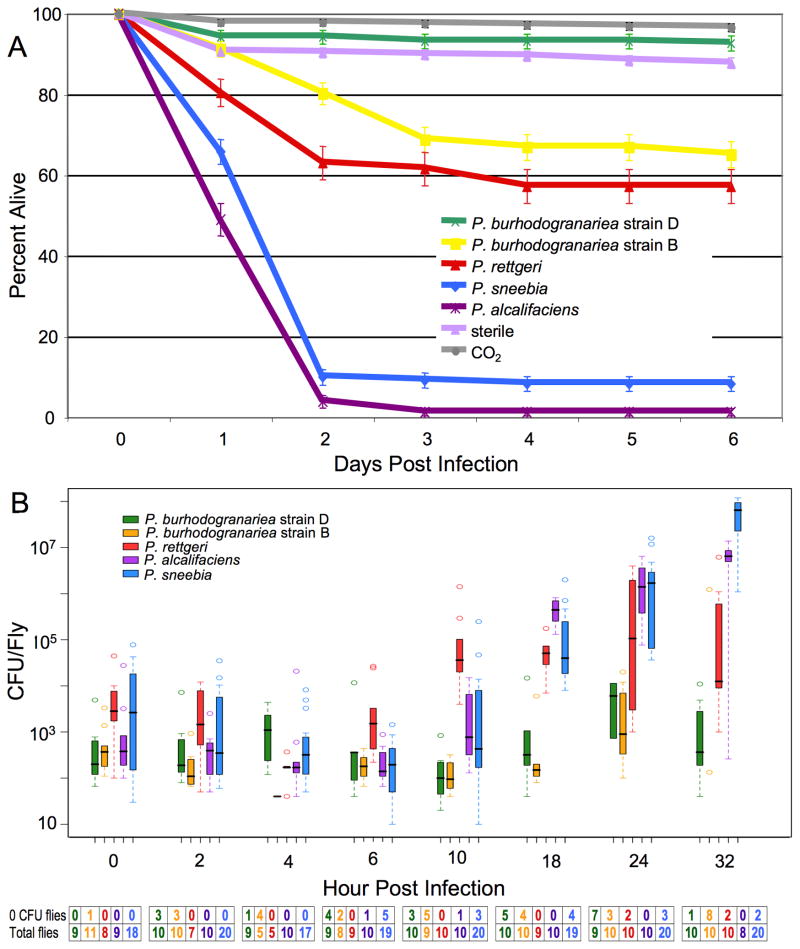
Mortality of and bacterial proliferation in D. melanogaster. (A) Mortality of D. melanogaster from Providencia Infection. Wild type D. melanogaster were infected through pinprick infections with different strains of Providencia. All treatments result in highly significant differences in mortality (all pairwise contrasts p < 0.0001), except the difference between sterile needle and CO2 controls, between infection with P. burhodogranariea strain D and either control, and between P. rettgeri and P. burhodogranariea strain B (in all cases p > 0.0025, the Bonferroni corrected cut off value). (B) Providencia Bacterial Load in D. melanogaster. Boxplot of the number of CFU present in D. melanogaster during the first 32 hours post infection. Note that the y-axis is a log scale. Whiskers approximate two times the standard deviation. The table under the graph has the number of flies that had no CFU at each time point for each treatment, as well as the total infected flies per treatment at each time point. Flies with no CFU present were not included in the boxplot. Sterilely wounded control flies never had any CFU at any time point.
Figure 2
Figure 2
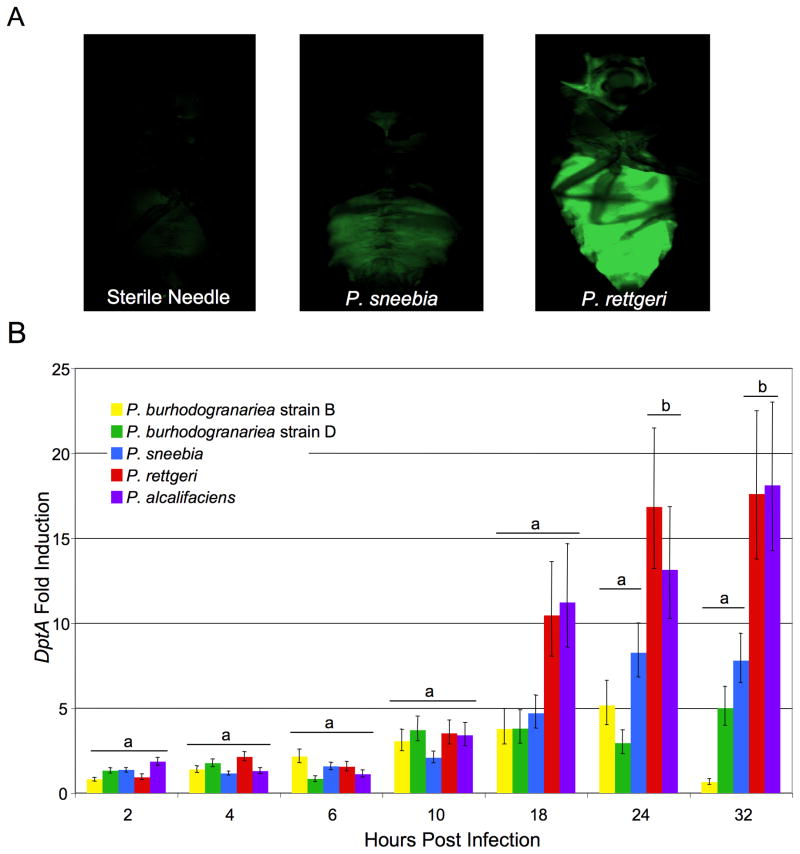
DptA Expression in Flies Infected with Providencia. (A) DptA-GFP flies infected with (left to right) a sterile needle, P. sneebia, or P. rettgeri at 32 hours post infection. (B) Graph of DptA expression as measured by QPCR. The fold induction was calculated as the level of expression above that caused by a sterile wound alone. Error bars represent the standard error. At each time point, treatments labeled with “a” are not significantly different from the sterile wound alone while those with “b” are significantly different from the sterile wound (corrected for multiple tests by Tukey-Kramer method, cut off p=0.05).
Figure 3
Figure 3
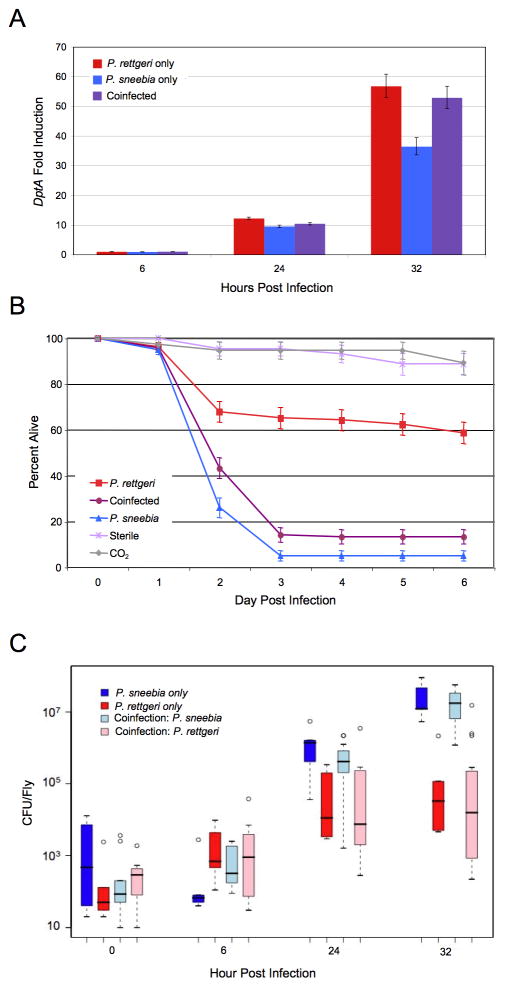
D. melanogaster Coinfected with Both P. sneebia and P. rettgeri. (A) Graph of DptA expression from infection with P. sneebia, P. rettgeri or both measured by QPCR. The fold induction was calculated as the level of expression over that caused by a sterile wound alone. Error bars represent the standard error. The AMP genes Def and Drs showed similar patterns (Suppl. Fig. 4.) (B) Survival of D. melanogaster from infections with P. sneebia, P. rettgeri or both. (C) Bacterial load of D. melanogaster infected with P. sneebia, P. rettgeri or both. The two bacteria are plotted separately in pale colors for the coinfected flies. Whiskers approximate two times the standard deviation. Coinfected flies show full induction of the immune system, but succumb to their infections and permit bacterial growth that is not different than what is observed in single infections.

References

    1. Gal-Mor O, Finlay BB. Pathogenicity islands: a molecular toolbox for bacterial virulence. Cell Microbiol. 2006;8:1707–1719. - PubMed
    1. Lazzaro BP. PhD thesis. USA: Pennsylvania State University; 2002. A population and quantitative genetic analysis of the Drosophila melanogaster antibacterial immune response.
    1. Juneja P, Lazzaro BP. Providencia sneebia sp. nov. and Providencia burhodogranariea sp. nov., isolated from wild Drosophila melanogaster. Int J Syst Evol Microbiol. 2009;59:1108–1111. - PubMed
    1. Lemaitre B, Hoffmann J. The host defense of Drosophila melanogaster. Annu Rev Immunol. 2007;25:697–743. - PubMed
    1. Brandt SM, Dionne MS, Khush RS, Pham LN, Vigdal TJ, Schneider DS. Secreted bacterial effectors and host-produced Eiger/TNF drive death in a Salmonella-infected fruit fly. PLoS Biol. 2004;2:e418. - PMC - PubMed

Publication types

LinkOut - more resources