


Tobacco leaf spot and root rot caused by Rhizoctonia solani Kühn
- PMID: 21355993
- PMCID: PMC6640363
- DOI: 10.1111/j.1364-3703.2010.00664.x
Tobacco leaf spot and root rot caused by Rhizoctonia solani Kühn
Abstract
Rhizoctonia solani Kühn is a soil-borne fungal pathogen that causes disease in a wide range of plants worldwide. Strains of the fungus are traditionally grouped into genetically isolated anastomosis groups (AGs) based on hyphal anastomosis reactions. This article summarizes aspects related to the infection process, colonization of the host and molecular mechanisms employed by tobacco plants in resistance against R. solani diseases.
Taxonomy: Teleomorph: Thanatephorus cucumeris (Frank) Donk; anamorph: Rhizoctonia solani Kühn; Kingdom Fungi; Phylum Basidiomycota; Class Agaricomycetes; Order Cantharellales; Family Ceratobasidiaceae; genus Thanatephorus.
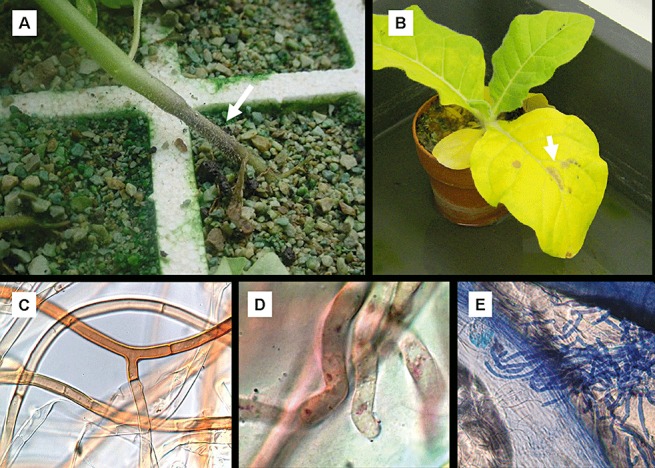
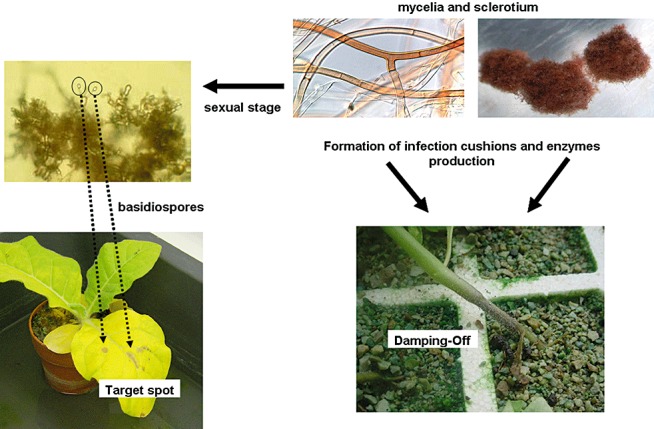
Identification: Somatic hyphae in culture and hyphae colonizing a substrate or host are first hyaline, then buff to dark brown in colour when aging. Hyphae tend to form at right angles at branching points that are usually constricted. Cells lack clamp connections, but possess a complex dolipore septum with continuous parenthesomes and are multinucleate. Hyphae are variable in size, ranging from 3 to 17 µm in diameter. Although the fungus does not produce any conidial structure, ellipsoid to globose, barrel-shaped cells, named monilioid cells, 10-20 µm wide, can be produced in chains and can give rise to sclerotia. Sclerotia are irregularly shaped, up to 8-10 mm in diameter and light to dark brown in colour.
Disease symptoms: Symptoms in tobacco depend on AG as well as on the tissue being colonized. Rhizoctonia solani AG-2-2 and AG-3 infect tobacco seedlings and cause damping off and stem rot. Rhizoctonia solani AG-3 causes 'sore shin' and 'target spot' in mature tobacco plants. In general, water-soaked lesions start on leaves and extend up the stem. Stem lesions vary in colour from brown to black. During late stages, diseased leaves are easily separated from the plant because of severe wilting. In seed beds, disease areas are typically in the form of circular to irregular patches of poorly growing, yellowish and/or stunted seedlings.
Resistance: Knowledge is scarce regarding the mechanisms associated with resistance to R. solani in tobacco. However, recent evidence suggests a complex response that involves several constitutive factors, as well as induced barriers controlled by multiple defence pathways.
Management: This fungus can survive for many years in soil as mycelium, and also by producing sclerotia, which makes the management of the disease using conventional means very difficult. Integrated pest management has been most successful; it includes timely fungicide applications, crop rotation and attention to soil moisture levels. Recent developments in biocontrol may provide other tools to control R. solani in tobacco.
© 2010 CIGB. MOLECULAR PLANT PATHOLOGY © 2010 BSPP AND BLACKWELL PUBLISHING LTD.
Figures
References
-
- Adams, G.C. and Butler, E.E. (1983) Environmental factors influencing the formation of basidia and basidiospores in Thanatephorus cucumeris . Phytopathology, 73, 152–155.
-
- Anuratha, C.S. , Zen, K.C. , Cole, K.C. , Mew, T. and Muthukrishnan, S. (1996) Induction of chitinases and β‐1,3‐glucanases in Rhizoctonia solani‐infected rice plants: isolation of an infection related chitinase cDNA clone. Physiol. Plant. 97, 39–46.
-
- Armentrout, V.N. and Downer, A.J. (1987) Infection cushions development by Rhizoctonia solani on cotton. Phytopathology, 77, 619–623.
-
- Armentrout, V.N. , Downer, A.J. , Grasmick, D.L. and Weinhold, A.R. (1987) Factors affecting infection cushion development by Rhizoctonia solani on cotton. Phytopathology, 77, 623–630.
-
- Bateman, D.F. and Lumsden, R.D. (1965) Relation of calcium content and nature of the pectic substances in bean hypocotyls of different ages to susceptibility to an isolate of Rhizoctonia solani . Phytopathology, 55, 734–738.
Publication types
MeSH terms
LinkOut - more resources
Full Text Sources
Other Literature Sources
