Review
. 2011 Mar;178(3):946-55.
doi: 10.1016/j.ajpath.2010.12.004.

Signaling mechanism of poly(ADP-ribose) polymerase-1 (PARP-1) in inflammatory diseases

Affiliations
Review

Signaling mechanism of poly(ADP-ribose) polymerase-1 (PARP-1) in inflammatory diseases

Xueqing Ba et al. Am J Pathol. 2011 Mar.

Abstract

Poly(ADP-ribosyl)ation, attaching the ADP-ribose polymer chain to the receptor protein, is a unique posttranslational modification. Poly(ADP-ribose) polymerase-1 (PARP-1) is a well-characterized member of the PARP family. In this review, we provide a general update on molecular structure and structure-based activity of this enzyme. However, we mainly focus on the roles of PARP-1 in inflammatory diseases. Specifically, we discuss the signaling pathway context that PARP-1 is involved in to regulate the pathogenesis of inflammation. PARP-1 facilitates diverse inflammatory responses by promoting inflammation-relevant gene expression, such as cytokines, oxidation-reduction-related enzymes, and adhesion molecules. Excessive activation of PARP-1 induces mitochondria-associated cell death in injured tissues and constitutes another mechanism for exacerbating inflammation.


Figures

Figure 1
Figure 1
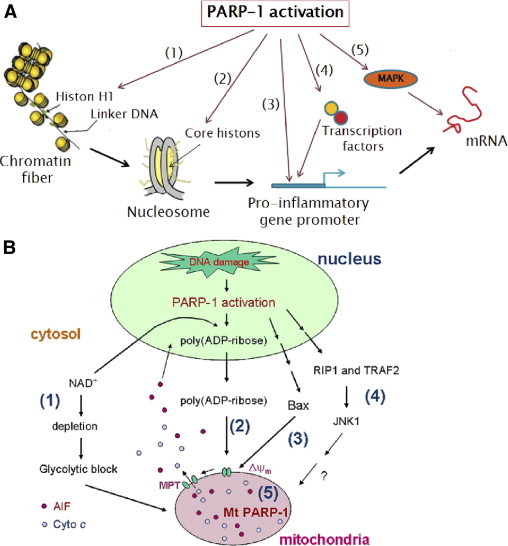
A: Potential routes of PARP-1 stimulation of inflammatory gene expression. First, at the level of chromatin remodeling, the modification of histone H1 by PARP-1 (1) relaxes the highly compacted chromatin fibers and facilitates transcription machinery access to the target genes (2). Second, at the level of transcription, activated PARP-1 either directly binds to the promoter region of target genes (3) or acts on transcription factors and regulates their transcriptional activity (4). Third, at the level of posttranscription, activated PARP-1 affects p38 (MAPK) and then regulates the posttranscriptional stability of mRNAs (5). B: Potential routes of nuclear-mitochondrial cross talk in PARP-1–dependent cell death pathways. 1: Extensive PARP-1 activation leads to depletion of NAD+ from the cytosol and accumulation of poly(ADP-ribose) in the nucleus. NAD+ depletion can block glycolysis and thereby block the delivery of glucose-derived substrates to the mitochondria. 2: Poly(ADP-ribose) formed in the nucleus might be transported out of the nucleus and act directly on mitochondrial membranes. 3: Pro-apoptosis protein Bcl-2–associated X protein (Bax) is activated and translocates to mitochondrial membranes. The actions of both poly(ADP-ribose) and Bax on mitochondrial membrane lead to cell death through a process involving mitochondrial depolarization (Δψm), MPT, and mitochondrial release of AIF and cytochrome c (Cyto c). 4: Blocking the receptor-interacting protein (RIP) 1–TNF receptor (TRAF)–associated factor 2–c-Jun NH2-terminal kinase (JNK) signal transduction pathway can also inhibit PARP-1–induced mitochondrial events and resultant cell death. It remains to be established whether these three pathways are interrelated or are independent of each other. 5: The localization of PARP-1 and the formation of PARs in mitochondria (mt) as mechanisms for impaired membrane potential (Ψm), NAD+ content, cellular respiration, and cell death factors (ie, Cyto c and AIF) remain to be examined in future studies.

References

    1. Riquelme P.T., Burzio L.O., Koide S.S. ADP ribosylation of rat liver lysine-rich histone in vitro. J Biol Chem. 1979;254:3018–3028. - PubMed
    1. Burzio L.O., Riquelme P.T., Koide S.S. ADP ribosylation of rat liver nucleosomal core histones. J Biol Chem. 1979;254:3029–3037. - PubMed
    1. Suzuki H., Quesada P., Farina B., Leone E. In vitro poly(ADP-ribosyl)ation of seminal ribonuclease. J Biol Chem. 1986;261:6048–6055. - PubMed
    1. Pleschke J.M., Kleczkowska H.E., Strohm M., Althaus F.R. Poly(ADP-ribose) binds to specific domains in DNA damage checkpoint proteins. J Biol Chem. 2000;275:40974–40980. - PubMed
    1. Otto H., Reche P.A., Bazan F., Dittmar K., Haag F., Koch-Nolte F. In silico characterization of the family of PARP-like poly(ADP-ribosyl)transferases (pARTs) BMC Genomics. 2005;6:139. - PMC - PubMed

Publication types

Substances