. 2011 Mar;178(3):1257-69.
doi: 10.1016/j.ajpath.2010.11.050.

Albuminuria and glomerular damage in mice lacking the metabotropic glutamate receptor 1

Affiliations

Albuminuria and glomerular damage in mice lacking the metabotropic glutamate receptor 1

Aldamaria Puliti et al. Am J Pathol. 2011 Mar.

Abstract

The metabotropic glutamate (mGlu) receptor 1 (GRM1) has been shown to play an important role in neuronal cells by triggering, through calcium release from intracellular stores, various signaling pathways that finally modulate neuron excitability, synaptic plasticity, and mechanisms of feedback regulation of neurotransmitter release. Herein, we show that Grm1 is expressed in glomerular podocytes and that a glomerular phenotype is exhibited by Grm1(crv4) mice carrying a spontaneous recessive inactivating mutation of the gene. Homozygous Grm1(crv4/crv4) and, to a lesser extent, heterozygous mice show albuminuria, podocyte foot process effacement, and reduced levels of nephrin and other proteins known to contribute to the maintenance of podocyte cell structure. Overall, the present data extend the role of mGlu1 receptor to the glomerular filtration barrier. The regulatory action of mGlu1 receptor in dendritic spine morphology and in the control of glutamate release is well acknowledged in neuronal cells. Analogously, we speculate that mGlu1 receptor may regulate foot process morphology and intercellular signaling in the podocyte.


Figures

Figure 1
Figure 1
Evaluation of mGlu1 receptor expression by means of RT-PCR. A: Screening of the human cDNA library (MTC Multiple Tissue cDNA panels I and II). Lane 1, heart; lane 2, brain; lane 3, placenta; lane 4, lung; lane 5, pancreas; lane 6, kidney; lane 7, skeletal muscle; lane 8, liver; lane 9, spleen; lane 10, thymus; lane 11, prostate; lane 12, testis; lane 13, peripheral blood leukocytes; lane 14, colon; lane 15, small intestine; and lane 16, ovary. nc, negative control; and M, 100-bp DNA ladder. B: Expression of mGlu1 receptor in the renal cortex of Grm1crv4/crv4 and wild-type mice by means of RT-PCR. n.c., negative control; M, 100-bp DNA ladder. The upper band represents the mutated sequence, and the lower band represents the wild-type sequence. Primers (MGLUR1-F3/MGLUR1-R11) have been drawn to amplify a fragment of the Grm1 encompassing the crv4 mutation and corresponding to a cDNA insertion of 139 bp. C: The quality of RNA extracted from renal cortex was evaluated by means of RT-PCR using primers specific for podocin (Nphs2) and nephrin (Nphs1) for mutated and wild-type mice. M, 100-bp DNA ladder. D: Expression of mGlu1 receptor in renal cortex, isolated renal glomeruli, primary podocytes from wild-type mice, and conditionally immortalized podocytes obtained by means of RT-PCR using primers (MGLUR1-F20/MGLUR1-R24). n.c., negative control; M, 100-bp DNA ladder. The quality of extracted RNA was evaluated by means of RT-PCR using primers specific for nephrin (Nphs1) and Gapdh.
Figure 2
Figure 2
Western blot analysis of mGlu1 receptor in renal cortex (A) and isolated glomeruli (B) of wild-type and Grm1crv4/crv4 mice. Thirty micrograms of proteins from renal cortex and 10 μg of proteins from cerebellum per lane were applied to the SDS–polyacrylamide gel electrophoresis gel. Gapdh was used as a loading control, and nephrin (Nphs1) or podocin (Nphs2) was used as loading control for specific renal proteins. C: Representative Western blot analysis of mGlu1 receptor expression in isolated renal glomeruli obtained from wild-type (left) and heterozygous Grm1+/crv4 (right) mice. Approximately 20 μg of proteins from wild-type cerebellum (crb) and wild-type renal glomeruli (glo) per lane were applied to the SDS–polyacrylamide gel electrophoresis gel (left). In heterozygous Grm1+/crv4 renal glomeruli, the presence of the mGlu1 receptor band is more evident by using double quantities of proteins as used for mGlu1 receptor detection in wild-type glomeruli (right). D: Quantification of mGlu1 receptor protein expression level. Data represent the mean ± SE percentage of Grm1+/crv4 versus wild-type mice of three mice for each group analyzed in duplicate by means of Western blotting. Expression levels are normalized for Gapdh in the same blotted membrane.
Figure 3
Figure 3
Immunofluorescence shows expression of the mGlu1 receptor in the glomerulus of a wild-type animal (A) and its complete absence from the renal tissue of a Grm1crv4/crv4 mouse (B). Original magnification, ×400. Immunofluorescence double staining of renal tissue conducted on 1-μm semithin sections reveals glomerular co-staining of nephrin (C) and Grm1 (D) (merged in E) and confirms the comma-like pattern of Grm1 staining along the glomerular tuft. Original magnification, ×1000. Gold particles can be observed in podocytes of wild-type tissues (arrows) (F and G), whereas they are completely absent from glomeruli of Grm1crv4/crv4 animals (H). Scale bar = 200 nm. Immunofluorescence double staining (DAPI counterstain) of cultured podocytes shows co-localization of nephrin (I and L) and Grm1 (J and M) in small dots along cell processes (merged in K and N). Original magnification, ×1000.
Figure 4
Figure 4
Electron microscopy of 2-month-old mice reveals normal features of wild-type mice (A) and segmental foot process effacement in heterozygous (B, arrows) and homozygous (C) glomeruli. Accordingly, mean FPW progressively increases from wild-type to homozygous glomeruli (D). Error bars represent SE. Scale bar = 5 μm. Transmission electron micrographs of 8-month-old animals reveal normal morphology of wild-type glomeruli (E and H) and increasingly abnormal features of heterozygous (F and I) and homozygous (G and J) mice, especially in terms of foot process effacement and basement membrane thickness and irregularity. Scale bars: 5 μm (E–G); 2 μm (H–J).
Figure 5
Figure 5
Podocyte proteins in 8-month-old animals. Immunofluorescence displays diffuse progressive loss of the podocyte markers nephrin (B and C) and synaptopodin (E and F) and segmental loss of podocin (H and I) and ZO-1 (K and L) in glomeruli of 8 month-old Grm1+/crv4 and Grm1crv4/crv4 mice, whereas wild-type glomeruli still have normal expression of all molecules (A, D, G, and J). Original magnification: ×200; ×400. M and N: Western blot analysis of lysates from isolated glomeruli of 8-month-old wild-type, Grm1+/crv4, and Grm1crv4/crv4 mice. Five mice for each group were analyzed by means of Western blotting (20 μg of protein per lane) using specific antibodies as indicated. Expression levels are normalized for Gapdh in the same blotted membrane. M: Representative immunoreactive bands. Nphs1, nephrin; Nphs2, podocin; Synpo, synaptopodin; ZO-1, tight junction protein 1; Actn4, α-actinin-4; Cd2ap, cd2-associated protein; and Gapdh, glyceraldehyde-3-phosphate dehydrogenase. N: Quantification of protein expression level. Data represent the mean ± SE percentage of Grm1+/crv4 and Grm1crv4/crv4 versus wild-type mice. Original magnification ×200 (D, E, F); ×400 (A–C, G–L).
Figure 6
Figure 6
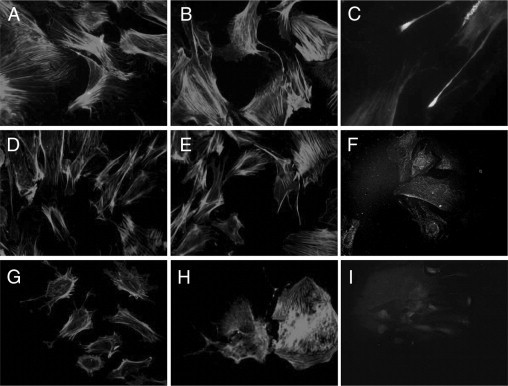
Immunofluorescence of primary podocytes. Compared with podocytes from wild-type mice (A–C), heterozygous-derived (D–F) and homozygous-derived (G–I) cells show remodeling of F-actin, with loss of stress fibers (D, E, G, and H) and progressive decrease of nephrin expression (F and I). Original magnification: ×200 (A, B, D–G); ×400 (C, H, I).
Figure 7
Figure 7
Grm1 silencing experiments. A:Grm1 staining in the podocyte cell line after transfection with scramble siRNA shows intact expression of Grm1. B: At higher magnification, Grm1 positivity along cell processes is more evident. Silencing with 10 nmol/L siRNA results in reduction of staining from most cells (C), although some positivity can be observed at higher magnification (D). Complete silencing is reached by 20 nmol/L siRNA (E and F). DAPI nuclear counterstaining in all preparations demonstrates that there is no apoptotic or necrotic damage to the cells due to the transfection procedure. Original magnification: ×200 (A, C, E); ×400 (B, D, F). G: Western blot analysis of protein extracts from scramble siRNA (lane 1) shows a Grm1 band, which is absent from cells silenced with 10 nmol/L–specific (lane 2) and 20 nmol/L–specific (lane 3) siRNAs. α-Tubulin is used as protein load control. MWM, molecular weight marker.
Figure 8
Figure 8
Cells transfected by scramble siRNA conserve actin stress fibers (A and B) and nephrin staining along cell processes (C). Cell transfection by 10 nmol/L–specific (D–F) and 20 nmol/L–specific (G–I) siRNAs show remodeling of the actin cytoskeleton, with loss of stress fibers and peripheral actin staining in several cells (D, E, G, and H) and loss of nephrin staining (F and I). Immunofluorescence; original magnification: ×200 (A, B, D, E, G, and H); ×630 (C, F, and I).
Figure 9
Figure 9
Effects of adriamycin injection on renal morphology. A: The renal tissue of saline-injected mice displays normal glomerular and interstitial features. B: A normal glomerulus. C: A renal section taken from a wild-type animal injected with a dose of 8 mg/kg body weight of adriamycin does not show signs of tubulointerstitial or glomerular damage. D: At higher magnification, a glomerulus looks completely normal. E: Tubular casts are present in a renal section of a Grm1crv4/crv4 mouse injected with the same dosage of adriamycin. Different fields taken from the renal tissue of an adriamycin-injected animal display tubular casts near normal (F) or damaged (G and H) glomeruli, indicated by arrows. The represented damaged glomeruli show signs of segmental (G) or global (H, upper glomerulus, arrow) sclerosis. In H, the lower glomerulus (arrowhead) displays increased cellularity, likely due to inflammatory cells. Acid Fuchsin Orange-G and PAS staining; original magnification: ×200 (A, C, E, G); ×400 (F, H); ×630 (B, D).

References

    1. Rastaldi M.P., Armelloni S., Berra S., Calvaresi N., Corbelli A., Giardino L.A., Li M., Wang G.Q., Fornasieri A., Villa A., Heikkila E., Soliymani R., Boucherot A., Cohen C.D., Kretzler M., Nitsche A., Ripamonti M., Malgaroli A., Pesaresi M., Forloni G.L., Schlondorff D., Holthofer H., D'Amico G. Glomerular podocytes contain neuron-like functional synaptic vesicles. FASEB J. 2006;20:976–978. - PubMed
    1. Giardino L., Armelloni S., Corbelli A., Mattinzoli D., Zennaro C., Guerrot D., Tourrel F., Ikehata M., Li M., Berra S., Carraro M., Messa P., Rastaldi M.P. Podocyte glutamatergic signaling contributes to the function of the glomerular filtration barrier. J Am Soc Nephrol. 2009;20:1929–1940. - PMC - PubMed
    1. Olive M.F. Metabotropic glutamate receptor ligands as potential therapeutics for addiction. Curr Drug Abuse Rev. 2009;2:83–98. - PMC - PubMed
    1. Nakanishi S. Molecular diversity of glutamate receptors and implications for brain function. Science. 1992;258:597–603. - PubMed
    1. Fagni L., Chavis P., Ango F., Bockaert J. Complex interactions between mGluRs, intracellular Ca2+ stores and ion channels in neurons. Trends Neurosci. 2000;23:80–88. - PubMed

Publication types

MeSH terms

Substances