


Phylogeographic origin of Helicobacter pylori is a determinant of gastric cancer risk
- PMID: 21357593
- PMCID: PMC3133872
- DOI: 10.1136/gut.2010.234468
Phylogeographic origin of Helicobacter pylori is a determinant of gastric cancer risk
Abstract
Background and aims: Helicobacter pylori colonises the stomach in half of all humans, and is the principal cause of gastric cancer, the second leading cause of cancer death worldwide. While gastric cancer rates correlate with H pylori prevalence in some areas, there are regions where infection is nearly universal, but rates of gastric cancer are low. In the case of Colombia, there is a 25-fold increase in gastric cancer rate in the Andean mountain (high risk) region compared to the coastal (low risk) region, despite similarly high (∼90%) prevalence of H pylori in the two locations. Our aim was to investigate the ancestral origin of H pylori strains isolated from subjects in these high- and low-risk regions and to determine whether this is a predictive determinant of precancerous lesions.
Methods: Multi-locus sequence typing was used to investigate phylogeographic origins of infecting H pylori strains isolated from subjects in the Pacific coast and Andes Mountains in the state of Nariño, Colombia. We analysed 64 subjects infected with cagA+ vacA s1m1 strains. Gastric biopsy slides from each individual were scored for histological lesions and evaluated for DNA damage by immunohistochemistry.
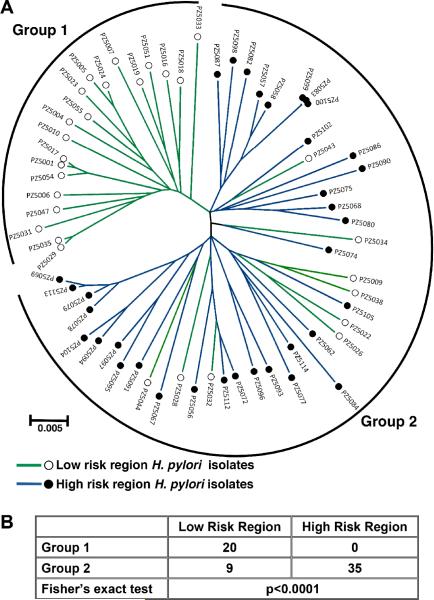
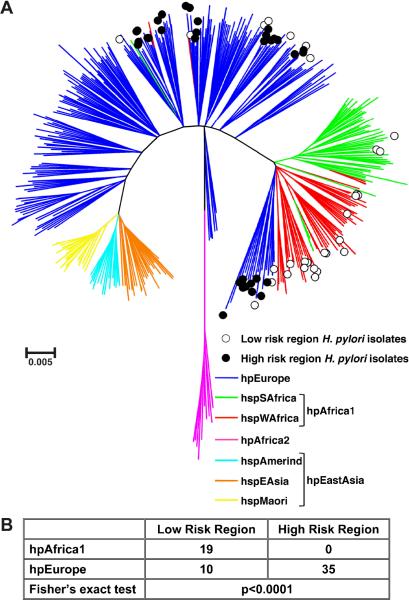
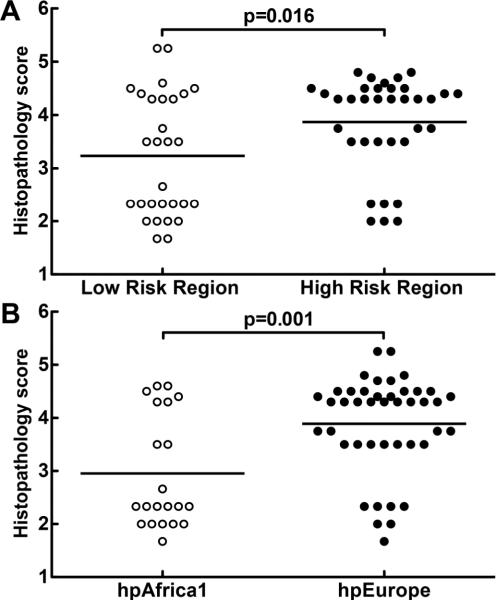
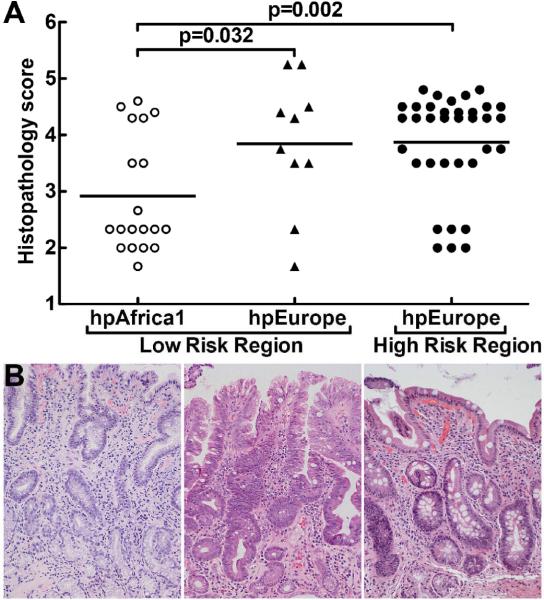
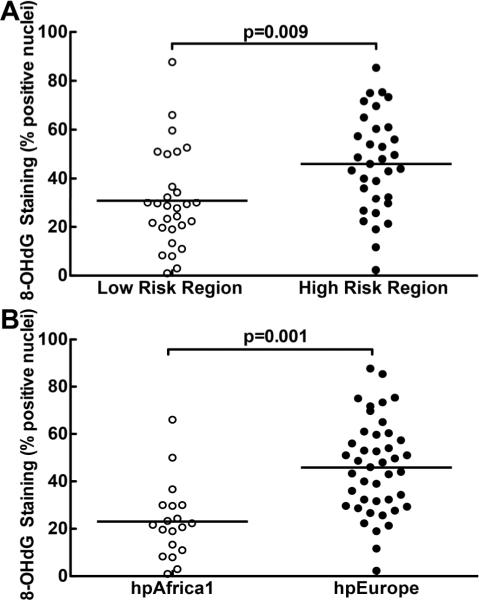
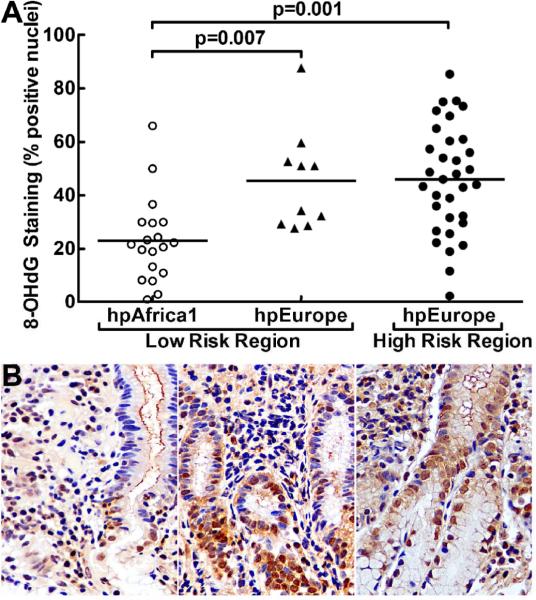
Results: We show that strains from the high-risk region were all of European phylogeographic origin, whereas those from the low risk region were of either European (34%) or African origin (66%). European strain origin was strongly predictive of increased premalignant histological lesions and epithelial DNA damage, even in the low-risk region; African strain origin was associated with reduced severity of these parameters.
Conclusion: The phylogeographic origin of H pylori strains provides an explanation for geographic differences in cancer risk deriving from this infection.
Figures
Comment in
-
Virulence factors or ancestral origin of Helicobacter pylori: which is a better predictor of gastric cancer risk?Gut. 2012 Mar;61(3):469-70. doi: 10.1136/gutjnl-2011-300317. Epub 2011 May 24. Gut. 2012. PMID: 21610271 Free PMC article. No abstract available.
References
-
- Marshall BJ, Warren JR. Unidentified curved bacilli in the stomach of patients with gastritis and peptic ulceration. Lancet. 1984;1:1311–5. - PubMed
-
- Uemura N, Okamoto S, Yamamoto S, et al. Helicobacter pylori infection and the development of gastric cancer. N Engl J Med. 2001;345:784–9. - PubMed
-
- Correa P. A human model of gastric carcinogenesis. Cancer Res. 1988;48:3554–60. - PubMed
-
- Correa P, Haenszel W, Cuello C, et al. Gastric precancerous process in a high risk population: cohort follow-up. Cancer Res. 1990;50:4737–40. - PubMed
Publication types
MeSH terms
Grants and funding
- P01CA116087/CA/NCI NIH HHS/United States
- R01 CA077955/CA/NCI NIH HHS/United States
- R01CA77955/CA/NCI NIH HHS/United States
- P30 DK058404/DK/NIDDK NIH HHS/United States
- KL2 RR024977/RR/NCRR NIH HHS/United States
- P01 CA116087/CA/NCI NIH HHS/United States
- UL1 RR024975/RR/NCRR NIH HHS/United States
- R01 DK058587/DK/NIDDK NIH HHS/United States
- R01DK053620/DK/NIDDK NIH HHS/United States
- P01CA028842/CA/NCI NIH HHS/United States
- R01 DK053620/DK/NIDDK NIH HHS/United States
- P01 CA028842/CA/NCI NIH HHS/United States
- R01AI068009/AI/NIAID NIH HHS/United States
- R01 AT004821/AT/NCCIH NIH HHS/United States
- TL1 RR024978/RR/NCRR NIH HHS/United States
- UL1RR024975/RR/NCRR NIH HHS/United States
- R01AI039657/AI/NIAID NIH HHS/United States
- P30DK058404/DK/NIDDK NIH HHS/United States
- R01 AI039657/AI/NIAID NIH HHS/United States
- R01 AI068009/AI/NIAID NIH HHS/United States
- R01DK58587/DK/NIDDK NIH HHS/United States
LinkOut - more resources
Full Text Sources
Other Literature Sources
Medical
